360 Body Lift Recovery: The Guide to Your Transformative Healing Odyssey
10/16/2026
The 360 body lift isn't just a surgical procedure; it's the final, celebratory calibration of your entire weight loss odyssey. After the monumental effort of shedding significant weight, you've reached the threshold of a new physical reality. I recognize that the prospect of a 360 body lift recovery often brings a complex mix of exhilaration and deep-seated anxiety. You might worry about the circumferential incision, the logistics of managing surgical drains, or how long you'll be sidelined from your daily life. It's natural to feel protective of the body you've worked so hard to reclaim.
I've guided countless patients through this transformative healing process; I want to replace your uncertainty with a clear, clinical roadmap. This guide provides an empathetic, day-by-day map of what to expect as your body settles into its new, geometric contours. We'll demystify everything from initial mobility restrictions to the long-term optimization of your scars. By understanding the methodical stages of healing, you can move forward with the confidence that your recovery will be as precise and successful as the surgery itself.
Key Takeaways
- Navigate your healing journey with a detailed timeline that guides you from the first 48 hours of clinical observation through the transition to home-based care.
- Master the "beach chair" sleeping position and other specialized comfort measures designed to protect your new anatomic contours during your 360 body lift recovery.
- Gain confidence in managing post-operative logistics, including a step-by-step approach to surgical drains and the essential role of compression garments.
- Learn how to safely reintroduce movement using walking as a primary healing tool while strictly adhering to the "no lifting" rule to protect internal sutures.
- Discover how meticulous surgical technique and expert specialization serve as the critical foundation for minimizing complications and ensuring a smooth aesthetic outcome.
Table of Contents
- The 360 Body Lift Recovery Timeline: What to Expect
- Managing Post-Operative Comfort and Pain Control
- The Recovery Toolkit: Drains, Compression, and Nutrition
- Returning to Movement: Exercise and Activity Restrictions
- Why Expert Specialization is the Key to a Smooth Recovery


The 360 Body Lift Recovery Timeline: What to Expect
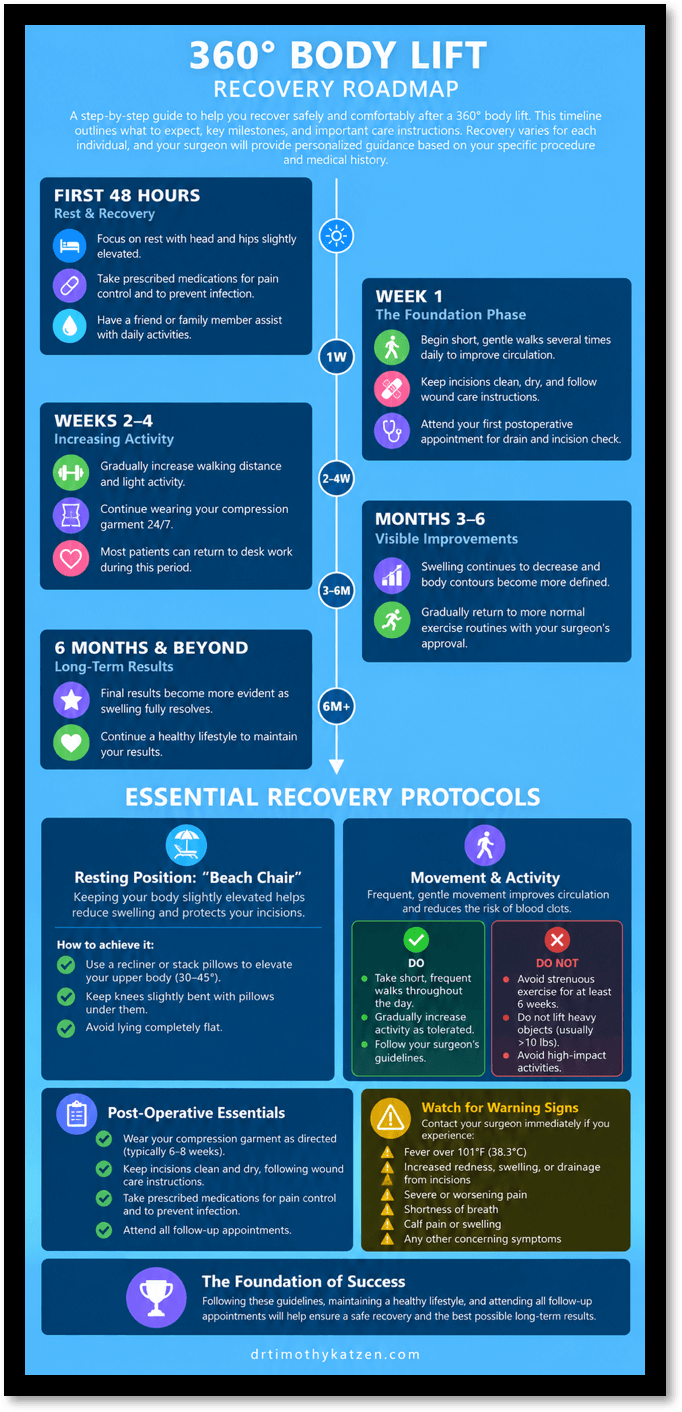
I view the first 48 hours as the most critical period for clinical calibration. During this time, your focus is purely on managing the immediate effects of anesthesia and initiating very gentle movement. My team and I monitor your stability closely, ensuring that your circulation is optimal and your pain is well-managed. This phase is the foundational bedrock of your 360 body lift recovery, where we prioritize safety above all else.
From days three to seven, you'll likely experience the peak of surgical swelling. This is a natural inflammatory response as your tissues begin the complex process of healing following a Circumferential Abdominoplasty. Transitioning to home care during this week requires a methodical approach to your prescribed recovery protocol and plenty of restorative rest.
Week 1: The Foundation of Healing
Many patients describe a profound "tight" sensation that wraps around their entire midsection. This is expected. Your skin and underlying structures have been meticulously repositioned to create a smoother, firmer profile. To support this new geometry, you must rely heavily on your support person during the first 72 hours. They'll assist with everything from meal preparation to basic mobility. I insist on short, frequent walks through your home every few hours. These small steps are vital for preventing blood clots and encouraging healthy lymphatic drainage while your body is in its most vulnerable state.
Weeks two to four represent your "turning point." Your energy levels usually begin to climb, and you'll find that the heavy surgical fatigue starts to dissipate. Between months three and six, the most aggressive swelling subsides, allowing the refined results of your 360 body lift recovery to emerge more clearly each day.
The Long-Term View: 6 Months and Beyond
True anatomic restoration takes time. While you'll look remarkable much sooner, residual swelling in the lower back area often persists until the six-month mark. This is frequently the last area to fully settle. Over the first year, your scars will undergo a maturation process, gradually fading from a deep pink to a softer, flatter tone that blends more naturally with your skin. This is the season to finalize your new wardrobe and embrace your permanent silhouette. It's a time to celebrate the physical freedom you've earned through this long personal odyssey.
Managing Post-Operative Comfort and Pain Control
I view pain management as a collaborative partnership between specialist and patient. To ensure your 360 body lift recovery is as smooth as possible, I utilize a multimodal approach. This strategy combines clinical prescriptions with targeted comfort measures to address pain from several physiological angles. By following the established Body Lift Recovery Guidelines, we can minimize reliance on any single medication while maximizing your overall well-being during the initial healing phases.
You may encounter a psychological "dip" around Day 3 or 4. This is a common phenomenon where the initial adrenaline of the procedure fades, and the reality of the recovery process sets in. It's often accompanied by increased swelling and a feeling of fatigue. I want you to know this is temporary. It's also vital to distinguish between normal healing sensations, like tingling or localized tightness, and warning signs such as spreading redness, fever, or sudden shortness of breath. If you ever feel uncertain about a symptom, reaching out for a consultation with a specialist can provide the reassurance you need.
Optimizing Your Sleeping and Resting Positions
The "Beach Chair" position is the gold standard for resting after a circumferential procedure. By using several firm pillows to keep your head elevated and your knees bent, you create a soft V-shape with your body. This specific geometry is essential because it minimizes tension on the 360-degree incision line. You must avoid sleeping flat or on your side for the first few weeks; side sleeping pulls on the lateral aspects of your incision, which can compromise the fine-line scarring we aim to achieve. Many of my patients find that transitioning from a standard bed to a recliner provides superior back support and makes it easier to maintain this protected posture throughout the night.
The Science of Swelling (Edema) Management
Swelling is typically more significant in a 360 lift than in a standard tummy tuck because the surgery involves a full 360 degrees of tissue modification. This disrupts the lymphatic channels more extensively. I recommend strictly monitoring your sodium intake during the first month. High salt levels cause the body to retain water, which increases pressure on your sutures and heightens your discomfort. For the first 72 hours, cold compresses can be used intermittently to manage acute inflammation. However, after this initial window, we prioritize gentle warmth and consistent movement to encourage circulation and the natural reabsorption of fluid by your body's lymphatic system.
The Recovery Toolkit: Drains, Compression, and Nutrition
Success in your 360 body lift recovery depends on more than just the surgical technique; it requires a meticulous approach to the tools that support your healing. I provide every patient with a specific set of protocols for managing the mechanical and biological aspects of their recovery. Central to this toolkit are your surgical drains and compression garments. These aren't just accessories. They are essential components of a clinical strategy designed to protect your new anatomic proportions and ensure your safety as your tissues settle into place.
Before you arrive home from surgery, you should have your environment fully staged. I recommend having loose, button-down clothing, antibacterial soap, and a dedicated notebook for tracking your daily progress. Having these supplies ready allows you to focus entirely on the restorative work of healing without the stress of last-minute logistics. Following the established Body Lift Recovery Guidelines, we use these tools to bridge the gap between the operating room and your final, celebratory result.
Mastering Your Surgical Drains
Drains are necessary to remove excess fluid that naturally accumulates after a circumferential procedure. I ask my patients to measure and record the output from each drain at least three times a day. To keep the fluid moving, you'll need to "strip" the tubing. This involves holding the tube near the exit site and gently sliding your fingers down toward the collection bulb. It's a simple yet vital task that prevents clogs. We typically look for the output to drop below 30ccs in a 24-hour period for two consecutive days before we schedule their removal. Maintaining strict hygiene at the drain exit sites is non-negotiable to prevent localized infection during this period.
Nutrition for the Post-Weight Loss Patient
Patients who have achieved massive weight loss face unique nutritional challenges. Your body has often been in a state of caloric deficit for years, yet it now needs a surplus of energy for complex tissue repair. I focus heavily on fueling collagen synthesis to support a strong, healthy 360-degree scar. You must prioritize high-quality protein to provide the necessary building blocks for wound closure. I tell my patients very clearly: dieting is strictly prohibited during the first 12 weeks of your 360 body lift recovery.
I also emphasize the role of specific micronutrients. Vitamin C and Zinc act as catalysts for skin maturation and immune function. Hydration is equally critical; water is the medium through which your body transports these nutrients to the surgical sites. By viewing food as medicine rather than just fuel, you empower your body to complete its transformation with resilience and strength.
Returning to Movement: Exercise and Activity Restrictions
Walking is the cornerstone of your early 360 body lift recovery. I prescribe it not as a workout, but as essential medicine. In the initial days, a few minutes of movement every hour prevents complications like blood clots and encourages your tissues to heal. However, there's a distinct difference between therapeutic movement and overexertion. You must strictly adhere to the "no lifting" rule. For the first six weeks, lifting anything heavier than a gallon of milk (approximately 8 to 10 pounds) risks tearing internal sutures or straining your circumferential incision.
I want you to view your activity level as a dial rather than a switch. You'll gradually turn it up as your body gives you the green light. If you notice a sudden increase in swelling or localized throbbing after an activity, it's your body's signal to scale back and rest. Listening to these physiological cues is vital for ensuring your results settle perfectly into their new, geometric proportions.
Safe Mobility in the Early Weeks
Protecting your midsection requires rethinking how you move. To get in and out of bed, I recommend the "log roll" technique. Instead of using your abdominal muscles to sit up, you should roll onto your side as a single unit and use your arms to push yourself upright. Household chores like vacuuming, loading the dishwasher, or lifting laundry baskets must wait. These activities engage the core and back in ways that can jeopardize your surgical outcome. Additionally, you cannot drive until you've been off all narcotic pain medications for at least 24 hours and feel physically capable of performing an emergency braking maneuver without hesitation.
Reintroducing Exercise and Core Work
By the fourth week, many of my patients feel a significant surge in energy. This is the time to slowly introduce low-impact lower body movements, such as steady walking on flat ground. However, you must remain cautious. Abdominal and lower back exercises are the very last to be reintroduced to your routine. Because a circumferential lift involves extensive work on both the anterior and posterior midsection, your core needs ample time to stabilize. Engaging these muscles too early can lead to widened scars or fluid accumulation.
The six-week mark is your primary milestone. At this stage, we usually discuss graduating to more vigorous movement and light cardio. I always advise consulting with my surgical team before returning to high-impact sports or heavy weightlifting. If you're ready to plan your final transformative step, schedule your consultation with Dr. Katzen to ensure your recovery is managed with expert, specialized care.
Why Expert Specialization is the Key to a Smooth Recovery
A 360 body lift is one of the most complex procedures in plastic surgery, requiring a surgeon who understands the intricate, three-dimensional tension of a circumferential procedure. While a standard surgeon may perform a tummy tuck occasionally, a specialist in post-weight loss transformation views the body through the lens of geometric anatomic restoration. This high-level precision is exactly what makes a 360 body lift recovery more predictable and successful. When tension is distributed meticulously across the entire midsection, the risk of wound separation or widened scarring decreases significantly.
I view myself as a dedicated partner in your transformation rather than just a technician. Meticulous surgical technique isn't only about the aesthetic result; it's about reducing the physiological burden on your body during the healing process. By minimizing tissue trauma and ensuring perfect symmetry, we set the clinical foundation for a smoother return to your daily life. Personalized follow-up care is the hallmark of my practice. Whether you are a local patient or traveling from across the globe, my team provides a comprehensive support system that monitors every stage of your healing with professional authority and profound empathy.
The Katzen Standard of Care
I pay obsessive attention to circumferential symmetry and the precise placement of your scar. It's designed to be hidden within your natural contours, ensuring the result looks as natural as it feels. For my national and international patients, I've developed a specialized protocol that ensures you receive elite care regardless of your home zip code. We aim to transform the recovery period from a clinical necessity into a celebratory milestone. It's the profound moment where years of weight loss effort finally manifest in a body that reflects your true self.
Taking the Final Step in Your Odyssey
A 360 body lift is often the missing piece of a long personal odyssey. Removing the heavy "belt" of excess skin provides immediate functional relief, improving your mobility and ending the chronic skin irritation that often follows massive weight loss. This anatomic restoration is a deeply emotional experience. It validates your hard work and allows you to fully inhabit your new physical reality without the reminder of the skin that once held you back. If you're ready to complete your journey, schedule your consultation with Dr. Katzen to plan your transformation. This final celebratory step is where your new life truly begins.
Embrace the Final Chapter of Your Transformation
Your journey through a 360 body lift recovery is the definitive bridge between your past weight loss efforts and the physical freedom you deserve. We've explored how a methodical approach to the healing timeline, a specialized nutritional protocol, and the disciplined use of compression garments work together to protect your new, geometric contours. By prioritizing safety and expert clinical guidance, you ensure that this final stage of your odyssey is as successful and restorative as the transformation itself.
Dr. J. Timothy Katzen is a world-renowned specialist in post-weight loss body contouring with over 25 years of meticulous surgical expertise. He approaches every procedure as a dedicated partner, combining elite clinical skills with a compassionate, person-centric philosophy. You don't have to navigate this complex process alone. Expert care is the key to turning a medical event into a celebratory milestone.
Take the final step in your transformation; schedule your consultation with Dr. Katzen today.
The reflection in the mirror should finally match the strength of the person who achieved such incredible weight loss. You've earned this moment of renewal and the confidence that comes with a body fully restored.
Frequently Asked Questions
How long does the pain last after a 360 body lift?Acute pain is typically managed with prescribed medication for the first 7 to 10 days. Most patients transition to over the counter options by the second week. While you'll feel a significant tightness for several weeks, the sharp discomfort dissipates relatively quickly as you follow the prescribed multimodal pain management protocol. It's essential to stay ahead of the pain during the first 48 to 72 hours to ensure a smoother healing process.
When can I shower after my circumferential body lift surgery?You can typically take a sponge bath within the first 48 hours, but a full shower usually requires waiting until 48 to 72 hours post-op. I generally advise patients to wait until their initial surgical dressings are removed. When you do shower, avoid scrubbing the incision sites and pat the area dry gently with a clean towel. Ensure someone is nearby to assist you, as the heat and steam can sometimes cause lightheadedness.
How long will I need to wear my compression garment?Most patients wear a medical grade compression garment 24/7 for at least six weeks during their 360 body lift recovery. This "second skin" is vital for minimizing edema and supporting the new anatomic contours as the tissues adhere. After the initial six week period, you may transition to wearing it only during the day or switching to a lighter stage two garment for an additional few weeks, depending on your individual swelling levels.
Can I recover from a 360 body lift alone, or do I need help?You cannot recover from this procedure alone; you must have a dedicated support person for at least the first 72 hours. This individual will assist with managing surgical drains, preparing high protein meals, and helping you navigate to the bathroom. Because your mobility is restricted and you must maintain the "beach chair" position, having reliable help is a safety requirement that prevents you from straining your circumferential incision or experiencing a fall.
What are the signs of a complication during 360 body lift recovery?While complications are rare with meticulous surgical technique, you should watch for specific warning signs. These include a fever over 101.5 degrees, sudden shortness of breath, or spreading redness around the incision. Other red flags include a significant, asymmetrical increase in swelling or a foul odor from the drain sites. If you experience any of these symptoms, contact your surgical team immediately for a clinical assessment to ensure your safety.
When can I return to a desk job after surgery?Most patients return to a sedentary desk job within two to four weeks. If your 360 body lift recovery is progressing well and you are no longer taking narcotic pain medications, you can often resume remote work sooner. However, you must still prioritize movement. I recommend standing up and walking for a few minutes every hour to maintain healthy circulation and prevent stiffness while you are working from a seated position.
How do I minimize scarring around my entire waistline?Minimizing scars starts with meticulous surgical closure and continues with a disciplined post-operative regimen. Once your incisions have fully closed, usually around week four, you'll begin using medical grade silicone sheets or gels. Protecting the scar from UV exposure for the first year is also critical, as sun damage can cause permanent darkening. Consistent hydration and high quality protein intake further support the collagen synthesis necessary for a flat, thin, and well matured scar line.
Will I lose more weight during the recovery process?You shouldn't expect significant weight loss during recovery, as this is a time for tissue stabilization and healing rather than dieting. While the surgical removal of the skin "belt" results in an immediate reduction in pounds, your focus must remain on high quality nutrition. I strictly prohibit caloric restriction during the first 12 weeks. Your body needs ample energy to repair tissues and settle into its final, celebratory anatomic proportions following your weight loss journey.