Finding a Surgeon for Plus-Size Body Contouring
10/6/2026
What if the most important sign of a suitable surgeon isn’t a body-size label, but the care taken to understand your health, anatomy, and goals? When finding a surgeon for plus size body contouring, it’s understandable to wonder whether weight will overshadow the person behind the number.
Your safety matters, and body size can be one part of assessing surgical risk. It shouldn’t replace a thoughtful conversation about your individual circumstances or leave you feeling judged. You deserve clear explanations, realistic expectations, and a plan shaped around your needs.
This article explains how to assess relevant qualifications and body-contouring experience, what individualized planning should cover, and how to discuss safety and candidacy in a consultation. At J. Timothy Katzen, M.D., personalized care and advanced body-contouring experience, including procedures for people after significant weight loss, inform these conversations. A consultation is an opportunity to discuss your goals and options, not a promise of a particular procedure or result.
Key Takeaways
- Identify what you hope body contouring will address, then distinguish reshaping specific areas from weight-loss treatment.
- When finding a surgeon for plus size body contouring, assess plastic surgery board certification and relevant body-contouring experience.
- Look for planning that considers your health history, anatomy, goals, and the scope of a potential procedure.
- Use a consultation to assess whether explanations are clear, expectations are realistic, and your priorities are heard without judgment or pressure.
- Learn how Dr. Katzen’s advanced body-contouring experience and personalized approach can inform a discussion about your goals, candidacy, options, and safety.
Table of Contents
- Finding a Surgeon for Plus-Size Body Contouring Starts With Your Goals
- How to Assess a Surgeon’s Credentials and Body-Contouring Experience
- Compare Surgical Recommendations Through Safety and Personalization
- Evaluate Communication, Respect, and Follow-Through Before Deciding
- Consider Dr. Katzen’s Body-Contouring Approach as a Next Step
Finding a Surgeon for Plus-Size Body Contouring Starts With Your Goals
People consider body contouring for many personal reasons. Loose skin may affect comfort or how clothing fits. Changes after substantial weight loss can also leave someone hoping their outer shape better reflects how they feel. These concerns deserve a thoughtful conversation, not assumptions about what someone should want because of their body size.
Body contouring refers to procedures intended to reshape specific areas by addressing concerns such as excess skin or localized contour. A tummy tuck, also called abdominoplasty, is one example of a procedure that reshapes the abdomen. Body contouring is not weight-loss surgery or a substitute for weight management. Body contouring reshapes selected areas; it doesn’t treat significant weight loss or replace ongoing weight management.
Body size alone can’t establish whether surgery is appropriate. A clinical assessment should consider your anatomy, overall health, goals, and the risks and scope of a proposed procedure. Finding a surgeon for plus size body contouring means understanding how those factors shape the discussion, rather than expecting one cutoff or procedure to fit everyone.
Which concerns can body contouring address?
Depending on your anatomy, a discussion may include loose or excess skin, localized contour concerns, or changes following substantial weight loss. The abdomen, for example, may be part of a conversation about a tummy tuck, while other areas may call for different considerations. Not every concern requires surgery, and one procedure won’t suit everyone. A surgeon’s assessment helps clarify which options, if any, align with your goals and health.
Why a body-inclusive approach matters
Respectful care gives you room to describe what matters, whether that’s comfort, clothing fit, or a change in a particular area. Your priorities shouldn’t be replaced by assumptions or pressure to meet a narrow aesthetic standard. Personalized planning connects those priorities with your anatomy and safety. Candidacy and results vary, so a responsible discussion should set realistic expectations without promising a specific shape or surgical experience.
At J. Timothy Katzen, M.D., personalized care is central to considering body-contouring options. The practice’s experience includes advanced body contouring for patients after significant weight loss, including 360 lower body lifts. Your concerns, health, and anatomy belong in the same conversation, and no single plan fits everyone.
How to Assess a Surgeon’s Credentials and Body-Contouring Experience
Credentials are a practical starting point when you want to understand a surgeon’s training, particularly when a procedure involves complex goals or health considerations. When finding a surgeon for plus size body contouring, look beyond titles and broad claims: learn what a credential represents, then consider whether the surgeon’s experience relates to your concerns and anatomy.
What board certification tells you, and what it does not
The American Board of Plastic Surgery (ABPS) is a specialty board within the American Board of Medical Specialties (ABMS). Board certification in plastic surgery is distinct from membership in a professional organization or a general claim of expertise in cosmetic procedures. Membership may reflect an affiliation, but it isn’t the same as specialty-board certification.
Use official ABMS and ABPS resources to verify a surgeon’s current certification and details. Look for the specific specialty rather than relying on a title alone. Certification indicates that a surgeon has met the board’s requirements; it can’t guarantee a particular result or remove the risks of surgery.
Certification identifies a specialty qualification, membership reflects an affiliation, and procedure-specific experience shows how closely a surgeon’s work relates to your goals. Each offers different information, so consider them separately.
Look for experience relevant to your goals
A broad statement about cosmetic expertise doesn’t tell you whether a surgeon regularly plans procedures for concerns like yours. Relevant experience means familiarity with the procedure being discussed and the anatomical considerations it involves. For example, excess skin after substantial weight loss can call for different planning than a localized contour concern. The procedure and approach still depend on an individual clinical assessment.
Dr. Katzen’s practice focuses on advanced body contouring, including 360 lower body lifts for patients after significant weight loss. This experience is relevant context if you’re exploring comprehensive contour changes after major weight loss, but it doesn’t establish candidacy for every plus-size patient or determine which procedure is appropriate. Your health, anatomy, priorities, and surgical risks remain central to that decision.
Before a consultation, note the specific areas or changes you want to discuss. Ask how the surgeon’s assessment connects your goals and anatomy to possible options, risks, and limitations. You can learn more about Dr. Katzen’s body-contouring approach and how personalized planning fits into the process.
Compare Surgical Recommendations Through Safety and Personalization
A surgical recommendation should connect your goals with the realities of your health and anatomy. When finding a surgeon for plus size body contouring, listen for the reasoning behind a recommendation, not just the name of the proposed procedure. People with similar concerns may receive different recommendations because their medical histories, tissue distribution, and priorities differ.
| Individualized Planning | Generic, Outcome-First Promises |
|---|---|
| Explores your goals, health history, anatomy, and the areas you want to address. | Suggests a procedure or result before explaining how it fits your circumstances. |
| Discusses benefits, risks, limitations, alternatives, and the scope of surgery. | Focuses on an idealized outcome while giving little attention to trade-offs or risk. |
| Allows for alternatives, staged treatment, or no surgery if that better fits the clinical assessment. | Frames surgery as the only answer or implies the same plan suits everyone. |
What a personalized surgical plan should consider
A sound discussion starts with what you hope to change and which areas are involved. The surgeon should consider your relevant health history and anatomy, then explain how a proposed procedure relates to potential benefits and limitations. If one operation would be too extensive or wouldn’t address your priorities, alternatives may include a different approach, staged treatment, or deciding against surgery. Body size alone can’t determine candidacy, and no single BMI threshold establishes the right plan for everyone.
How safety and realistic expectations fit together
Safety belongs in the same conversation as potential results. A responsible consultation should explain procedure-specific risks, anesthesia, the surgical setting, and how recovery planning relates to your circumstances. You can ask how the facility’s accreditation is established and who will manage anesthesia. Risk assessment is individual; no operation is risk-free, and a procedure isn’t appropriate for everyone.
An individualized candidacy assessment supports informed decisions by weighing your goals alongside your health, anatomy, and procedure-specific risks. A clear plan should leave room for questions and explain uncertainty, rather than promise a particular shape or minimize complications. At J. Timothy Katzen, M.D., personalized care informs discussions of goals, candidacy, options, and safety, so recommendations are considered in the context of the individual, not a label.
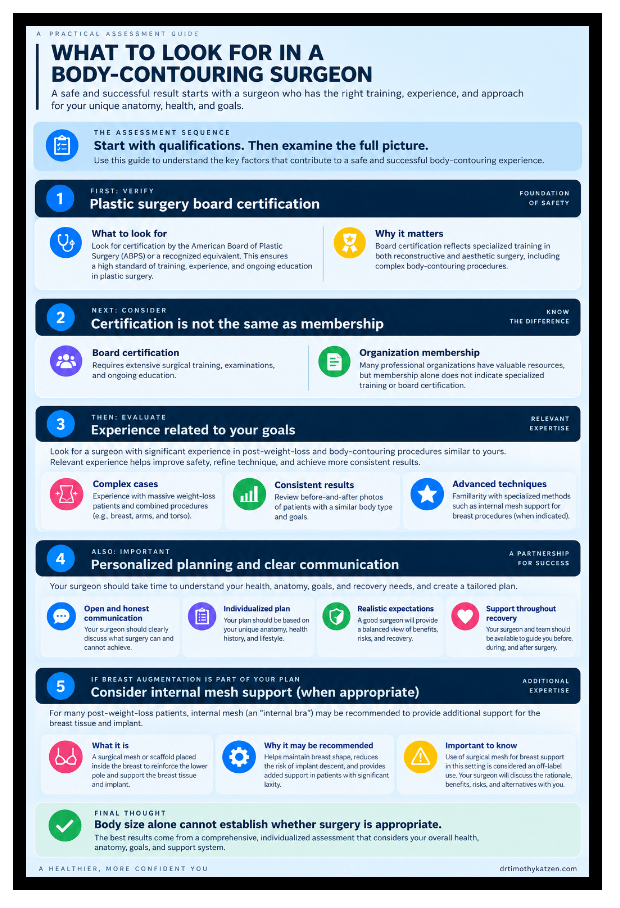
Infogram about what to look for in a body-contouring surgeon
Evaluate Communication, Respect, and Follow-Through Before Deciding
A consultation isn’t only a chance to hear which procedure might be considered. It also helps you assess whether the surgeon and practice discuss your priorities with care and explain the decision-making process clearly. When finding a surgeon for plus size body contouring, notice whether you feel heard as an individual, rather than reduced to a number or a set of assumptions.
Signs of respectful, goal-centered communication
Attentive communication gives you room to describe what you hope to address in your own words. You shouldn’t have to defend your motivations or feel pushed toward someone else’s ideal of what your body should look like. Clear answers matter, too. If a recommendation depends on further assessment, that uncertainty deserves a direct explanation, not a promise designed to end the discussion.
Use this framework to reflect on the conversation:
- Clarity: Are the potential benefits, limitations, risks, and alternatives explained in language you understand?
- Respect: Does the surgeon listen to your goals without shame, pressure, or assumptions about your weight or motivation?
- Realistic expectations: Are possibilities discussed honestly, without guaranteeing a particular shape or experience?
- Continuity: Is it clear how assessment and follow-up fit into the care plan, and where questions belong as you consider next steps?
You don’t need to leave with every decision made. You should leave with a clearer understanding of the reasoning, the questions still to resolve, and whether the conversation respected your priorities.
Understand the care plan beyond the operation
Surgical planning includes more than the procedure itself. Preoperative assessment helps inform the clinical plan, while postoperative follow-up is part of care after surgery. Understanding how these steps fit into the practice’s approach helps you consider the full experience without making assumptions about recovery timing or support details.
At J. Timothy Katzen, M.D., personalized care means your priorities are part of the discussion, alongside candidacy, options, and safety. The practice provides preoperative assessments and standard postoperative follow-up. These are important parts of a care plan, but they don’t guarantee a particular outcome or remove individual risks.
To learn more about how communication and individualized planning come together, explore Dr. Katzen’s body-contouring care.
Consider Dr. Katzen’s Body-Contouring Approach as a Next Step
Choosing a surgeon involves more than finding a procedure name. Consider verified credentials, experience related to your concerns, a clear discussion of safety, and care that treats your goals with respect. For anyone finding a surgeon for plus size body contouring, these factors shift the focus from a label to an informed, individual assessment.
Dr. Katzen is a board-certified plastic surgeon with advanced body-contouring experience. At J. Timothy Katzen, M.D., personalized care guides discussions of goals, candidacy, options, and safety. A recommendation should reflect your health and anatomy, not assumptions about what someone with a particular body size should want or be offered.
When advanced body-contouring experience may be relevant
The practice’s experience includes 360 lower body lifts, particularly for patients after significant weight loss. This can be relevant context if you’re considering changes across multiple areas after a major transformation. It doesn’t mean everyone needs or qualifies for that procedure. The right plan depends on the concerns you bring forward, your anatomy, and clinical assessment.
Move from research to a considered conversation
Before a consultation, note the areas you’d like to discuss, what you hope may change, and questions about risks, alternatives, or limitations. You don’t need to arrive certain that surgery is right for you. A useful conversation should help clarify whether a procedure may fit your circumstances, while making space for other options or for deciding not to proceed.
A consultation offers an opportunity to discuss your goals and candidacy without committing to a particular procedure or outcome. You can take time to consider what you learn and make your decision at your own pace.
Take the Next Step on Your Terms
Finding a surgeon for plus size body contouring involves more than identifying a procedure. Look for verified plastic surgery credentials, experience relevant to your concerns, and a careful discussion of your health, anatomy, options, and individual risks. You should also feel that your goals are heard without pressure or assumptions.
J. Timothy Katzen, M.D. is a board-certified plastic surgery practice with advanced body-contouring experience, including 360 lower body lifts for patients after significant weight loss. Personalized care guides conversations about goals and candidacy, while the right recommendation remains specific to each person. Experience with one procedure doesn’t mean it’s appropriate for everyone, and considering surgery doesn’t obligate you to proceed.
To discuss your goals and questions, explore Dr. Katzen’s body-contouring approach. A consultation can help you understand your options and decide what feels right for you.
Frequently Asked Questions
How do I find a surgeon for plus-size body contouring?
Start by looking for a plastic surgeon with verified specialty credentials and experience relevant to your goals. Ask how the surgeon assesses your anatomy, health history, and the specific areas you want to address. A thoughtful discussion should cover possible options, risks, limitations, and alternatives without pressure or promises of a particular result. Finding a surgeon for plus size body contouring also means finding communication that feels respectful and clear.
Does a surgeon need special certification for plus-size body contouring?
There isn’t a separate board certification specifically for plus-size body contouring. A core credential to understand is board certification in plastic surgery through the American Board of Plastic Surgery. Verify current certification through official board resources rather than relying only on memberships or broad cosmetic-surgery claims. Certification doesn’t guarantee a specific outcome or eliminate risk, so also consider experience with procedures related to your concerns and the surgeon’s approach to individualized planning.
Can plus-size patients have body-contouring surgery?
Some plus-size patients may be candidates for body-contouring surgery, but body size alone can’t determine whether surgery is appropriate. A surgeon evaluates individual health, anatomy, goals, and procedure-specific risks before discussing candidacy. There isn’t one threshold that applies to everyone. The assessment may lead to a surgical option, a different approach, or a recommendation to wait or not proceed. A consultation can help clarify what is appropriate for your circumstances.
What should a body-contouring consultation include?
A consultation should give you space to describe your goals and concerns, followed by an assessment of your health history and anatomy. The surgeon should explain relevant options and how their potential benefits, limitations, and risks relate to your situation. You should also be able to discuss anesthesia, the surgical setting, and follow-up planning. Clear answers matter, including an honest explanation if more information is needed before a recommendation can be made.
Is body contouring the same as weight-loss surgery?
No. Body contouring is intended to reshape selected areas, often by addressing excess skin or localized contour concerns. Weight-loss surgery is a different category of treatment, and body contouring isn’t a substitute for weight management or a method for significant weight reduction. A tummy tuck, for example, reshapes the abdomen rather than serving as weight-loss treatment. A surgeon can discuss whether a procedure aligns with your goals and health.
How can I tell whether a surgeon’s recommendations are personalized?
A personalized recommendation reflects your stated goals, anatomy, health history, and the scope of the proposed procedure. The surgeon should explain why an option may fit, along with its risks, limitations, and alternatives. Recommendations deserve careful discussion if they rely on a generic promise or assume what you want based on your body size. You should feel able to ask questions and receive direct answers without shame or pressure.
Does prior major weight loss change body-contouring planning?
It can. After substantial weight loss, changes such as excess skin or concerns across several areas may influence which procedures are considered and how they’re planned. The right approach still depends on your individual anatomy, health, priorities, and clinical assessment. Dr. Katzen’s practice has advanced body-contouring experience, including 360 lower body lifts for patients after significant weight loss. That experience doesn’t mean every patient needs or qualifies for that procedure.