Plastic Surgery for Older Adults: Safety, Options, and Candidacy
10/15/2026
A birthday alone can’t tell you whether surgery is appropriate. For plastic surgery for older adults, the more useful question is how your overall health, medications, goals, and the demands of a specific procedure fit together.
Questions about anesthesia, healing, complications, and recovery support deserve thoughtful, individualized answers. Age can inform surgical planning, but it shouldn’t be treated as a stand-alone verdict. Your medical history and the risks of the procedure matter, too.
This article explains factors that may shape candidacy, from health and anatomy to expectations and recovery planning. It also offers questions to raise with a qualified plastic surgeon, so you can better understand your personal risks and options. The aim isn’t to assume surgery is right or wrong because of age, but to help you make a considered decision based on your health and what you hope to achieve.
Key Takeaways
- Plastic surgery for older adults calls for an individualized review of health, goals, procedure-specific risks, and recovery needs.
- Prepare a complete list of medications and supplements for your care team, and don’t stop prescribed treatments without medical advice.
- Compare procedures by the concern they address and the recovery they involve. Suitability depends on your anatomy and clinical assessment.
- Before a consultation, clarify your goals, gather health information, and verify the surgeon’s plastic surgery board certification through an official source.
- Use the consultation to ask about risks, recovery support, and alternatives, then take time to weigh the trade-offs without pressure.
Table of Contents
- Plastic Surgery for Older Adults: Does Age Determine Candidacy?
- How Health, Medications, and Procedure Type Shape Surgical Risk
- Facial and Body Plastic Surgery Options for Older Adults
- How to Prepare for a Plastic Surgery Consultation Later in Life
- Making a Personal Decision About Plastic Surgery as an Older Adult


Plastic Surgery for Older Adults: Does Age Determine Candidacy?
Questions about healing, anesthesia, and surgical safety are understandable at any age, and they may feel especially important later in life. There isn’t one answer that applies to everyone. Before deciding, consider the demands of the procedure, your health, and the practicalities of recovery.
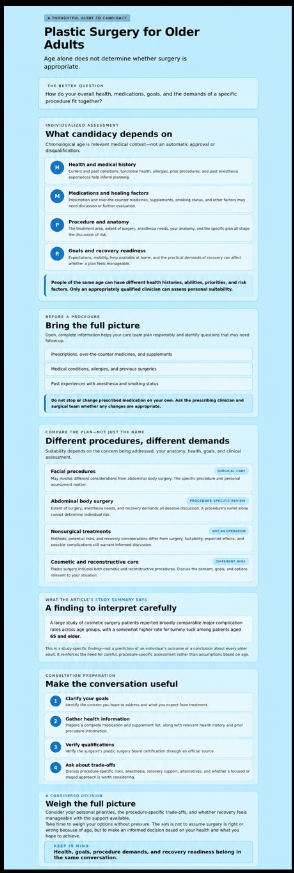
Candidacy is an individualized assessment of a person’s health, goals, chosen procedure, and ability to recover. Chronological age is relevant medical context, but it doesn’t automatically approve or disqualify someone. People of the same age can have different medical histories, functional abilities, priorities, and risk factors. A procedure that suits one person may not suit another.
Plastic surgery includes both cosmetic and reconstructive procedures, as described in this overview of Plastic surgery. Cosmetic care also includes surgical procedures and nonsurgical treatments, which differ in their methods, potential risks, and recovery considerations. Even a treatment that doesn’t involve an operation calls for an informed discussion about suitability, expected effects, and possible complications.
Is there an age limit for plastic surgery?
There’s no single age cutoff for every procedure. Age alone doesn’t show how someone manages daily activities, what health conditions they have, or how a particular operation may affect them. A clinician will consider chronological age alongside functional health, medical history, and the procedure being discussed. Only an appropriately qualified clinician can assess your personal suitability.
What does an individualized safety assessment consider?
An assessment may include current and past medical conditions, prescription and over-the-counter medications, supplements, smoking status, and previous procedures. Share these details openly. They help the care team identify what may need further evaluation and guide discussions about anesthesia, surgical planning, and recovery. Don’t stop or change prescribed medication on your own. Ask the prescribing clinician and surgical team for guidance.
Planning also extends beyond the operating room. Your mobility, the help available at home, and your expectations for recovery may affect whether a plan feels manageable. For example, consider whether you could arrange help with routine tasks if your clinician recommends limiting activity during recovery. These factors aren’t reasons to assume surgery is or isn’t right for you. They’re practical topics to discuss before deciding whether to proceed.
A thoughtful evaluation replaces age-based assumptions with a clearer discussion of personal priorities, procedure-specific trade-offs, and readiness for recovery.
How Health, Medications, and Procedure Type Shape Surgical Risk
A careful risk discussion starts with more than age. Your medical conditions and current health can influence whether additional evaluation is needed, how anesthesia is planned, and what recovery may involve. Sharing these details helps your surgeon weigh the potential benefits of a procedure against its demands in your circumstances.
Which health details should patients disclose?
Bring an up-to-date list of prescriptions, over-the-counter medicines, and supplements. Also discuss relevant medical conditions, allergies, previous surgeries, and any past experience with anesthesia. Be candid about smoking and other factors that could affect healing. These details aren’t a test you need to pass. They help your care team plan responsibly and identify questions that may need follow-up.
Don’t stop or adjust a prescribed medication on your own. Ask your prescribing clinician and surgical team whether any changes are appropriate before a procedure.
Why can risk differ between procedures?
Procedures vary in the area treated, their extent, anesthesia needs, and recovery demands. A facial procedure and abdominal body surgery may involve different considerations, but a procedure’s name alone can’t determine an individual’s risk. Your anatomy, health, goals, and specific surgical plan all matter.
A large study of cosmetic surgery patients reported broadly comparable major-complication rates across age groups, with a somewhat higher rate for tummy tuck among patients aged 65 and older. This is a study-specific finding, not a prediction of any individual’s outcome or a conclusion about every older adult. It does, however, underscore why tummy tuck candidacy deserves careful assessment rather than assumptions based on age.
The extent of surgery matters, too. Combining procedures may change the length and complexity of an operation and the recovery plan. Ask whether a more focused approach could address your goals, or whether staging procedures is worth discussing. There’s no single plan that fits everyone.
Population-level findings describe groups. Your surgical risk depends on your health and the specific procedure being considered.
For plastic surgery for older adults, honest disclosure and procedure-specific planning make the discussion more useful. If abdominal concerns are part of your goals, a consultation with Dr. Katzen may help you discuss tummy tuck candidacy in light of your health, anatomy, and priorities.
Facial and Body Plastic Surgery Options for Older Adults
People consider procedures for different reasons, including changes around the eyes or brow, facial skin laxity, or excess skin and contour concerns after weight changes. These options aren’t interchangeable. A procedure that addresses one concern may not address another. For plastic surgery for older adults, start by defining the concern, then discuss health, anatomy, potential trade-offs, and recovery.
What facial procedures might address visible aging?
A facelift is intended to address changes in the lower face and jawline. Eyelid surgery focuses on the upper or lower eyelid area, while a brow lift addresses the brow region. Nonsurgical skin treatments are a separate category of care. They may target selected skin concerns, but shouldn’t be assumed to provide results equivalent to surgery. Ask what changes are realistic for your anatomy, what recovery may involve, and whether alternatives fit your priorities.
When might body contouring enter the conversation?
Body contouring may be discussed when someone has a specific concern involving body shape or excess skin, including after significant weight loss. It addresses selected contour concerns, not age itself. A tummy tuck requires an individualized assessment of health, anatomy, goals, and procedure-specific risks. A clinician can help determine whether it relates to your concern and whether the likely recovery fits your circumstances.
| Concern | Broad Option | Consultation Question |
|---|---|---|
| Changes in the lower face or jawline | Facelift, a surgical option | What changes might this procedure address, and what recovery should I plan for? |
| Changes around the eyelids | Eyelid surgery | Which area is relevant to my concern, and what are the procedure’s limits? |
| Brow position or appearance | Brow lift | Would this address my goal, or should I discuss another approach? |
| Selected skin concerns | Nonsurgical skin treatment | How does this differ from surgery in possible effects and recovery? |
| Abdominal contour or excess skin | Body contouring, including possible tummy tuck evaluation | How do my health, anatomy, and goals affect whether this is appropriate? |
No option is universally safest or best for older adults. Procedure extent, personal health, anatomy, and recovery needs all shape the discussion. Use the table to prepare questions, then ask a qualified clinician to explain the benefits, limitations, risks, and recovery considerations specific to your situation.
How to Prepare for a Plastic Surgery Consultation Later in Life
A little preparation can make a consultation more useful and help you leave with a clearer understanding of your options. For plastic surgery for older adults, the conversation should connect your goal with your health history, the procedure under consideration, and any support recovery may require. Use the appointment to ask questions, share concerns, and decide whether you have enough information to consider next steps.
What should you bring to the consultation?
Gather your current medication and supplement list, relevant medical records, and notes about previous surgeries or anesthesia. Write down what concerns you and what changes you hope to discuss. Mention any health changes, mobility concerns, or questions about help at home during recovery. You can also bring someone you trust to listen and take notes, if that would be useful.
Which questions help assess a surgeon and plan?
Verify a surgeon’s board certification in plastic surgery through the American Board of Plastic Surgery’s official resources. Then ask about the surgeon’s relevant experience and the procedure-specific considerations in your case. Direct questions can help you understand the plan before making a decision:
-
What alternatives should I consider, including not having surgery?
-
What are the risks and anesthesia considerations for this procedure in my circumstances?
-
What might recovery involve, and what help could I need at home?
-
Who will provide follow-up care, and how can I contact the team with concerns?
-
Which symptoms after surgery require prompt medical attention, and what should I do if they occur?
-
Would combining procedures change the risks or recovery demands? Could a simpler or staged plan be considered?
-
What outcomes are realistic for my anatomy and goals?
Ask for clear follow-up instructions, including whom to contact if you have concerns after surgery. A consultation can support shared decision-making, but it doesn’t replace individualized medical advice from clinicians familiar with your health.
Save this consultation checklist: clarify your goal, bring health and medication information, verify credentials, ask about alternatives and procedure-specific risks, and plan for recovery support.
If abdominal concerns are part of your goals, you can discuss tummy tuck candidacy with Dr. Katzen as one step in learning whether the procedure merits consideration for your circumstances.
Making a Personal Decision About Plastic Surgery as an Older Adult
A thoughtful decision starts with your priorities, not an age-based assumption or someone else’s experience. Consider four questions: What change matters to you? What does your health assessment suggest? What trade-offs come with the procedure? And are you prepared for the recovery and follow-up it may involve? These questions can turn a broad interest in plastic surgery for older adults into a more personal conversation with a qualified plastic surgeon.
How can you weigh potential benefits against recovery demands?
Be specific about the change you hope to achieve and why it matters in your daily life. Then ask how the proposed procedure might address that goal, what it can’t change, and what recovery could require. Consider healing time, practical help at home, follow-up appointments, and your ability to follow the surgeon’s instructions. These details are part of the decision, not an afterthought.
Take time to reflect after a consultation. You don’t need to decide on the spot. Outcomes vary, and no procedure can guarantee a particular appearance. Depending on your goals and medical assessment, a suitable choice may be surgery, a nonsurgical option, postponing a decision, or choosing no procedure. Any of these can be a valid outcome of an informed discussion.
What is a sensible next step if you are considering body contouring?
Discuss your goals and health history with a qualified plastic surgeon who can assess your individual circumstances. If your concern is abdominal contour or excess skin, a tummy tuck may be a topic to explore, but only a personalized evaluation can determine whether it’s appropriate. The decision should account for your anatomy, health, procedure-specific risks, and readiness for recovery, without pressure or promises.
Dr. Katzen’s practice focuses on tummy tuck and advanced body contouring, including care for patients after significant weight loss. If you have an abdominal concern, you can Learn about Dr. Katzen’s practice and consultation process as a low-pressure step toward understanding whether a discussion of tummy tuck candidacy is relevant to you.
Make Your Next Step an Informed One
Age alone doesn’t determine whether surgery is appropriate. For plastic surgery for older adults, candidacy depends on personal health, goals, procedure-specific considerations, and readiness for recovery. A thoughtful consultation can help you understand potential risks, alternatives, and what a procedure may realistically address. The right decision may be surgery, another option, waiting, or choosing no procedure.
If abdominal contour or excess skin is your concern, a personalized discussion can help clarify whether a tummy tuck merits consideration in your circumstances. J. Timothy Katzen, M.D., is a board-certified plastic surgery practice established in 1997, with a focus on tummy tuck and advanced body contouring, including care for patients after significant weight loss.
Learn about Dr. Katzen’s practice and consultation process to explore whether a conversation about your goals may be a useful next step. Take the time you need, ask direct questions, and choose a path that feels informed and right for you.