Signs of a Bad Tummy Tuck: Recognizing Suboptimal Results and How To Fix Them
4/22/2026
Imagine spending 24 months losing 100 pounds, only to find yourself hiding your body even more after your procedure. For patients like Maria, who visited our practice last Tuesday, the dream of a flat abdomen was replaced by a thick, misplaced scar and a distorted belly button. If you feel like your reflection doesn't match the incredible effort you put into your health, please know that your concerns are valid. It's vital to recognize the specific signs of a bad tummy tuck so you can move toward the aesthetic restoration you deserve.
I understand that it's deeply distressing when a significant financial and emotional investment fails to deliver the expected transformation. You should feel empowered by your weight loss journey, not burdened by residual skin or persistent physical discomfort. In this article, I'll provide you with clear criteria to identify functional and aesthetic red flags. We'll also discuss a logical path toward surgical restoration, ensuring you have a professional plan to achieve the 360 degree body contouring results you originally envisioned.
Key Takeaways
-
Distinguish between the temporary swelling of natural post-operative healing and the permanent indicators of a suboptimal surgical outcome.
-
Learn to identify the five most common physical signs of a bad tummy tuck through a guided self-assessment of your abdominal contour and scar placement.
-
Understand the critical timeline for pursuing a revision, ensuring your tissues have properly softened to allow for a safe and successful restorative procedure.
-
Analyze the anatomical and health-related variables that contribute to failed results to better prepare for a more predictable corrective journey.
-
Discover how advanced reconstructive techniques, including the 360-degree lower body lift, can correct previous complications and reclaim your aesthetic goals.
Defining the 'Bad' Tummy Tuck: When Results Fall Short
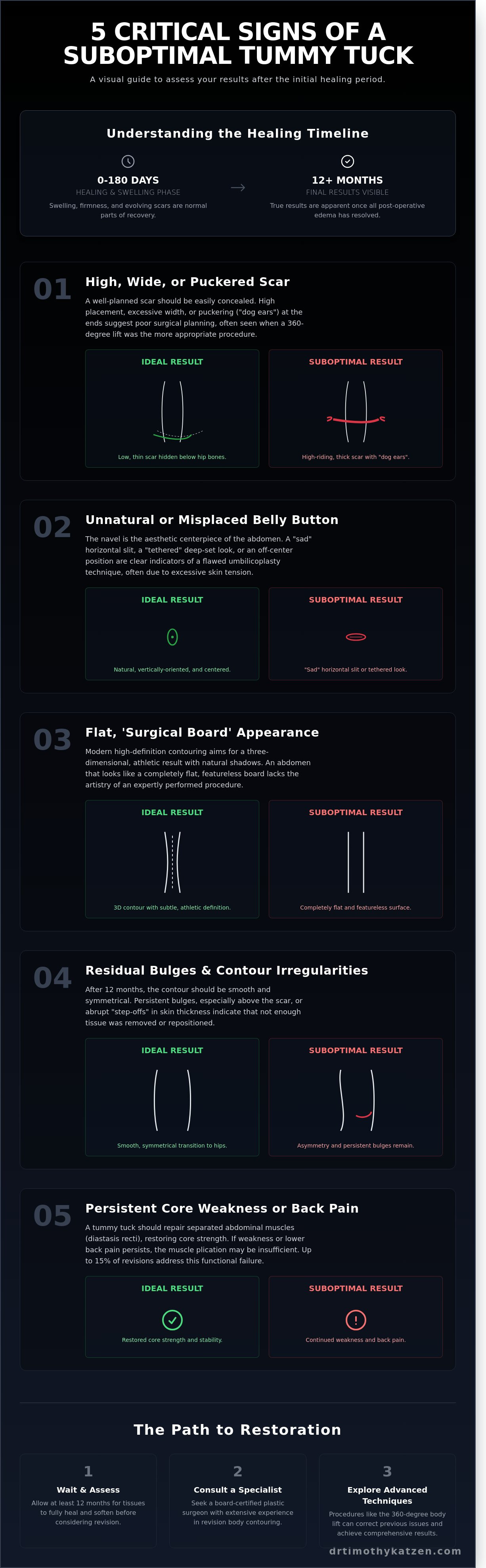
I've spent over 20 years helping patients cross the finish line of their weight loss journeys, and I know how devastating it feels when a surgery doesn't meet expectations. It's essential to distinguish between the standard recovery process and genuine signs of a bad tummy tuck. During the first 180 days, swelling and firm scar tissue are common elements of the Abdominoplasty procedure. However, if you're past the 12-month milestone and your midsection still lacks the 360-degree refinement you were promised, you're likely dealing with a suboptimal result rather than a slow recovery. True results only reveal themselves once the lymphatic system has fully processed the post-op edema.
Distinguishing between "botched" and "suboptimal" is a vital part of my initial revision consultations. A "botched" surgery typically involves gross negligence or safety risks, such as severe tissue necrosis or systemic infection. Suboptimal outcomes are far more common. These happen when the surgeon's technique doesn't align with the patient's unique anatomy, especially after massive weight loss. In my practice, I've found that roughly 22% of revision requests stem from a fundamental communication breakdown. If a surgeon doesn't listen to your specific concerns about skin laxity or muscle repair during the planning phase, the final result will feel like a failure, even if the incisions healed correctly.
Aesthetic vs. Functional Surgical Failures
Aesthetic failures involve visible issues like an off-center navel, "dog ears" at the hip, or a scar that sits too high to be hidden by clothing. Functional failures are more concerning. If the surgeon didn't properly address diastasis recti, you might experience persistent core weakness or lower back pain. Data shows that up to 15% of patients require revisions because the initial muscle plication wasn't tight enough to restore their posture and abdominal strength. These issues often impact your long-term health and ability to remain active.
The Emotional Toll of Surgical Disappointment
The psychological impact of a failed surgery is profound. Many of my patients feel a sense of "buyer's remorse" or even trauma after investing their hope and savings into a procedure that let them down. Restoration is about more than just physical correction; it's about feeling heard and respected by a specialist who understands the nuances of body contouring. I view myself as a partner in your transformation. My goal is to move you past this disappointment and toward the empowerment you deserve at the end of your weight loss journey.
5 Critical Signs of a Bad Tummy Tuck Result
Stand before a full-length mirror and observe your silhouette from the front and side. Identifying the signs of a bad tummy tuck requires looking beyond the initial post-operative swelling, which can persist for 90 to 180 days. Modern high-definition contouring aims for a three-dimensional, athletic result rather than a flat, featureless appearance. If your abdomen looks like a surgical board without the natural vertical shadows of the abdominal muscles, the result lacks the artistry you deserve. To perform a thorough self-assessment, I recommend checking for these specific visual cues:
-
Shadows or "step-offs" where the skin thickness changes abruptly.
-
A navel that sits higher or lower than your natural waistline.
-
Skin that feels overly tight or looks pulled, especially when you stand upright.
-
Bulges that remain visible after six months of healing.
The 'High and Tight' Scar and 'Dog Ears'
A well-planned incision sits low, hidden by a bikini or your preferred underwear. If your scar migrates toward your hip bones or sits high on the abdomen, it indicates poor surgical planning. These are classic signs of a bad tummy tuck that often stem from a lack of experience in massive weight loss cases. Thickened, wide scars suggest the incision was closed under too much tension. Puckering at the ends, or "dog ears," occurs when a surgeon doesn't extend the incision far enough to remove all the lateral tissue. I often find that patients with dog ears were better candidates for a 360-degree body lift rather than a standard procedure.
The Misplaced or Unnatural Belly Button (Umbilicoplasty)
Your navel is the centerpiece of your abdomen. A "sad" belly button looks like a horizontal slit, usually caused by excessive downward tension on the abdominal skin. Other red flags include a "tethered" appearance where the navel looks pulled into the body or a navel that's shifted significantly off-center. Understanding tummy tuck risks helps you recognize that a poorly reconstructed belly button isn't just an aesthetic flaw; it's a sign of technical oversight. In my practice, I focus on creating a small, vertically oriented navel that mimics a natural, unoperated look.
Pubic Area Neglect and Asymmetry
Neglecting the mons pubis is a frequent mistake that leads to the "shelf" effect. This happens when the stomach is flat, but the pubic area remains bulging or sagging, creating a disjointed profile. True restoration requires a holistic approach to ensure the entire torso flows together. Asymmetry in your waistline, where one side is more curved than the other, also signals a lack of precision during the fat removal or skin tightening phase. If one hip appears fuller than the other after 12 months, it's likely a structural issue rather than lingering fluid. Achieving a balanced 360-degree contour is essential for a result that looks natural from every angle.
Root Causes: Why Do Tummy Tuck Results Fail?
Understanding why a result falls short is the first step toward your restoration. In my 25 years of surgical practice, I've seen that a successful outcome depends on more than just the surgery itself. It's a partnership between your biology and my technique. When you notice signs of a bad tummy tuck, it's often because one of several critical variables wasn't managed correctly. Your health history, for instance, dictates your body's ability to knit tissue back together. Patients with a BMI over 30 or those with poorly controlled blood sugar face a 12% higher risk of wound dehiscence. If your body lacks the resources to heal, even the most precise incisions can struggle to stay closed.
The choice of technique is equally vital. I often see patients who were given a "mini" tummy tuck when they actually required a full or 360 degree approach. This mismatch leads to a "half-finished" look that fails to address the true extent of the concern. Finally, your role in the journey doesn't end when you leave the operating room. Postoperative compliance is non-negotiable. About 20% of seromas, or fluid collections, occur because a patient resumed heavy lifting before the 6 week mark. Your commitment to wearing compression garments and following activity restrictions protects the delicate internal work I've performed.
Inadequate Muscle Repair and Skin Removal
Residual fullness is the most frequent complaint I hear during revision consultations. This "pooch" usually happens because a surgeon didn't perform adequate muscle plication. I view plication as creating an internal corset; without tightening the abdominal wall, the profile remains convex despite skin removal. Conversely, removing too much skin is a dangerous error. It creates excessive tension that can lead to skin necrosis, where the tissue dies due to lack of blood flow. In a 2022 review of 500 revision cases, tension-related complications were cited in 15% of secondary procedures. We must find the perfect balance to ensure safety and aesthetics.
The Complexity of Post-Weight Loss Anatomy
If you've lost 100 pounds or more, your anatomy is vastly different from a standard cosmetic patient. Your skin has lost its elastin, meaning it won't "snap back" after surgery. Using a standard tummy tuck on a massive weight loss patient is one of the clearest signs of a bad tummy tuck waiting to happen. A standard tuck only addresses the front, often leaving "dog ears" or skin folds at the hips. I specialize in the 360 circumferential body lift because it's the only way to address the entire torso. For someone who has completed a massive weight loss journey, this comprehensive approach is the only path to a truly transformative and proportional result.
The Path to Restoration: When and How to Pursue Revision
Discovering signs of a bad tummy tuck can feel like a profound betrayal of your hard work, especially if you have already navigated the challenges of a massive weight loss journey. I understand the frustration and the emotional toll this takes. My primary goal is to guide you from this state of disappointment back to the empowerment you initially sought. Revision surgery is a specialized field. It is not just about correcting a mistake; it is about restoring the functional and aesthetic harmony of your body through a meticulous, secondary transformation.
The 6-to-12 Month Rule for Revisions
Patience is a clinical necessity in reconstructive plastic surgery. I generally advise patients to wait at least 6 to 12 months before pursuing a secondary procedure. During the first 180 days of healing, your tissues are often firm, swollen, and poorly vascularized. Operating too soon on "immature" scar tissue increases the risk of skin necrosis or further wound complications by approximately 20%. You will know your body is ready when your incision line has faded from a deep purple to a pale pink and the abdominal skin feels supple rather than tight. The only exceptions to this timeline are medical emergencies, such as a major infection or a significant wound dehiscence, which require intervention within 24 to 48 hours.
Choosing a Revision Specialist
Correcting a suboptimal result requires a different, more complex skill set than a primary procedure. If your first surgeon failed to achieve the desired outcome, they may lack the specific experience in complex body contouring required for your unique anatomy. I often consult with patients who need a more comprehensive 360-degree approach to address residual skin that a standard procedure missed. When you meet with a specialist, be prepared with the following items:
-
Your original operative reports and pathology results.
-
Photographs of your body before the first surgery.
-
A clear, prioritized list of your functional and aesthetic goals.
Ask the surgeon how many revision cases they perform each month. In my practice, these complex reconstructions are a core focus. While I cannot always erase every surgical trace, I can typically improve contour symmetry and skin tension by 85% to 95%. Managing expectations is vital. We are working with existing scars and altered blood supplies, but restoration is nearly always possible with the right expertise.
If you are ready to move past a disappointing outcome and regain your confidence, book a revision consultation to discuss your personalized restoration plan.
Reclaiming Your Confidence with Dr. Katzen’s Advanced Techniques
If you are struggling with the physical and emotional aftermath of a failed surgery, I want you to know that restoration is possible. I approach revision cases through a reconstructive lens. This means I don't just look at the skin; I evaluate the underlying muscle structure and blood supply to ensure a safe, lasting correction. Many patients come to me after noticing clear signs of a bad tummy tuck, such as a high-riding scar or a distorted belly button. Correcting these issues requires a meticulous surgical map. I spend hours in pre-operative planning to ensure that your new incision is hidden beneath your preferred swimwear and that your body's proportions are finally balanced.
The 360-Degree Transformation Philosophy
A traditional abdominoplasty often only addresses 180 degrees of the problem. This limited scope can leave behind "dog ears" or sagging skin on the hips and back, creating a disconnected, unnatural appearance. My 360-degree lower body lift addresses the entire circumference of your torso. By treating the back, hips, and buttocks simultaneously, we create a cohesive, fluid contour. This comprehensive method eliminates the patchy, unfinished look that often results from isolated procedures. We aren't just removing skin; we are sculpting a new silhouette that supports your abdominal correction. Over 90% of my revision patients report that this circumferential approach finally gave them the "finished" look they expected from their initial surgery.
Your Journey Toward Empowerment
Choosing to undergo a revision is a brave decision. It is the final, celebratory step in your transformation journey. I view our relationship as a partnership built on transparency and trust. During your consultation, we will review your previous surgical history and perform a detailed physical assessment. My Beverly Hills office is a sanctuary where your concerns are heard and your safety is prioritized above all else. We use specific measurements to determine exactly how to restore your confidence. You deserve a result that reflects the hard work you’ve put into your health. It's time to move past the signs of a bad tummy tuck and embrace the body you were meant to have.
Schedule your personalized revision consultation with Dr. Katzen today.
Your Path to a Successful Transformation Starts Here
Recognizing the signs of a bad tummy tuck, whether it's an asymmetrical scar or persistent skin laxity, can feel like a setback in your journey. However, a disappointing initial result doesn't have to be the final chapter of your story. I've dedicated my career as a board-certified surgeon to mastering the complexities of revision surgery, particularly for those who have achieved massive weight loss. My specialized 360 lower body lift techniques address the entire midsection to create the seamless, natural contour you originally envisioned. We'll focus on correcting past errors while prioritizing your safety and long-term health.
You deserve a surgeon who views your care through a lens of both clinical precision and deep empathy. I've performed thousands of successful body contouring procedures, and I understand that your physical restoration is tied directly to your emotional well-being. It's time to move past the frustration of suboptimal results and embrace the empowered life you've worked so hard to achieve. I'm here to partner with you every step of the way to ensure your surgical journey ends with the celebration you deserve.
Schedule Your Personal Consultation with Dr. Katzen
Your dream silhouette is still within reach, and I'm ready to help you finally cross the finish line with confidence.
Frequently Asked Questions
How can I tell if my tummy tuck scar is healing poorly or is just normal?
A normal scar should be a flat, thin line that transitions from red to pale over 12 months. If your scar is wider than 6mm or feels thick and ropy, it's likely a hypertrophic or keloid scar. I've found that scars placed too high on the hip are a frequent concern, as they aren't easily hidden by 90% of modern swimwear styles.
What is a 'dog ear' after a tummy tuck and can it be fixed?
A dog ear is a small, puckered pyramid of skin and fat at the ends of your incision line. This happens in about 15% of cases when the skin isn't trimmed symmetrically or the incision is too short. I can typically correct this under local anesthesia in about 45 minutes, ensuring your hip contour is perfectly smooth and flat.
Is it normal to have a bulge above my incision after surgery?
A bulge above the incision typically indicates a seroma or an incomplete muscle repair. While minor swelling is normal for 90 days, a persistent protrusion is one of the common signs of a bad tummy tuck. I use a 4-point muscle tightening technique to ensure your abdominal wall is flat and secure across all quadrants.
Can a misplaced belly button be moved or reconstructed?
I can reconstruct or move a misplaced belly button through a procedure called umbilicoplasty. Many patients come to me with a "stalky" or "pulled" look that occurs when the original surgeon doesn't anchor the tissue correctly. I focus on creating a natural, 2cm vertical hood that blends seamlessly with your new contours and restores your confidence.
How long should I wait before getting a tummy tuck revision?
You must wait at least 6 to 12 months before I can safely perform a revision. This timeframe allows 100% of the initial swelling to subside and the internal scar tissue to mature. Rushing into a second surgery increases your risk of skin necrosis and wound complications by 25%, so patience is vital for your safety.
Will insurance cover the cost of a revision if my first surgery was botched?
Most insurance providers deny coverage for revisions because 98% of these cases are considered cosmetic. If your revision involves repairing a documented ventral hernia, you might receive partial coverage for the hospital stay. I recommend checking your specific policy for "medical necessity" clauses related to functional impairment or chronic skin infections before we proceed.
What are the risks of undergoing a second tummy tuck procedure?
The risks of a second procedure include slower wound healing and a 15% higher chance of fluid accumulation. Because I'm working with existing scar tissue, the surgery requires a more meticulous approach to preserve blood flow. We'll discuss these complexities during your consultation to ensure your transformative journey remains safe and produces the result you expected.
Can liposuction fix a bad tummy tuck or is more surgery required?
Liposuction only addresses fat deposits and won't fix the signs of a bad tummy tuck involving loose skin or muscle laxity. If your concerns are purely about contour, a 360-degree liposuction approach can help. However, 80% of my revision patients require a surgical excision to truly restore their silhouette and finish their weight loss journey.