360 Body Lift vs. Tummy Tuck: Which Procedure Completes Your Transformation?
10/23/2026
Figure #1: Picture of a weight loss patient deciding between a 360 Body Lift vs. Tummy Tuck. CHATGPT AI generated model.
What if the procedure you've spent months researching only solves half of the puzzle? You've likely reached a point in your personal odyssey where you're ready to celebrate your weight loss, yet the mirror reflects a silhouette that still feels unfinished. When evaluating a 360 body lift vs tummy tuck, it's common to feel torn between a localized correction and a more comprehensive, geometric restoration. You want to move through your day without the physical discomfort of skin laxity or the emotional weight of hiding rolls under layers of clothing.
I understand that this decision isn't just about aesthetics; it's about reclaiming your quality of life and ensuring your clothes finally fit the way they should. In this guide, I'll demystify the technical nuances between these two transformative interventions. You'll discover which procedure best addresses concerns like sagging buttocks and back rolls that a standard abdominal repair might miss. By the end, you'll have the clinical clarity needed to decide which path will ultimately provide the smooth, contoured waistline you've earned from every angle.
Key Takeaways
- Understand the fundamental differences between a 360 body lift vs tummy tuck and how each approach addresses specific areas of skin laxity.
- Learn why a circumferential approach is often the gold standard for restoring your silhouette after massive weight loss by treating the back and buttocks.
- Identify the physical indicators that determine if a localized abdominal correction is sufficient or if a full-circle lift is necessary for your goals.
- Gain a clear understanding of the recovery expectations and scar patterns associated with these life-changing reconstructive procedures.
- Discover how to choose a specialist who views your body as a three-dimensional unit to ensure a harmonious and natural final result.
Table of Contents
- Frontal Correction vs. Circumferential Contouring: The Core Difference
- The 360 Lower Body Lift: Why "Full Circle" Matters
- When is a Tummy Tuck Sufficient? Identifying the Ideal Candidate
- The Final Step: Choosing Your Specialist for Body Contouring
- Reclaiming Your Silhouette and Your Confidence
Frontal Correction vs. Circumferential Contouring: The Core Difference
When you look in the mirror after a significant weight loss journey, you're viewing a body that has undergone a profound structural shift. Your skin, once stretched to accommodate a different volume, now exists as a three-dimensional envelope that may no longer fit your new frame. Choosing between a 360 body lift vs tummy tuck requires an honest assessment of where that excess tissue resides. It's not merely a question of how the front of your stomach looks, but how your entire midsection interacts with your clothing and your movement.
The primary differentiator between these two procedures is the treatment of the posterior and lateral regions. While a tummy tuck focuses on the anterior wall, a 360 body lift addresses the entire circumference of your torso. I often tell my patients that the choice depends on where your excess skin "travels" beyond your hip bones. If you can pinch significant skin on your lower back or flanks, a frontal correction alone might leave your transformation feeling unfinished.
Defining the Traditional Tummy Tuck
A standard Abdominoplasty (Tummy Tuck) is a linear procedure designed to restore the anterior abdominal wall. During this surgery, I focus on two main objectives: repairing the rectus diastasis (the separation of the abdominal muscles) and excising the apron of skin that hangs over the beltline. This intervention is ideal for patients whose skin laxity is strictly isolated to the front of the stomach. The incision typically runs from hip to hip, carefully positioned so it's hidden within the bikini line. While it creates a beautiful, flat profile from the front, it doesn't address the "dog ears" or back rolls that often persist after massive weight loss.
Defining the 360 Lower Body Lift
The 360 body lift is essentially a tummy tuck that continues around the back to remove a full circle of tissue. It's a more comprehensive, geometric restoration that treats your torso as a single unit. Instead of stopping at the hips, the incision travels across the lower back, allowing me to lift and tighten the "muffin top" area, smooth out lower back rolls, and provide a global lift to the outer thighs. One of the most significant benefits of this circumferential approach is the gluteal restoration; by removing the posterior skin, I can lift and reshape the buttocks without the need for implants. It's the definitive final step for those who want a smooth, contoured waistline from every possible angle.
The 360 Lower Body Lift: Why "Full Circle" Matters
Massive weight loss is rarely a linear experience. It doesn't just happen to your stomach; it happens to your entire frame. When you reach your goal weight, you might find that while your abdomen is flatter, you're still struggling with a "shelf" of skin that wraps around your lower back. This is where the distinction between a 360 body lift vs tummy tuck becomes vital for your final result. While a standard abdominoplasty is an excellent tool for many, it often leaves the posterior and lateral regions untouched, creating a visual disconnect between a flat front and a sagging back.
The 360 approach is designed to eliminate this disconnect. By removing a continuous ribbon of skin and fat from the entire beltline, I can restore the geometric integrity of your midsection. This "full circle" correction ensures that your skin envelope fits your new, smaller frame perfectly. It provides the most dramatic improvement in how clothing and swimwear fit, allowing you to wear fitted garments without worrying about rolls or hanging tissue being displaced to the sides or back. For a foundational understanding of the anterior component, you can review Tummy Tuck Procedure Details from the Mayo Clinic, which outlines the traditional abdominal approach.
Addressing the Posterior and Lateral Flanks
One of the most frustrating aspects of post-weight loss life is the presence of stubborn back rolls. These are not pockets of fat that diet or exercise can reach; they are folds of redundant skin. A 360 body lift addresses these lateral and posterior flanks directly. By applying tension circumferentially, I can smooth the hip silhouette and eliminate the "muffin top" effect. Interestingly, treating the back is often essential for a truly flat abdominal result. The lateral tension pulled from the sides helps anchor the frontal repair, preventing the skin from bunching at the hip bones, a common issue known as "dog ears."
The Gluteal and Thigh Lift Component
A 360 body lift acts as a natural, "auto-augmentation" butt lift. Many patients lose volume in their glutes along with their weight, leaving the buttocks looking flat or deflated. By removing the heavy, sagging skin from the lower back, the remaining gluteal tissue is lifted into a more youthful, rounded position. This procedure also offers a secondary benefit by tightening the skin on the outer and anterior thighs. It restores balance to your lower body proportions, ensuring your legs and buttocks match the renewed contour of your waistline. If you feel your transformation is currently "half-finished," I invite you to explore how a reconstructive approach can provide the 360-degree closure you deserve.
When is a Tummy Tuck Sufficient? Identifying the Ideal Candidate
While I often advocate for the circumferential approach in complex reconstructive cases, it's essential to recognize when a more targeted intervention is the right choice for your specific anatomy. Not every transformation requires a full-circle correction. For many, the physical journey hasn't involved the massive fluctuations in weight that affect the entire torso. Instead, the concern is localized. A standard tummy tuck is often the ideal solution for post-pregnancy patients or individuals who've lost a moderate amount of weight while maintaining excellent elasticity in their back and flank skin.
The primary goal of this procedure is to address the "pooch" or the apron of skin, known as a pannus, that resides strictly on the front of the abdomen. If your lower back is smooth and your hips don't have significant skin overhang, a 360 lift might be more surgery than you actually require. During our consultation, I perform a meticulous physical examination to ensure that a frontal incision won't result in "dog ears" at the hip ends. These are small, unsightly puckers of skin that occur when a surgeon attempts to pull too much tension into a space that isn't long enough to accommodate the redundant tissue. My priority is ensuring your incision is as clean and flat as your new profile.
The Role of Muscle Repair (Diastasis Recti)
Muscle tightening is the silent foundation of a successful tummy tuck. For many mothers, the primary issue isn't just skin laxity; it's the separation of the rectus abdominis muscles, a condition called diastasis recti. During the procedure, I use internal permanent sutures to pull these muscles back together, effectively creating an internal corset. This provides a flat, firm profile that diet and exercise simply cannot achieve once the connective fascia has been stretched beyond its limit. In a Clinical Review of Abdominoplasty, the importance of this structural repair is highlighted as a key component for both functional support and aesthetic success. While muscle repair is part of a 360 lift too, it's often the central focus of a traditional tummy tuck.
Assessing Your Skin Elasticity
How do we decide between a 360 body lift vs tummy tuck during your evaluation? I often use a "pinch test" on your flanks and lower back. If I can grasp more than an inch of loose, redundant tissue in those areas, a frontal-only approach will likely leave you frustrated with side bulges that the surgery didn't reach. Factors like age and a history of sun damage also play a significant role, as they diminish the skin's ability to "snap back" after a localized pull. If we ignore circumferential laxity, the tummy tuck might flatten the front but actually highlight the sagging on the sides. My goal is to ensure your results are harmonious and balanced across your entire midsection.
Recovery is the bridge between your surgical intervention and your final, celebrated result. When weighing a 360 body lift vs tummy tuck, the physical investment in healing is a significant factor. While both procedures require the use of specialized compression garments to manage swelling and support your new contours, the extent of the tissue removal dictates the pace of your return to daily life. A tummy tuck typically allows you to return to light work within 2 weeks. In contrast, the more extensive nature of a 360 body lift usually requires 3 to 4 weeks before you feel ready for a professional environment.
Scar Management and Placement
The visual signature of these procedures is defined by the scar. A tummy tuck leaves a frontal arc, whereas a 360 body lift results in a continuous circle around your midsection. I approach scar placement as an art of geometric alignment. By positioning the incision low on the hips and across the lower back, I ensure it remains hidden within standard underwear and swimwear. Choosing between a 360 body lift vs tummy tuck involves accepting that a longer incision often translates to a more complete transformation. While a longer scar may seem daunting, it often yields a more harmonious look than a shorter tummy tuck scar. For patients with circumferential laxity, a short scar can lead to skin bunching at the ends. A full-circle incision allows for a meticulous, tension-free closure that minimizes scar width and prevents the "shelf" effect from returning.
Post-Operative Mobility and Support
Mobility during the first few days requires a specific, methodical approach. I ask my patients to maintain a "beach chair" position, where you remain slightly flexed at the hips while resting. This reduces tension on your new incisions, especially the circumferential closure of a body lift. Managing drains and incision care is a temporary but essential part of the process that ensures your safety and optimal healing. While you'll be walking shortly after surgery, you must wait 6 to 8 weeks before resuming heavy lifting or high-impact exercise. If you are ready to begin this final stage of your physical odyssey, you can schedule a detailed consultation to discuss your personalized recovery plan.
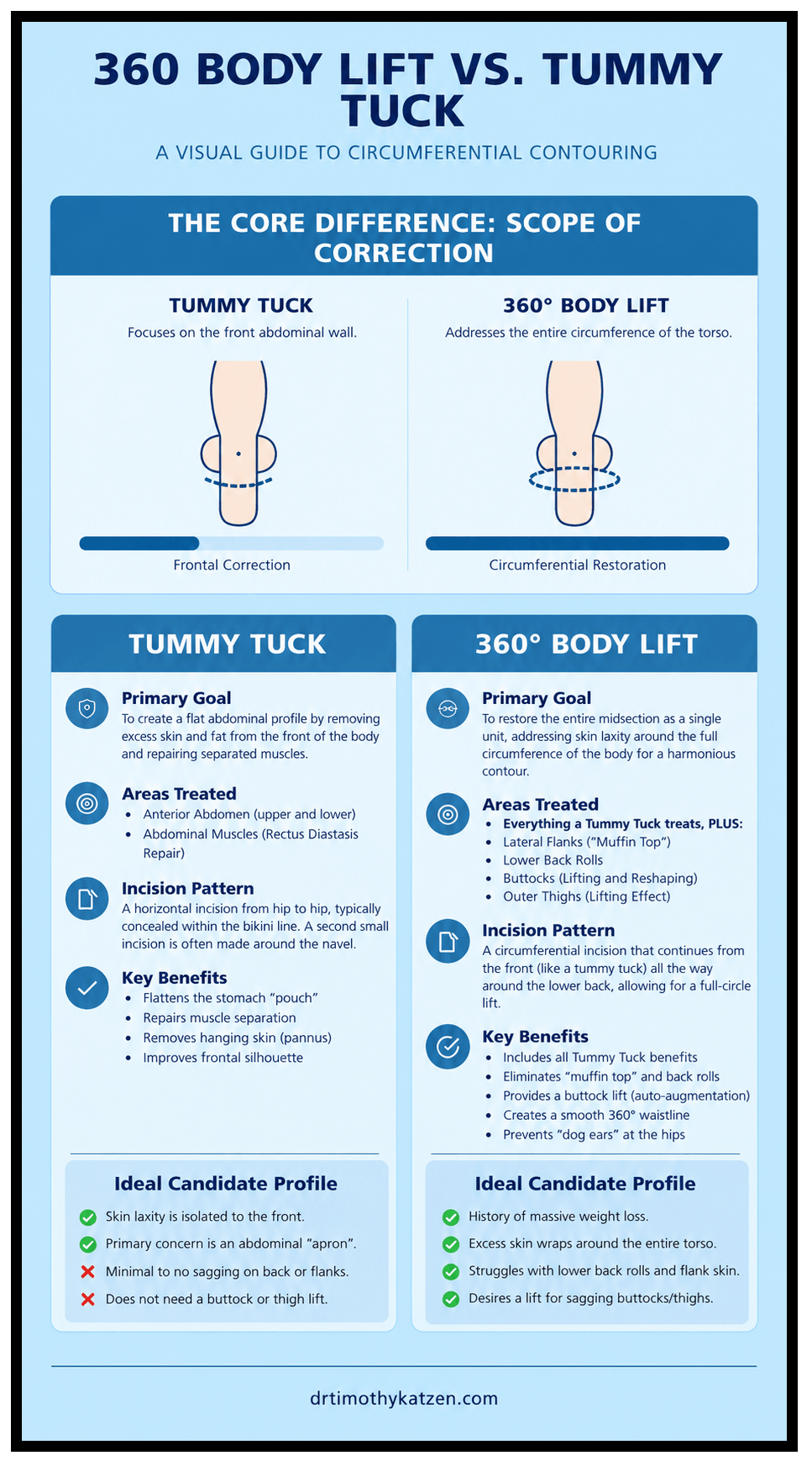
Figure #2: Picture of an Infogram of the comparison of a 360 Body Lift vs. Tummy Tuck.
The Final Step: Choosing Your Specialist for Body Contouring
Selecting the right partner for this final stage is perhaps the most critical decision in your entire odyssey. While many surgeons perform aesthetic procedures, the needs of a massive weight loss patient are fundamentally different. I view these interventions as reconstructive journeys rather than simple cosmetic enhancements. You've already done the hard work of losing the weight; now, you deserve a result that honors that effort. When you are deciding between a 360 body lift vs tummy tuck, you need a specialist who treats your body as a three-dimensional, geometric unit rather than a series of flat surfaces. This holistic perspective ensures that every angle is considered, from the curve of your hips to the lift of your gluteal region.
I believe that every patient deserves a personalized plan that respects their individual history. Your skin's current state is a map of the challenges you've overcome, and our goal is to provide a closure that feels like a celebration. This isn't just about removing tissue; it's about restoring your confidence and physical comfort. I encourage you to look beyond standard marketing and seek out a practitioner who understands the profound emotional and physical shift that follows a massive transformation. Trust is the foundation of this process, and that trust is built on clinical expertise and a shared vision of your final result.
The Importance of Specialization in Massive Weight Loss
Massive weight loss patients present unique anatomical challenges, such as diminished skin elasticity and complex nutritional histories that affect healing. These factors require a meticulous surgical approach that a standard aesthetic practice might not be equipped to handle. The technical complexity of managing large volumes of skin removal necessitates a deep understanding of anatomical tension and blood supply. I believe the 360 lower body lift is the gold standard for MWL reconstruction because it addresses the total physical change your body has endured. By choosing a specialist who focuses on this niche, you ensure that your surgeon has the experience to manage the specific skin quality and volume issues that follow significant weight loss.
Your Consultation: What to Ask
During our meeting, I encourage you to be thorough and inquisitive. Ask about exact incision placement and how I manage muscle repair alongside circumferential skin excision. We should also discuss the possibility of combining your midsection restoration with other procedures, like a breast lift or arm lift, to create a harmonious total-body result. It's vital to review specific 360 body lift before-and-after galleries; looking at tummy tuck results alone won't show you the comprehensive back and hip transformations possible with a circumferential approach. I am here to act as your dedicated partner, ensuring your surgical plan respects the unique path you've traveled. If you're ready to see what's possible, I invite you to schedule your personalized consultation with Dr. Katzen to discuss your 360 transformation.
Reclaiming Your Silhouette and Your Confidence
Deciding between a 360 body lift vs tummy tuck is the final milestone in your personal odyssey. It's the moment where we align your physical form with the incredible strength you've shown throughout your weight loss journey. Whether you require a localized abdominal repair or a full circumferential restoration, the goal remains the same: a body that feels like home again. This choice is about more than just aesthetics; it's about the functional and emotional freedom that comes when your skin finally fits your new frame.
My approach is rooted in a meticulous, 360-degree surgical philosophy that views your transformation as a three-dimensional reconstruction. As a board-certified specialist with world-renowned expertise in massive weight loss, I'm dedicated to providing the clinical precision and empathetic care you deserve during this celebratory phase. Begin your transformation with a specialized 360 body lift consultation. You've fought hard to reach this point, and it's my privilege to help you cross the finish line with absolute confidence.
Frequently Asked Questions
Is a 360 body lift more painful than a tummy tuck??A 360 body lift generally involves a more intensive recovery period than a tummy tuck because of the circumferential nature of the incision. While you'll experience more initial soreness due to the larger treatment area, we utilize advanced pain management protocols to keep you comfortable. Most patients find the discomfort manageable with prescribed medication and proper rest. The trade-off is a more complete geometric restoration of your entire midsection.
Will insurance cover a 360 body lift or tummy tuck after weight loss?Insurance coverage for these procedures is extremely rare as they're typically classified as cosmetic. In very specific cases, partial coverage might be possible if you have documented medical complications like chronic skin infections or severe mobility issues. However, most patients should plan for this as a personal investment in their well-being. I recommend checking with your provider, but be prepared for a denial for purely aesthetic goals.
How much weight should I lose before having a 360 body lift?You should be at or very near your goal weight and maintain stability for at least three to six months before surgery. Significant weight fluctuations after the procedure can compromise your results and lead to new skin laxity. When evaluating a 360 body lift vs tummy tuck, your BMI and overall health are more important than a specific number on the scale. Stability ensures your new contours remain crisp.
Can I get pregnant after a 360 body lift or tummy tuck?You can certainly have a safe pregnancy after these procedures, but I generally recommend waiting until your family is complete. Pregnancy will stretch the abdominal muscles and skin again, which can undo the structural repairs made during surgery. If you do become pregnant afterward, your body will adapt safely, but you might require a secondary touch-up procedure later to restore your original surgical results and skin tightness.
How long do the results of a 360 body lift last?The results of a circumferential lift are technically permanent because the excess skin is physically removed from your body. While your body will continue to age naturally, the foundational changes to your silhouette remain. If you maintain a stable weight and a healthy lifestyle, your contoured profile will last for decades. It's the final, lasting step of your weight loss odyssey that anchors your transformation for years to come.
Will a 360 body lift fix the sagging on my thighs?Yes, a 360 body lift provides a significant lift to the outer and anterior thighs by pulling tension upward from the waistline. While it isn't a replacement for a dedicated thigh lift if you have extreme laxity near the knees, it effectively tightens the upper third of the legs. This circumferential pull creates a much smoother transition between your hips, buttocks, and thighs than a standard frontal abdominal repair.
Can I combine a 360 body lift with liposuction?Combining these procedures with liposuction is quite common and often recommended to achieve the most refined, athletic contour. While the lift removes redundant skin, liposuction allows me to sculpt the underlying fat layers for better definition. This combination is often referred to as a high-definition approach. It ensures that the final result isn't just flat, but also beautifully shaped and proportional to your new, smaller frame.
What happens if I lose more weight after the surgery?Losing a significant amount of weight after surgery can lead to new areas of skin laxity and may diminish your results. When comparing a 360 body lift vs tummy tuck, both require weight stability for the best long-term outcome. If you lose an additional five to ten pounds, your results should remain stable. However, a loss of thirty pounds or more might necessitate a revision to tighten the newly loosened skin.