Body Contouring Surgery Cost in 2026: What Shapes Your Estimate?
10/28/2026

Figure #2: Picture of an infogram depicting a female patient discussing the price breakdown of body contouring surgery in 2026. Model patient and created by CHATGPT.
What if the lowest body contouring surgery cost estimate doesn’t reflect the full surgical plan? It’s understandable to want a clear number, especially when online figures vary and don’t account for your anatomy or goals. After significant weight loss, the areas treated and the extent of skin removal can also shape how surgery is planned.
A useful estimate is more than a headline figure. It should help you understand the proposed surgical scope and which parts of the care pathway may be listed separately, such as facility, anesthesia, testing, garments, or medications. Knowing what to look for makes it easier to compare estimates fairly, without assuming different plans cover the same care.
This article explains the factors that shape a personalized estimate, outlines common cost components, and offers ways to prepare for a focused discussion of your options. At J. Timothy Katzen, M.D., surgical procedure fees include surgeon fees, pre-operative assessments, and standard post-operative follow-up appointments. Dr. Katzen’s experience in post-weight-loss body contouring supports planning around each patient’s needs, rather than applying a one-size-fits-all figure.
Key Takeaways
- The body contouring surgery cost depends on the proposed surgical scope, your anatomy, and your goals, not simply the number of areas treated.
- After major weight loss, the extent and distribution of excess skin can shape the plan, so a personalized assessment matters.
- An estimate may list surgeon, facility, anesthesia, testing, garment, and prescription charges separately. Understand what each figure covers.
- Prepare for a clearer cost discussion by identifying your priorities, treatment areas, and questions about recovery and follow-up.
- At J. Timothy Katzen, M.D., individualized planning draws on advanced body contouring experience. Surgical procedure fees include surgeon fees, pre-operative assessments, and standard post-operative follow-up appointments.
Table of Contents
- What Does Body Contouring Surgery Cost, and Why Is There No Single Figure?
- How Surgical Scope and Post-Weight-Loss Needs Shape Cost
- What May Be Included in a Body Contouring Surgery Estimate?
- How to Prepare for a Clear, Personalized Cost Discussion
- A Personalized Body Contouring Cost Discussion at Dr. Katzen's Practice
What Does Body Contouring Surgery Cost, and Why Is There No Single Figure?
After major weight loss or pregnancy, loose skin may remain even after significant physical changes. Surgical body contouring refers to procedures that remove excess skin and reshape selected areas. This section focuses on surgery, not nonsurgical body-sculpting sessions, which are different treatments with different planning considerations.
An individualized estimate is a cost outline based on a patient’s anatomy, goals, proposed operation, and related care needs. It is not a standard price that applies to everyone. A general figure can’t show what a specific plan involves. The body contouring surgery cost depends in part on what the surgeon recommends treating and the extent of the operation.
Which procedures can fall under surgical body contouring?
A tummy tuck, also called abdominoplasty, is one example of surgical body contouring. It focuses on the abdomen. This Abdominoplasty (Tummy Tuck) overview describes its role in addressing loose skin, including after pregnancy or major weight loss. A lower body lift is a different operation that may address excess skin across a broader area around the lower torso. These procedures aren’t interchangeable. The suitable option depends on the areas and concerns being addressed.
For a closer discussion of how tummy tuck approaches differ, see the related tummy tuck comparison article. A procedure name alone doesn’t define the full surgical plan. The treatment area, extent of skin excess, and patient’s goals all matter.
Why can two patients receive different estimates?
Two people may describe a similar concern, such as loose skin after weight loss, but have different anatomy and needs. One person may be focused on the abdomen, while another may have excess skin across more than one area. The amount and distribution of skin, the areas planned for treatment, and the extent of surgery can all influence the proposed operation.
Post-weight-loss planning may call for a broader assessment than a concern limited to one isolated area. That doesn’t mean every patient needs an extensive procedure. It means the surgeon considers the whole picture before recommending a scope of treatment, rather than pricing by a simple count of areas. At J. Timothy Katzen, M.D., advanced body contouring experience includes 360 lower body lift surgery for patients after significant weight loss, while each plan remains individualized.
The surgeon’s assessment connects your priorities and anatomy to a specific plan. That plan provides the basis for a meaningful estimate. A universal figure may offer general background, but it can’t substitute for understanding what your proposed surgery includes and why.
How Surgical Scope and Post-Weight-Loss Needs Shape Cost
The proposed operation is a major reason estimates differ. The areas being treated, how much excess skin needs to be removed, and how the surgeon plans to address those concerns all shape the scope of surgery. A plan focused on the abdomen differs from one that addresses loose skin around a broader part of the torso. The body contouring surgery cost reflects that individualized scope, not simply a count of body areas.
Differences between estimates reflect the individualized scope and complexity of the surgery being planned. The American Society of Plastic Surgeons also identifies factors such as procedure type and surgeon experience as relevant to cost. Its body contouring cost guidance offers useful context, but a general overview can’t replace an estimate based on your anatomy and proposed care.
How does significant weight loss affect a surgical plan?
After substantial weight loss, excess skin may remain in more than one area, and its distribution varies from person to person. The surgeon considers where the skin is located and which concerns matter most to the patient. That assessment helps determine whether a focused operation or a broader approach may be appropriate. A 360 lower body lift is one specialized option for some patients, not a default recommendation for everyone after weight loss.
At J. Timothy Katzen, M.D., advanced body contouring experience includes 360 lower body lift surgery for patients after significant weight loss. The goal is to match the operation to the individual, rather than assume that a shared history calls for the same procedure or extent of treatment.
How do procedure combinations change the estimate?
When a plan addresses more than one concern, the overall surgical scope changes. The surgeon must consider how the procedures fit together, what the proposed operation entails, and what care requirements follow from that plan. Combining procedures is a clinical planning decision, not an automatic way to reduce cost. Adding unrelated procedures solely in pursuit of savings may not fit a patient’s goals or appropriate plan.
For example, a patient may want to address abdominal skin and another area of loose skin. The surgeon’s assessment can clarify whether those concerns belong in one coordinated plan or call for a different approach. The number of areas alone doesn’t answer that question.
Before discussing an estimate, note the areas that concern you most and what you hope surgery will address. This gives the surgeon a clearer starting point for discussing scope, options, and related care needs. Patients considering abdominal contouring can also explore personalized tummy tuck planning as part of understanding their options.
What May Be Included in a Body Contouring Surgery Estimate?
A surgical estimate may show several components, not just the surgeon’s fee. The exact line items depend on the proposed plan and how the estimate is structured, so treat the categories below as possibilities rather than charges every patient will have. At J. Timothy Katzen, M.D., surgical procedure fees include surgeon fees, pre-operative assessments, and standard post-operative follow-up appointments. Other possible expenses are not automatically included in the procedure fee. The surgeon’s fee is one part of the anticipated cost of surgery. The broader estimate may also account for facility, anesthesia, and other plan-related charges. Reviewing each component helps you understand what a quoted total represents and what may be listed separately.
| Possible component | What it may cover | What to understand |
|---|---|---|
| Surgeon fees | The surgeon's professional services for the planned operation. | Included in the practice's surgical procedure fees. |
| Pre-operative assessments | Assessments before surgery as part of preparing for the procedure | Included in the practice's surgical procedure fees. |
| Facility | Use of the surgical facility or operating room, where applicable. | May be listed separately; don't assume it is part of the surgeon's fee. |
| Anesthesia | Anesthesia services related to surgery, where applicable. | May appear as a separate estimate component. |
| Medical Tests | Pre-surgery tests that may be needed for an individual plan. | Distinguish tests from pre-operative assessments; they aren't necessarily the same item. |
| Post-surgery garments | Garments that may be used during recovery. | May be a separate cost category. |
| Prescription Medications | Prescriptions associated with the surgical and recovery plan. | May be listed separately. |
| Standard follow-up appointments | Routine post-operative follow-up appointments | Included in the practice's surgical procedure fees. |
How to read an estimate without comparing unlike totals
Two totals aren’t directly comparable unless they describe a similar operation and clarify what each includes. A surgeon’s fee alone isn’t the same as a total that also lists facility and anesthesia charges. Nor should a surgical estimate be compared with the price of nonsurgical body-sculpting sessions or unrelated procedures. Those refer to different treatment plans.
During your consultation, review the written plan alongside its estimate. Match the proposed procedure and treatment areas to the listed components, then note which items are included and which may be separate. This makes the body contouring surgery cost easier to interpret without assuming that an attractive headline total covers the same care as another estimate.
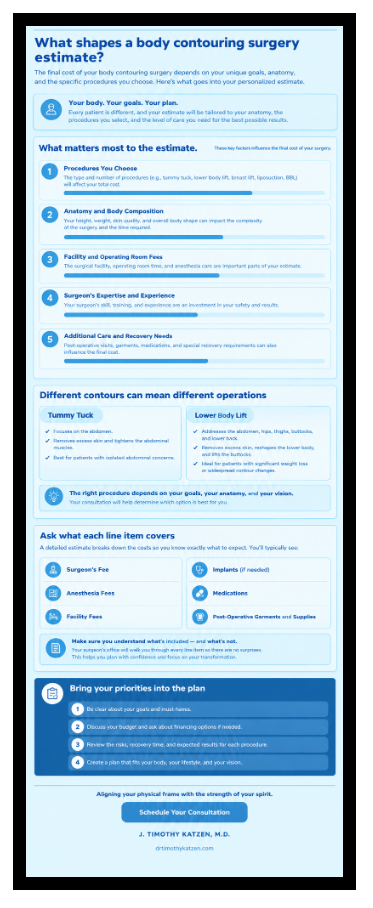
Figure #2: Picture of an infogram depicting what determines a body contouring surgery estimate.
How to Prepare for a Clear, Personalized Cost Discussion
A consultation is more useful when it connects your priorities with a specific surgical plan. You don’t need to arrive knowing the procedure name. A clear description of what concerns you, what you hope to address, and what you’d like explained can make the discussion more focused and the estimate easier to understand.
What information helps make the discussion useful?
Before your consultation, organize your questions and relevant history. This isn’t about choosing your own operation in advance. It’s about helping the surgeon understand your experience and priorities, then discussing what may be appropriate for your anatomy.
1. Describe your goals. Explain what you hope surgery will address, whether that’s excess skin, changes to a particular area, or concerns after a major transformation.
2. Identify the areas that matter most. Note where loose skin or other concerns affect you, and distinguish your primary priorities from areas you’re less concerned about.
3. Share relevant history. Discuss major weight changes, previous surgeries, and other details that may help the surgeon understand your circumstances and plan an assessment.
4. Ask how the proposed scope matches your goals. Invite a clear explanation of which areas the recommended procedure addresses and why that approach fits the discussion.
5. Bring questions about the written estimate. Mark any line items or terms you’d like explained, so you can review the plan and its components together.
What should the estimate discussion clarify?
Review the written estimate alongside the proposed procedure. Clarify which fees are identified, how they relate to the planned surgery, and whether any listed items are separate. Consider other possible categories based on what the estimate states, rather than assuming they are included or required.
- Confirm that the procedure and treatment areas described in the estimate match the plan discussed.
- Distinguish the practice’s included assessments and standard follow-up appointments from other listed cost categories.
- Discuss recovery planning and follow-up needs, including how the care pathway is expected to work, without assuming every possible item applies to you.
Insurance coverage can depend on your individual policy and clinical circumstances. Don’t assume a procedure will be covered or excluded based on general information alone. Review questions about your policy in light of your specific situation.
Thoughtful preparation can make a body contouring surgery cost discussion clearer and more personal, helping you understand the reasoning behind the proposed plan rather than focusing only on a single total. Explore a personalized body contouring consultation to discuss your goals, surgical options, and estimate.
A Personalized Body Contouring Cost Discussion at Dr. Katzen's Practice
Choosing surgery is a personal decision, often made after a long period of physical change. At J. Timothy Katzen, M.D., a board-certified plastic surgery practice, the discussion begins with your goals and the areas you want to address. The practice offers tummy tuck surgery alongside advanced body contouring. The aim is to understand the concerns behind your questions and develop a plan around your individual needs, not apply a standard procedure or estimate to every patient.
For patients after significant weight loss, the practice has experience with 360 lower body lift surgery. This is one specialized option, not a default recommendation. The appropriate scope depends on the patient’s anatomy, the distribution of excess skin, and the concerns being considered. An assessment connects those details to a proposed operation and gives the cost discussion a meaningful foundation.
How does an individualized plan connect goals with cost?
A useful conversation links three things: what you hope surgery will address, what the surgeon observes during assessment, and what procedure scope is proposed. For example, a patient focused on abdominal skin may discuss a different surgical plan from someone whose concerns extend more broadly around the lower torso. The point isn’t to decide by counting areas, but to understand why a particular plan may fit the concerns being evaluated.
Once the proposed surgery is clear, its estimate can be discussed in context. At the practice, surgical procedure fees include surgeon fees, pre-operative assessments, and standard post-operative follow-up appointments. These stated inclusions clarify part of the estimate. They don’t imply that every possible facility, anesthesia, medication, garment, or other charge is included. Consider the written estimate and surgical plan together to understand the identified components without assuming unlisted items apply.
There’s room to ask practical questions. You might want to understand which areas the proposed surgery addresses, what the included assessments involve, and how standard follow-up fits into the plan. Discussing recovery planning and follow-up needs can also help you think through the care pathway. No estimate can promise a particular result; it describes costs associated with a proposed plan based on an individual assessment.
What is the next step toward understanding your estimate?
Bring your priorities and questions to a personalized discussion. Sharing relevant weight-loss or surgical history can give the surgeon helpful context, while a clear explanation of your goals helps shape the conversation. You can then review the proposed procedure, the fees identified in the estimate, and the practice’s included surgeon fees, pre-operative assessments, and standard post-operative follow-up appointments.
The body contouring surgery cost is tied to the surgery being proposed and the findings of your individual assessment. A thoughtful discussion can help you understand how those pieces fit together and what the estimate represents. Discuss your body contouring goals with Dr. Katzen's team.
Take the Next Step Toward a Plan That Fits You
The most useful next step isn’t trying to make a broad online figure fit your circumstances. It’s bringing your questions, priorities, and hopes for surgery into a focused conversation. That can help you understand how a proposed plan relates to your needs and what information you still need before making a decision.
Approach the body contouring surgery cost discussion as part of planning for care, not as a standalone number. You deserve to understand the reasoning behind the recommended scope and feel comfortable taking time to consider your options. If you’ve experienced a significant physical transformation, your goals are personal, and your surgical discussion should make room for that.
J. Timothy Katzen, M.D.’s practice can help you explore the questions that matter to your individual plan. Discuss your goals and explore your surgical options.
A thoughtful conversation can turn uncertainty into a clearer path forward, one informed decision at a time.
Frequently Asked Questions
How much does body contouring surgery cost?
There isn’t one figure that applies to every patient. The body contouring surgery cost depends on the operation being considered, the areas treated, surgical complexity, and the care components identified in the plan. For a useful comparison, line up the proposed procedures and inclusions side by side. If two estimates describe different surgical scopes, their totals may not represent equivalent care.
What factors affect the cost of body contouring surgery?
Factors include the procedure selected, the extent of treatment, the complexity of the plan, and the professional or facility services involved. Your anatomy and goals help shape the surgical recommendation, too. For example, a plan focused on one area may differ from one addressing broader concerns. Look at the proposed operation and listed components together, rather than relying on a generic range to predict your personal estimate.
What is usually included in a body contouring surgery estimate?
An estimate may identify surgeon fees, anesthesia, facility charges, tests, garments, and prescriptions, but inclusions vary. At J. Don’t assume other categories are included or apply to your plan. Review the written estimate and note which items are stated, which are separate, and which aren’t listed.
Does insurance cover body contouring surgery after weight loss?
Coverage depends on your insurance policy, clinical circumstances, and the procedure being considered. Don’t infer coverage from a general online answer. Review your policy and ask your insurer how it evaluates the proposed procedure and what documentation it requires. A surgical consultation can clarify the planned operation, but the insurer determines coverage under your policy’s terms. Keep any coverage discussion separate from the surgeon’s estimate.
Is a lower body lift more expensive than a tummy tuck?
These are different operations, so their names alone don’t provide a reliable cost comparison. A tummy tuck focuses on the abdomen, while a lower body lift may address a broader area around the lower torso. To understand two estimates, compare the areas each plan proposes to treat, the extent of surgery, and the components listed. The appropriate procedure depends on your anatomy and goals, not a simple ranking.
Can combining body contouring procedures lower the total cost?
Combining procedures doesn’t automatically lower the total. It changes the proposed surgical plan, and whether a combination is appropriate depends on your goals, health, and the surgeon’s assessment. If combined surgery is being considered, discuss how the procedures fit together, what care the plan involves, and how the estimate is itemized. The decision should be based on an individualized surgical plan, not an assumed discount.
Why do body contouring surgery estimates vary between patients?
Patients differ in anatomy, areas of excess skin, priorities, and surgical needs. Those differences can lead to different proposed operations and scopes. The professional and facility components identified may also vary between plans. For example, two people who have lost weight may have different skin distribution and concerns. To interpret estimates fairly, compare the planned procedures and the specific items each estimate includes.
Is nonsurgical body contouring priced the same way as surgery?
No. Nonsurgical treatments and surgery are different types of care, with distinct plans and pricing structures. A nonsurgical service may be priced per session, while a surgical estimate relates to an operation and its associated components. Before comparing options, identify which approach is being discussed and what it is intended to address. Then review the relevant pricing details within that category, rather than comparing unlike totals.