360 Body Lift Before and After: A Definitive Guide to Total Torso Transformation
9/25/2026
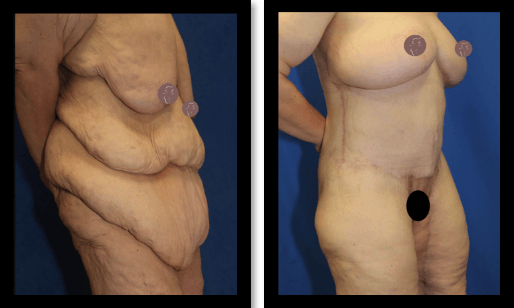
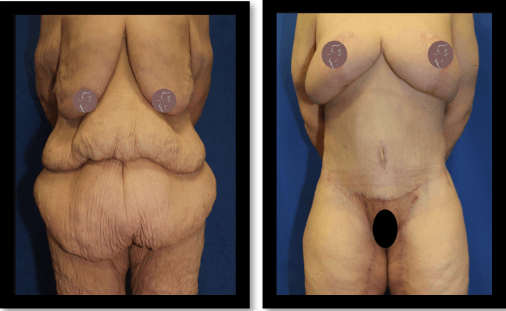
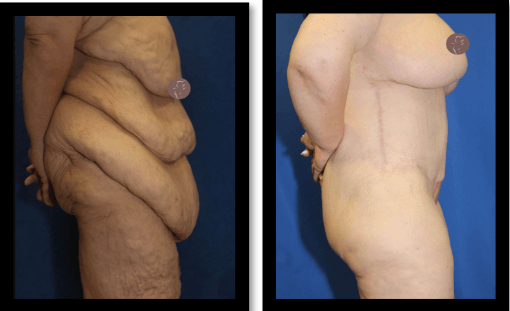
Figure 1: Before and after pictures of a 360 circumferential lower body lift in a massive weight loss 44-year-old female. Her maximum weight was 556 pounds. She had lost 350 lbs.
What if the most challenging phase of your weight loss journey isn't losing the weight, but living in the redundant tissue left behind? When you examine 360 body lift before and after transformations, you quickly realize you aren't alone in feeling unfinished. Persistent skin folds, chronic chafing, and ill-fitting clothes aren't a lack of discipline; they are structural realities that diet and exercise can no longer change.
You deserve both the physical comfort and the profound emotional closure that should accompany such an extraordinary personal victory. In this definitive guide, we will examine how a circumferential 360 body lift restores your midsection by treating the torso as a unified, continuous contour. You will learn precisely how this procedure tightens the abdominal wall, elevates the hips and buttocks, and strategically conceals surgical incisions. We will also analyze real patient outcomes and verified recovery protocols, equipping you with the clinical clarity needed to confidently navigate the final chapter of your weight loss odyssey.
Key Takeaways
- Understand how a circumferential belt lipectomy addresses the abdomen, flanks, and lower back simultaneously to create a continuous, unified contour.
- Learn how to critically evaluate 360 body lift before and after galleries by examining posterior angles, natural scar placement, and anatomical symmetry.
- Discover the dual-position surgical process that lifts the gluteal complex and thighs before restoring the anterior abdominal wall.
- Gain clarity on crucial recovery protocols, from managing surgical drains to utilizing compression garments for optimal soft-tissue adhesion.
- Recognize why treating post-weight loss body sculpting as the celebratory final step of your odyssey brings profound physical comfort and emotional closure.
Table of Contents
- What is a 360 Body Lift (Circumferential Abdominoplasty)?
- Analyzing 360 Body Lift Before and After Results
- The Surgical Journey: Engineering the 360 Transformation
- Recovery and Longevity: Sustaining Your 360 Results
- The Katzen Philosophy: The Final Step of Your Odyssey


What is a 360 Body Lift (Circumferential Abdominoplasty)?
A 360 body lift represents a complete anatomical restoration of the entire lower torso. Rather than isolating the front of the abdomen, this comprehensive procedure, clinically categorized as a circumferential abdominoplasty or belt lipectomy, removes a continuous band of redundant skin and underlying fat around your entire waistline. The incision encircles the midsection like a belt, allowing for a simultaneous tightening of the anterior abdominal wall, the lateral flanks, and the posterior lower back.
While individuals with minor postpartum skin laxity often do well with isolated procedures, patients presenting after massive weight loss (MWL) require a three-dimensional approach. Losing 50, 100, or more than 200 pounds deflates tissue in every direction. Evaluating real-world 360 body lift before and after cases shows that treating only the anterior surface leaves significant posterior tissue overhang untouched, failing to deliver the sleek waistline patients worked so hard to reveal.
The Mechanical Advantage of the 360 Approach
The engineering principle behind the 360 lift centers on balanced vector tension across the entire core. Addressing the full circumference eliminates the posterior skin apron that causes persistent lower back rashes and chafing. As excess tissue is resected posteriorly and anchored to the deep fascia, the surgical release creates an immediate upward suspension of the gluteal fold and lateral thighs. It lifts deflated buttocks and smoothens saddlebag areas, producing structural harmony that no anterior-only procedure can duplicate.
360 Body Lift vs. Standard Tummy Tuck
A standard tummy tuck utilizes an incision along the lower abdomen, terminating near the hip bones. When performed on someone with extensive post-bariatric laxity, this limited approach frequently pushes residual skin backward, causing thick lateral folds known as "dog ears." This creates an unnatural, square silhouette.
- Incision geometry: A traditional abdominoplasty stops at the anterior iliac crests, whereas a 360 lift extends completely around the sacrum, keeping the entire scar hidden beneath the underwear line.
- Torso contouring: For individuals who have shed substantial weight, the circumferential technique avoids a boxy, wide waist by carving inward curves along both flanks.
- Comprehensive change: Examining authentic 360 body lift before and after photographs demonstrates how this continuous tension creates a sleek, hourglass or athletic taper from front to back.
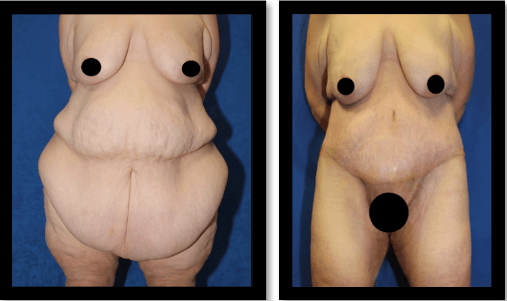
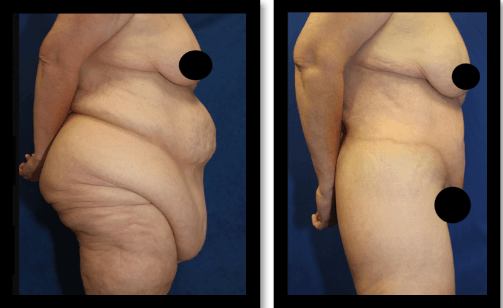
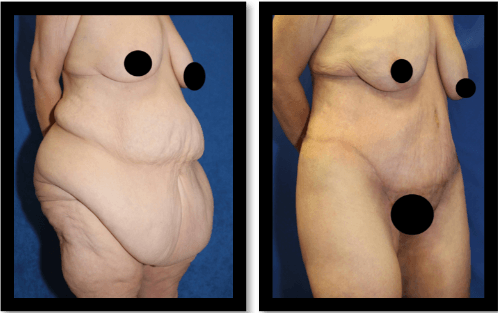
Figure 2: Before and after pictures of a 360 circumferential lower body lift in a massive weight loss 47-year-old female. Her maximum weight was 341 pounds. She had lost 133 lbs.
Analyzing 360 Body Lift Before and After Results
Evaluating a clinical gallery requires an objective, discerning eye, especially when your own physical comfort and aesthetic goals are at stake. When reviewing 360 body lift before and after portfolios, true surgical precision reveals itself through standardized angles, neutral patient posture, and consistent lighting rather than flattering shadows or strategic poses. A masterfully executed torso revision sculpts a tapered, organic waistline rather than an over-tightened, artificially flattened abdomen.
You should also track scar maturation across different postoperative intervals. At one to three months, incisions appear raised and erythematous as collagen rapidly remodels. By twelve months, meticulous layered closure should yield a thin, pale line sitting comfortably beneath typical undergarment borders.
What to Look for in the Frontal View
In the frontal perspective, inspect the reconstructed umbilicus. A meticulously sculpted belly button features a slight superior hood and a vertical orientation rather than an artificial, circular cutout. Examine the lateral hip curves to ensure balanced symmetry without bunching at the hips. Complete excision of the dependent pannus should re-establish natural abdominal anatomy while smoothly lifting the mons area without vertical tension.
Evaluating the Posterior and Lateral Results
Because this surgery redefines the lower body in three dimensions, lateral and rear angles provide the truest measure of technical skill. As highlighted in the American Society of Plastic Surgeons guide to body lift surgery, circumferential procedures simultaneously stabilize the pelvic girdle tissues and re-anchor descending gluteal skin.
- Gluteal suspension: Check for elevation of the gluteal fold and restoration of youthful projection to flattened buttocks.
- Posterior contour: Ensure deep lumbar folds, sacral rolls, and flank tissue have been completely smoothed away.
- Leg transition: Look for a continuous, uninterrupted line flowing from the outer waist into the lateral thighs.
If you are reviewing 360 body lift before and after results and seeking clarity on your individual options, you can explore surgical galleries at drtimothykatzen.com to see how customized circumferential contouring completes a personal transformation.
The Surgical Journey: Engineering the 360 Transformation
Executing a circumferential torso reconstruction demands rigorous operative architecture. Under general anesthesia, the procedure typically spans four to seven hours, requiring disciplined coordination to reshape the patient's entire core. Beyond removing redundant dermis, the surgical specialist performs an internal corset repair; plicating the separated rectus abdominis muscles (diastasis recti) to pull the core wall flat and stable. Incisions are plotted with geometric precision along the iliac crests and lower sacrum, ensuring the resulting scar settles beneath modern swimwear and undergarment styles.
The Technical Complexity of Circumferential Surgery
The hallmark of this operation is the dual-position operative strategy. The patient begins prone (face-down), allowing the surgical team to release, excise, and suspend the posterior lumbar tissue and gluteal complex. After securing the back, the surgical team carefully repositions the patient into a supine (face-up) orientation to resect the anterior apron and reposition the umbilicus. Preserving cutaneous blood supply and vascular integrity during this complex repositioning requires meticulous post-bariatric specialization.
Combining Liposuction with Skin Excision
A frequent point of confusion among prospective patients is equating circumferential skin excision with standalone "Lipo 360." While liposuction alone removes localized adipose tissue, it relies on youthful skin elasticity to retract. In post-massive weight loss patients, deflated dermis has lost its structural recoil. Direct surgical excision is mandatory to eliminate redundant tissue folds that cause discomfort. Surgeons selectively utilize conservative liposuction as a sculpting adjunct, feathering transitional zones over the ribs and flanks to establish continuous, three-dimensional contours.
When studying authentic 360 body lift before and after results, the difference between hollowed deflation and anatomic reconstruction is clear. Direct dermal resection restores functional mobility, completing the personal odyssey from chronic skin irritation to active, unrestrained living.