Can CoolSculpting Replace a Tummy Tuck? The Expert Comparison for 2026
10/16/2026
What if the "easy" path to a flat stomach is actually the longest detour you could take? It’s a question I hear often during my consultations: can coolsculpting replace a tummy tuck for someone who finally wants to feel confident? You’ve likely spent years on a dedicated personal odyssey, perhaps aided by the recent surge in GLP-1 weight loss medications, only to find that stubborn fat or loose skin remains. It's exhausting to reach the finish line of a major transformation but feel like your body is still hiding the person you’ve become.
I recognize that the prospect of surgery can feel daunting, and the promise of a non-surgical fix is incredibly tempting. You want a solution that respects your time, your budget, and your health. This article explores the clinical realities of fat freezing versus surgical abdominoplasty to ensure you make an informed choice for your unique anatomy. We will examine how each procedure addresses fat, skin laxity, and muscle separation to help you achieve a truly restorative, life-changing result.
Key Takeaways
- Understand the clinical limitations of fat freezing to determine if can coolsculpting replace a tummy tuck for your specific anatomy and aesthetic goals.
- Learn the fundamental difference between non-invasive fat reduction and the surgical removal of excess skin combined with internal muscle repair.
- Discover how to use the "Pinch Test" versus the "Hang Test" to identify whether your concern is subcutaneous fat or skin laxity.
- Recognize why a tummy tuck is often the necessary celebratory final step for those seeking a flat profile after significant weight loss or pregnancy.
- Identify the structural signs of rectus diastasis that require surgical intervention rather than non-surgical cooling treatments.
Table of Contents
- Understanding the Fundamental Differences Between CoolSculpting and Tummy Tuck
- The Science of Fat Reduction vs. Surgical Body Contouring
- Why CoolSculpting Cannot Replace a Tummy Tuck for Skin Laxity or Muscle Repair
- Determining Your Ideal Procedure: A Patient Evaluation Framework
- Achieving Your Final Transformation: Why a Professional Consultation Is Essential


Understanding the Fundamental Differences Between CoolSculpting and Tummy Tuck
When you stand in front of the mirror, you're looking for a specific, meaningful change. Many patients come to me with the same hopeful question: can coolsculpting replace a tummy tuck? It's a natural inquiry for anyone who wants to avoid the recovery time associated with surgery. However, to find the right answer, we have to look closely at your physical history and anatomical needs. These two procedures aren't just different methods; they solve entirely different problems within the body's geometry.
What Is CoolSculpting? (Cryolipolysis Explained)
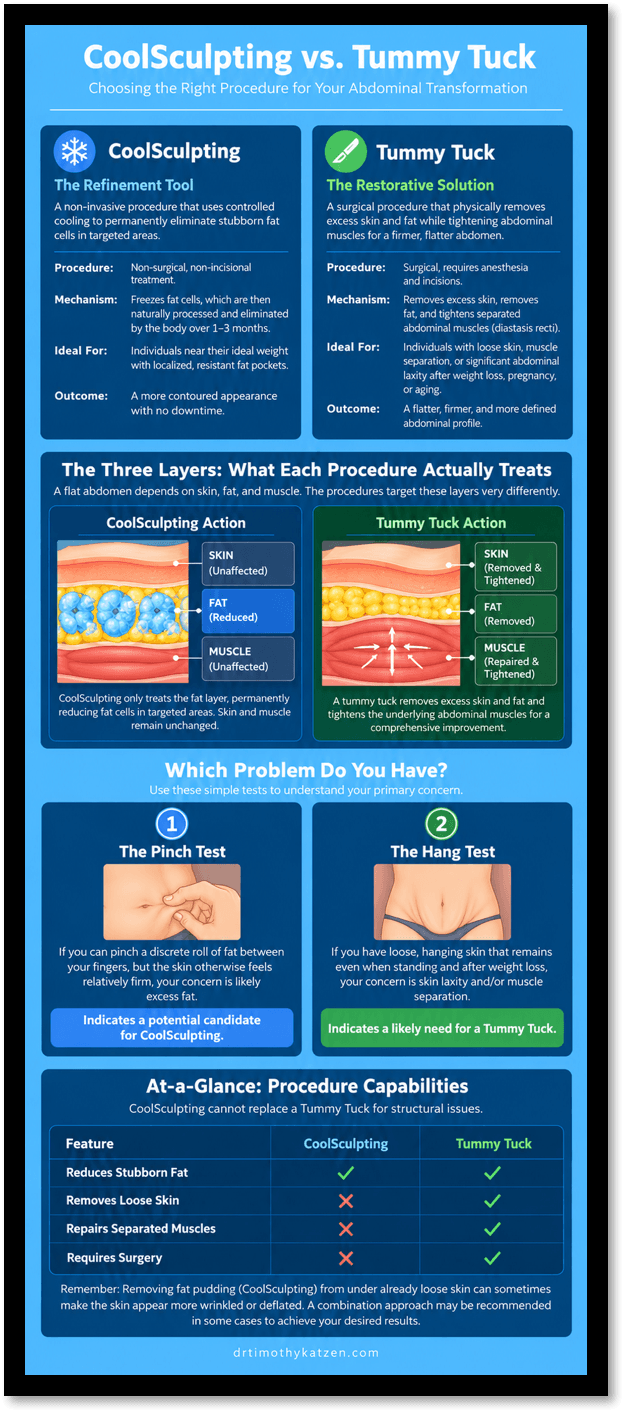
I view CoolSculpting as a precision tool for refining an already healthy silhouette. The technology relies on Cryolipolysis, a process that freezes fat cells to a temperature where they undergo natural cell death. Over several weeks, your body's lymphatic system processes and eliminates these cells. This is ideal for a person who is already fit but has a small "pooch" that won't budge. It's a refinement tool, not a reconstruction tool. It doesn't have the power to lift sagging tissue or tighten the internal corset of your muscles. It's purely about volume reduction in localized areas.
What Is a Tummy Tuck? (Abdominoplasty Explained)
On the other hand, a tummy tuck is a restorative event. It's designed for those who have undergone major life changes, such as significant weight loss or multiple pregnancies. I don't just remove fat; I excise the excess, inelastic skin that can cause physical discomfort and emotional distress. Crucially, I also address rectus diastasis. This is a condition where the abdominal muscles have stretched apart, creating a permanent bulge that no amount of crunches or fat freezing can fix. By using internal sutures to pull these muscles back together, I can restore the structural integrity of your core. This is a structural procedure for comprehensive contouring.
Choosing a non-surgical route is a choice about the process, but it shouldn't be a compromise on your ultimate goal. If you have loose skin or muscle separation, choosing a fat-reduction treatment will likely leave you frustrated. You might see a slight reduction in volume, but the underlying structural issues will remain. When people ask if can coolsculpting replace a tummy tuck, they're often seeking the flat, toned profile that only surgery can provide. A tummy tuck is the definitive solution for a comprehensive transformation, providing the final, celebratory step of your personal odyssey.
The Science of Fat Reduction vs. Surgical Body Contouring
I often explain to my patients that achieving a flat midsection is a matter of managing three distinct layers: the skin, the fat, and the underlying muscle. When considering if can coolsculpting replace a tummy tuck, we have to look at how each procedure interacts with these biological layers. While fat reduction is a shared goal, the mechanism of action and the final anatomical result differ profoundly. One relies on a slow metabolic process, while the other is an immediate structural restoration.
How CoolSculpting Affects Adipose Tissue
CoolSculpting targets the middle layer of this architecture. During a session, the applicator crystallizes fat cells, triggering a biological process called apoptosis. Over the next 1 to 3 months, your body's natural inflammatory response works to clear these dead cells through the lymphatic system. On average, you can expect a 20-25% fat reduction in the treated area per session. This is a subtle thinning of the adipose layer. It's a gentle change that happens behind the scenes, relying entirely on your body’s ability to process and eliminate the targeted tissue.
However, there is a biological limit to what fat reduction alone can achieve. While CoolSculpting can diminish the thickness of the fat layer, it possesses no mechanism to shorten or tighten overstretched skin. In fact, if your skin has already lost its elasticity due to age, pregnancy, or weight loss, removing the fat "padding" underneath can sometimes make the skin look more wrinkled or deflated. It's like removing the stuffing from a cushion without shrinking the fabric; the result is a loss of shape rather than a firmer profile.
How a Tummy Tuck Restores Anatomical Proportions
A tummy tuck addresses all three layers of the abdominal wall simultaneously. I don't just remove fat; I manually redrape the skin to create a smooth, taut appearance that fat freezing cannot replicate. For patients with a pannus, or "skin apron," surgery is the only clinical path to removal. During the procedure, I also tighten the fascia and muscle layer. This internal repair acts like a permanent corset, pulling the abdominal wall flat and restoring a youthful, geometric proportion to your torso.
This surgical approach offers a permanent and immediate removal of both excess fat and skin. It’s a comprehensive solution for those who have completed their weight loss journey and are ready for the final, celebratory step. If you're unsure which layer is causing your concern, a professional evaluation of your body contouring options can provide the clarity you need to move forward with confidence. Understanding these scientific differences ensures you don't spend time and resources on a treatment that isn't designed to fix your specific anatomical challenges.
Why CoolSculpting Cannot Replace a Tummy Tuck for Skin Laxity or Muscle Repair
I see many patients who have achieved incredible weight loss milestones, only to be met with a frustrating reality: their skin hasn't kept pace with their new, smaller frame. A common misconception I encounter is the belief that fat freezing somehow "tightens" the stomach. When patients ask if can coolsculpting replace a tummy tuck, they're often hoping for a shortcut to a flat profile. However, if your struggle involves loose skin or a protruding core, fat reduction alone will likely leave you disappointed. It's a matter of addressing the correct anatomical layer to achieve the harmony you deserve.
The Limitations of Non-Invasive Skin Tightening
Skin elasticity has a biological point of no return. Once the collagen and elastin fibers have been stretched beyond their limit, whether by pregnancy or significant weight gain, they cannot simply "snap back" through cooling or energy-based treatments. I often describe this as the "deflated balloon" effect. If we remove the fat (the air) without removing the excess skin (the rubber), the result is a midsection that looks more wrinkled and saggy than before. While non-invasive tools might offer a microscopic improvement in surface texture, they cannot mechanically shorten overstretched tissue. Only a surgical excision can remove that redundant skin and redrape the remaining tissue for a taut, youthful contour.
The Necessity of Muscle Plication
For many of my patients, the "bulge" they see in the mirror isn't fat at all; it's a structural failure of the abdominal wall known as rectus diastasis. This occurs when the vertical muscles of the abdomen separate, usually due to the intense internal pressure of pregnancy or weight gain. No amount of fat freezing can reach these deep layers. In a tummy tuck, I perform what is known as muscle plication. I meticulously cinch these muscles back together using permanent internal sutures. Think of it as restoring an internal corset that has been unlaced. This repair is what creates a truly flat, firm foundation. Without it, your stomach will continue to protrude regardless of how many fat cells you freeze.
If you've undergone a significant physical transformation, you've already done the hard work of losing weight. You've navigated a long personal odyssey to reach this point. Choosing a procedure that only addresses fat when your body requires structural repair can feel like a setback. When we evaluate whether can coolsculpting replace a tummy tuck for your specific needs, we're really asking if you want a minor reduction or a total restoration. For those with skin laxity and muscle separation, surgery isn't just an option; it's the only clinical path to a celebratory, life-changing result.
Determining Your Ideal Procedure: A Patient Evaluation Framework
Before we meet for a formal consultation, I want to provide you with a way to listen to your body’s unique signals. Deciding if can coolsculpting replace a tummy tuck for your specific needs often comes down to a simple physical assessment of your tissue and muscle structure. While both procedures aim to refine your midsection, they are designed for different anatomical starting points. By performing a few simple tests at home, you can gain a clearer understanding of whether your concern is a matter of volume or a matter of structure.
The Self-Evaluation Checklist
I recommend my patients start with the "Pinch Test" versus the "Hang Test." To perform the Pinch Test, gently grasp the tissue in your target area. If you can isolate a distinct pocket of fat while the skin remains firm and elastic, you may be a candidate for fat freezing. However, the Hang Test is often more revealing for those who have undergone significant weight loss. If you lean forward and the tissue folds, sags, or hangs away from the body, you are dealing with skin laxity. As we discussed previously, non-invasive cooling cannot retract this redundant tissue.
Next, assess your muscle integrity. Stand sideways in front of a mirror and relax your stomach. If you have a persistent bulge that remains even when you are at your goal weight, or if you notice a "doming" effect when you perform a crunch, you likely have rectus diastasis. This internal separation of the abdominal wall is a structural issue. No amount of fat reduction can pull those muscles back into a flat, geometric plane. Only the internal sutures of a tummy tuck can restore that firm foundation.
Comparing Recovery, Longevity, and ROI
When weighing your options, it's vital to consider the trade-off between recovery time and the finality of your results. CoolSculpting is often marketed for its zero-downtime appeal, which is attractive for busy lifestyles. However, achieving a visible change often requires multiple sessions, and the results are limited to a 20-25% reduction of fat in the treated area. For many, the cumulative cost of these sessions can approach the investment of a surgical procedure without ever addressing the skin or muscle issues that cause the most insecurity.
A tummy tuck requires a more significant commitment, typically involving a 2-4 week recovery period. Despite this, the return on investment is often much higher for my patients. It is a singular, definitive event that removes the "skin apron" and repairs the abdominal wall in one step. This procedure serves as the celebratory final step of your personal odyssey, providing a permanent transformation that non-surgical tools simply cannot replicate. If your self-assessment suggests that you need a structural change to feel truly whole, I encourage you to explore a tummy tuck with a specialist who understands the complexity of post-transformation bodies.
Achieving Your Final Transformation: Why a Professional Consultation Is Essential
I view every consultation as a clinical deep-dive into your personal odyssey. You’ve likely spent years, perhaps even decades, working toward the version of yourself that you see today. Whether your weight loss was achieved through traditional means or the recent advancements in GLP-1 medications, you deserve a result that honors that effort. When we sit down together, we aren't just talking about a medical procedure; we're mapping out the final, celebratory milestone of your transformation.
A common point of confusion in the current aesthetic market is whether can coolsculpting replace a tummy tuck for someone with a significant amount of loose skin. While fat reduction has its place in minor refinement, my meticulous approach to body contouring focuses on the entire three-dimensional geometry of your torso. I often look for a "360" result, which might involve combining a tummy tuck with targeted liposuction to ensure your silhouette is balanced and harmonious from every angle. This level of comprehensive planning is something a non-surgical clinic simply cannot provide.
The Value of a Board-Certified Specialist
Choosing a board-certified plastic surgeon ensures you receive an unbiased recommendation based on clinical necessity rather than available equipment. Because I perform the full spectrum of body contouring, I don't have to fit your needs into the limitations of a specific machine. My priority is your safety and the precision of your outcome. In a hospital-grade surgical environment, we can address complex structural issues like rectus diastasis and the removal of a large pannus with a level of care that prioritizes your long-term health. Each surgical plan is personalized to your unique anatomy, ensuring that the final result feels like a natural extension of your identity.
Your Journey Toward a New Silhouette
I encourage you to prioritize your long-term well-being over temporary shortcuts. It's tempting to look for the path of least resistance, but a true transformation requires a dedicated partner who understands the biological and emotional complexities of your journey. My person-centric philosophy is rooted in profound empathy. I understand the weight of carrying excess skin after you've already done the hard work of losing weight. This is your moment of renewal, a chance to finally see the results of your hard work without the interference of loose tissue or muscle separation. I invite you to schedule a consultation with Dr. Katzen to determine your best path forward. Let's turn this final step into the celebration you’ve earned.
Embarking on Your Final Step Toward Renewal
You've traveled a long road to reach this stage of your physical transformation. While the question of whether can coolsculpting replace a tummy tuck is common, the answer ultimately depends on the structural integrity of your abdominal wall. We have explored how fat freezing addresses volume, whereas a tummy tuck restores the very foundation of your core by repairing separated muscles and removing excess skin. Choosing the right path means looking beyond temporary fixes and prioritizing a result that matches the magnitude of your personal odyssey.
As a board-certified specialist with an international reputation for life-changing results, I am dedicated to helping you find the solution that provides the highest return on your emotional and physical investment. My expertise in massive weight loss body contouring ensures that your safety and aesthetic goals are at the forefront of every clinical decision. I invite you to begin your transformation with a personalized consultation to see which procedure truly aligns with your vision. You deserve to feel as strong and vibrant as the person you've worked so hard to become
Frequently Asked Questions
Is CoolSculpting a good alternative to a tummy tuck for loose skin?
CoolSculpting is not a viable alternative for loose skin because its technology is specifically designed for fat reduction through cryolipolysis. It lacks the biological mechanism to retract or tighten overstretched tissue. If you choose this non-invasive route when skin laxity is your primary concern, the results will likely be disappointing. A tummy tuck remains a surgical option that removes excess skin to address abdominal skin laxity after significant weight loss.
Can I get a tummy tuck if I have already had CoolSculpting?
You can generally consider a tummy tuck after having CoolSculpting treatments, but your surgeon should evaluate your individual circumstances. Previous non-invasive treatments do not automatically rule out surgery. When we evaluate whether CoolSculpting can replace a tummy tuck for your specific anatomy, we'll discuss how surgery may address excess skin and abdominal muscle separation that cooling treatments cannot correct.
Does CoolSculpting fix the "pooch" caused by pregnancy?
CoolSculpting cannot correct a pregnancy-related abdominal bulge if the underlying cause is rectus diastasis, a separation of the abdominal muscles. While CoolSculpting may reduce some subcutaneous fat, it does not repair separated muscles. A tummy tuck may include surgical muscle repair when appropriate. A qualified surgeon can assess the cause of your abdominal bulge and discuss suitable options.
Which is more expensive in the long run: CoolSculpting or a Tummy Tuck?
CoolSculpting generally has a lower initial cost per session, but multiple treatments may be needed, increasing the total expense. A tummy tuck typically costs more upfront and involves surgery, anesthesia, and recovery. The procedures also address different concerns: CoolSculpting reduces targeted fat, while a tummy tuck can remove excess skin and may repair separated abdominal muscles. Ask your provider for a personalized cost estimate based on your goals and the treatment recommended.
How much fat do I need to have to qualify for a tummy tuck?
There is no specific minimum amount of fat required to qualify for a tummy tuck. The procedure primarily addresses excess abdominal skin and may correct muscle separation, rather than simply removing fat. People at or near their goal weight may still consider surgery if they have persistent loose skin or abdominal wall concerns. A qualified plastic surgeon can evaluate your anatomy, overall health, and goals to determine whether the procedure is appropriate.
What happens if I get CoolSculpting and then lose more weight?
If you lose more weight after CoolSculpting, your body contours may change, and existing loose skin may become more noticeable. Fat reduction does not guarantee that skin will tighten to match your new proportions. The outcome depends on factors such as skin elasticity, the amount of weight lost, and your individual anatomy. If excess skin becomes a concern, a consultation can help you understand the available options.
Can CoolSculpting cause skin to sag more?
CoolSculpting is designed to reduce targeted fat, not tighten loose skin. After fat reduction, existing skin laxity may become more noticeable because there is less volume beneath the skin. The effect depends on your skin elasticity and the amount of fat treated. A qualified provider should assess your skin quality and treatment goals before recommending a procedure.
How do I know if my stomach bulge is fat or muscle separation?
It can be difficult to determine the cause of an abdominal bulge through self-assessment alone. Subcutaneous fat is the soft tissue beneath the skin, while rectus diastasis involves separation of the abdominal muscles. Both can occur together. A healthcare professional can examine your abdomen and help identify the likely cause. Understanding whether the concern involves fat, excess skin, or muscle separation is important when deciding whether CoolSculpting can replace a tummy tuck for your goals.