The Functional & Life-Changing Benefits of Diastasis Recti Repair in 2026
8/4/2026
What if the persistent bulge in your midsection isn't a sign of unfinished weight loss, but a structural gap that no amount of exercise can bridge? If you've achieved your goal weight but still struggle with a "pooch," chronic lower back pain, or the frustration of leaking when you jump or sneeze, you aren't alone. These symptoms often point to a physical separation of the abdominal muscles that requires a clinical, structural solution. Understanding the benefits of diastasis recti repair is the first step toward reclaiming the geometric foundation of your body.
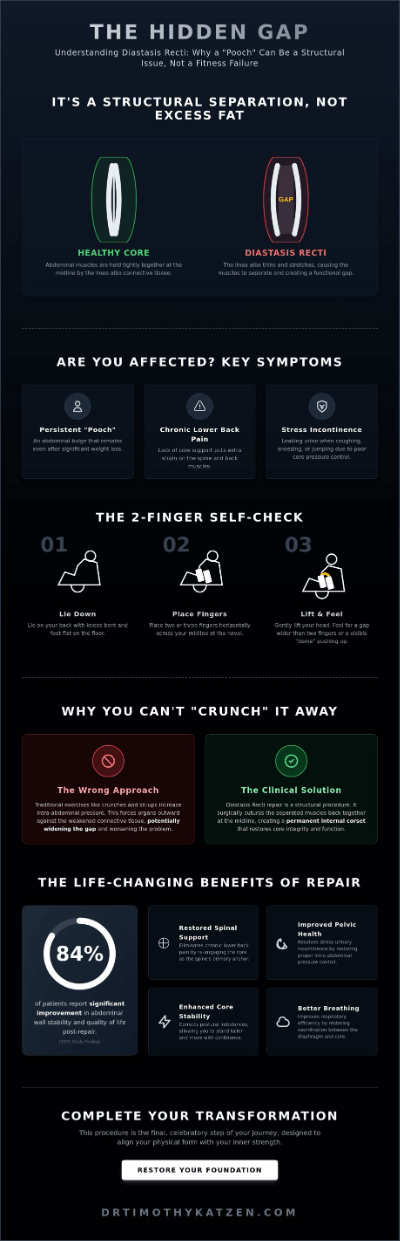
I understand that this journey is about more than just aesthetics; it's about the profound restoration of your physical integrity. You've done the hard work of transformation, yet your core may still feel weak or disconnected. A 2025 study found that nearly 84% of patients reported significant improvements in abdominal wall stability and quality of life following surgical repair. We'll explore how a Tummy Tuck provides the necessary internal reinforcement to eliminate chronic discomfort and provide the flat, stable profile that reflects your dedication. It's time to move past the frustration and complete your physical odyssey with a core that is as strong as it looks.
Key Takeaways
- Understand why persistent abdominal bulging is often a structural issue of the connective tissue rather than a lack of fitness or diet.
- Discover the functional benefits of diastasis recti repair, including the restoration of spinal support and the resolution of chronic lower back pain.
- Learn why traditional core exercises can often widen the muscle gap and why clinical intervention is necessary to restore your core's geometric integrity.
- Explore how a Tummy Tuck creates a permanent internal corset, providing a flat and stable abdominal wall that reflects your hard work.
- Recognize this procedure as the final, celebratory step of your personal transformation journey, designed to align your physical form with your inner strength.
Table of Contents
- Understanding Diastasis Recti: When the Core Loses Its Integrity
- The Functional Benefits: Resolving Pain and Restoring Movement
- Repair vs. Exercise: Why You Cannot "Crunched" Your Way to Healing
- The Integrated Transformation: Diastasis Repair in a Tummy Tuck
- Restoring Your Foundation: The Dr. Katzen Partnership
Understanding Diastasis Recti: When the Core Loses Its Integrity
Many of my patients come to me after a monumental weight loss journey, feeling a mix of pride and confusion. They've shed the pounds and reached their goal weight, yet their midsection doesn't reflect their effort. This isn't a failure of willpower or a lack of exercise. It's often a structural issue where the abdominal wall has lost its geometric tension. For those beginning their research, Understanding Diastasis Recti involves recognizing that the abdominal wall is a complex system, not just a layer of muscle. When the linea alba, the connective tissue holding your "six-pack" muscles together, thins and stretches, the muscles migrate outward. This creates a gap that allows internal organs to press against the abdominal wall, resulting in a persistent bulge.
It's vital to distinguish between fat accumulation and structural separation. Subcutaneous fat sits on top of the muscle, while diastasis recti is a failure of the "wall" itself. Even with a low body fat percentage, a separated core will protrude, making you look unfinished after weight loss. One of the primary benefits of diastasis recti repair is that it addresses this internal bowing that diet alone cannot touch. By restoring the midline, we don't just flatten the stomach; we restore the body's internal support system.
How to Identify Diastasis Recti: A Self-Check Guide
You can perform a simple assessment at home to check for muscle separation. Lie on your back with your knees bent and feet flat on the floor. Place your fingers horizontally across your midline, just above the belly button. Slowly lift your head and shoulders off the floor as if starting a crunch. If you feel a gap wider than two fingers, or if you notice a "ridge" or "dome" rising up along the center of your stomach, these are classic signs of a compromised core. This "doming" occurs because the stretched tissue can no longer contain the internal pressure of your abdomen during movement.
Causes Beyond Pregnancy: The Weight Loss Connection
While often associated with pregnancy, diastasis recti is incredibly common in the weight loss community. Years of carrying internal visceral fat create significant outward pressure, stretching the linea alba much like a balloon. When that fat is lost, the tissue doesn't always "snap back" into place. It's a deflated balloon effect where the skin is loose and the underlying structure remains distended. Genetics and collagen quality also play a role; some individuals naturally have thinner connective tissue that is more prone to permanent stretching. Recognizing these benefits of diastasis recti repair is the first step toward a functional, stable abdominal wall that finally matches your hard-earned transformation.
The Functional Benefits: Resolving Pain and Restoring Movement
I often see patients who have triumphed over significant weight loss only to find their bodies still feel disconnected. While the aesthetic change is rewarding, the true benefits of diastasis recti repair lie in the restoration of your body's structural synergy. Your core isn't just a set of muscles; it's the anchor for your entire skeleton. When the midline is compromised, your spine loses its primary support system. This often results in chronic lower back pain that no amount of physical therapy seems to resolve. By surgically reuniting the rectus muscles, I help you correct the postural imbalances caused by a "lazy" anterior core, allowing you to stand taller and move with renewed confidence.
This structural failure also impacts your breathing. A stabilized abdominal wall is essential for maintaining proper intra-abdominal pressure, which directly influences your respiratory efficiency. The Diastasis Recti Medical Definition describes this condition as the widening of the gap between the two sides of the rectus abdominis muscle. When we close this gap, we restore the delicate coordination between your diaphragm, core, and pelvic floor. It's about bringing your body back into geometric balance, ensuring every breath and movement feels supported rather than strained.
The Pelvic Floor Connection: Ending Stress Incontinence
One of the most life-changing benefits of diastasis recti repair is the resolution of stress urinary incontinence. Many of my patients have lived with the quiet anxiety of leaking while laughing, sneezing, or exercising. Think of your core as a pressurized canister; if the front wall is weak, the pressure pushes downward on the pelvic floor. During a Tummy Tuck, I perform muscle plication to tighten this wall, providing a stable "roof" for your pelvic organs. This restoration allows you to return to high-impact activities and social situations without fear. If you're ready to reclaim this level of freedom, discussing your options for repair is a powerful next step in your journey.
Gastrointestinal Health and Hernia Prevention
Beyond pain and movement, a separated core affects your internal health. Patients often report chronic bloating or a constant feeling of "stomach pressure" when their muscles are split. Proper abdominal wall tension is necessary for efficient digestive transit. This repair also serves as a critical preventative measure. A weakened midline is a prime location for ventral hernias to develop, as internal tissues can push through the thinned connective tissue. By reinforcing this area, we protect your health and prevent future complications, ensuring your transformation is as functional as it is beautiful.
Repair vs. Exercise: Why You Cannot "Crunched" Your Way to Healing
I meet many individuals who have spent countless hours in the gym, dedicated to planks and crunches, only to find their midsection still "domes" or "cones." It's a common misconception that a stronger core will eventually close the gap. While exercise can strengthen the individual muscle bellies, it cannot repair the thinned, overstretched connective tissue known as the linea alba. In fact, performing traditional abdominal exercises like crunches can often worsen the condition by increasing intra-abdominal pressure and pulling the rectus muscles further apart. One of the key Functional Benefits of Repair is that it addresses the structural failure that physical therapy alone cannot reach.
The limitation of physical therapy lies in its focus on muscle activation rather than structural integrity. You can have the strongest rectus abdominis muscles in the world, but if the bridge between them is broken, the core remains unstable. Surgical plication is the only definitive way to permanently shorten and reinforce that overstretched tissue. We aren't just making the muscles work better; we're physically resetting the foundation of your torso. This is why the benefits of diastasis recti repair are so profound for those who have exhausted every conservative option. It's about providing the mechanical stability that your body can no longer produce on its own.
The Biomechanics of the Gap
Think of your abdominal wall like a trampoline. The muscles are the springs, but the linea alba is the fabric. If that fabric is torn or severely overstretched, tightening the springs will only pull the hole wider. Your Transverse Abdominis (TVA) is your body's natural corset, and while it's vital for stabilization, it cannot pull the two sides of the Rectus Abdominis back together once the midline has lost its elasticity. Surgical intervention is the gold standard for connective tissue failure because it manually restores the anatomical proximity of the muscles.
When to Choose Surgery Over Therapy
Choosing surgery is often the final step in a long personal odyssey. Candidates for repair usually present with a gap wider than two centimeters, persistent lower back discomfort, or stress incontinence that hasn't responded to pelvic floor therapy. There is a significant psychological toll to "doing everything right" and still seeing a pregnant-looking pooch in the mirror. I view this procedure as a functional tool for restoration rather than an aesthetic shortcut. It's about ensuring your physical form finally aligns with the strength you've built through your weight loss journey. By securing the midline, we unlock the true benefits of diastasis recti repair, allowing your core to function as the powerful anchor it was meant to be.
The Integrated Transformation: Diastasis Repair in a Tummy Tuck
I believe that a true physical transformation requires a comprehensive approach that addresses both the surface and the structural foundation. When I perform a Tummy Tuck, the muscle repair isn't an afterthought; it's the core of the procedure. By integrating the repair into the surgery, I can address excess skin and muscle laxity in one seamless event. This creates what I often call the "internal corset," which is the permanent realignment of the rectus muscles using high-strength, permanent sutures. This internal reinforcement is a vital part of the benefits of diastasis recti repair, providing the tension necessary for a flat, functional midsection that reflects your hard work.
Recovery is a period of transition that requires patience and adherence to clinical guidance. Most patients require two to three weeks off from professional responsibilities to allow the initial healing to take place. While you'll feel the stability of the repair almost immediately, returning to strenuous exercise typically takes eight to twelve weeks. This methodical approach ensures that the internal corset is fully settled and secure before you begin testing your new core strength. If you're ready to see how this integrated approach can finalize your transformation, you can schedule a consultation to discuss your Tummy Tuck options.
The 360 Degree Approach for Post-Weight Loss Patients
For my patients who have achieved significant weight loss, a standard Tummy Tuck might only solve part of the equation. We often look at a 360 lower body lift to restore the entire trunk’s geometry. This allows us to lift and tighten the skin around the entire circumference of the body while simultaneously securing the midline. It's the final celebratory step of a long personal journey, ensuring your body's silhouette matches the strength you've build. By combining muscle repair with skin excision, we achieve a result that is both structurally sound and aesthetically pleasing.
Surgical Precision: The Meticulous Art of Plication
Surgical plication is a meticulous art that requires anatomical precision. I ensure the repair is tight enough to restore full core function but calibrated to allow for natural, comfortable movement. The technique involves placing sutures in a way that prevents recurrence while creating a flat, stable profile. This precision is what allows for the long-term benefits of diastasis recti repair, giving you a foundation that stands the test of time. The internal corset is the permanent realignment of the rectus muscles. This process ensures that the gap remains closed even under the pressure of daily activities, providing a lasting solution for core integrity.
Restoring Your Foundation: The Dr. Katzen Partnership
I view your surgical procedure as the final, celebratory step of a long personal odyssey. You've already navigated the difficult path of significant weight loss or post-pregnancy recovery, and now it's time for your physical foundation to reflect that inner strength. The benefits of diastasis recti repair represent more than a flat stomach; they are the restoration of your body's structural integrity and your own sense of wholeness. Patients often seek my expertise from national and international locations because they require a specialist who understands the nuanced geometry of post-transformative body sculpting. My practice is built on a foundation of trust and safety, ensuring you feel supported before you even step into the operating room.
Personalized care means I am your dedicated partner in this process. We don't just focus on the technical aspects of the Tummy Tuck; we address the emotional recovery that follows such a profound physical change. My commitment to anatomical precision ensures that your results are not only beautiful but also functionally superior, allowing you to move through the world with a renewed sense of safety and trust in your own body. This meticulous approach is designed to demystify the complexities of the procedure, providing you with a clear, logical path toward your final result.
A Dedicated Partner in Your Transformation
My philosophy prioritizes the person over the procedure. I recognize that every individual arrives with a unique history and specific lifestyle goals. My experience with complex body contouring allows me to navigate the challenges of massive weight loss with a high degree of excellence. By focusing on the functional benefits of diastasis recti repair, I empower you to reclaim an active life. Whether your goal is returning to high-impact athletics or simply living without chronic back pain, we work together to ensure your core is a reliable anchor for all your future endeavors. This partnership is about more than a single event; it's about your long-term well-being and physical freedom.
Taking the Final Step The decision to undergo surgery is a significant milestone in your transformative journey. It's essential to choose a board-certified specialist who views muscle repair as a fundamental component of physical health rather than a generic aesthetic standard. During our initial consultation, we'll discuss your history, evaluate the degree of muscle separation, and map out a path that restores your core's stability. This is the moment where your hard work and clinical expertise meet to finalize your transformation and resolve the discomfort that has held you back. To begin this final chapter and reclaim your strength, Schedule your consultation to restore your core strength and confidence.
Reclaiming Your Physical Integrity
Your journey toward a healthier, stronger version of yourself deserves a foundation that supports your new lifestyle. We've explored how a separated core is a structural concern that requires a clinical solution rather than more time in the gym. By addressing the midline through surgery, you unlock the full benefits of diastasis recti repair, which include the resolution of chronic back pain and the restoration of your body's geometric balance. This isn't just about a flat profile; it's about reclaiming a life free from the limitations of core instability.
As a board-certified plastic surgeon with over 25 years of experience, I specialize in the complex body contouring required after massive weight loss, including advanced 360 lower body lifts. I am committed to being your partner in this final, celebratory step of your odyssey. My goal is to ensure your physical form finally aligns with your internal strength through meticulous anatomical precision. You don't have to live with a core that feels unfinished or disconnected. Begin your transformation journey with Dr. Katzen today and step into a future defined by confidence and comfort. Your body has worked hard for you; it's time to give it the structural support it deserves.
Frequently Asked Questions
Is diastasis recti repair covered by insurance?
Insurance coverage for this procedure is generally limited because most carriers classify it as a cosmetic intervention. However, coverage may be possible if the repair is deemed medically necessary to address specific functional impairments. This typically requires documentation of a hernia, chronic skin infections in skin folds, or persistent lower back pain that hasn't responded to physical therapy. It's important to note that many 2026 policies, including those from UnitedHealthcare, explicitly exclude muscle repair when performed alongside other abdominal procedures.
How long is the recovery after muscle repair surgery?
You should plan for a significant recovery period to ensure the structural integrity of your repair. Most patients return to light professional duties within two to three weeks, but a full return to your normal routine takes longer. You must wait eight to twelve weeks before engaging in strenuous exercise or heavy lifting. This methodical pace allows the internal sutures to settle and ensures you experience the full benefits of diastasis recti repair without risking recurrence or injury.
Can I get pregnant again after having diastasis recti repair?
While a subsequent pregnancy is physically possible, I strongly recommend waiting until your family is complete before undergoing this surgery. The pressure of another pregnancy will restretch the abdominal wall and likely undo the surgical plication. To preserve the permanent realignment of your muscles and the geometric restoration of your midsection, it's best to view this procedure as the final, celebratory step of your transformation once you've finished having children.
Will repairing my diastasis recti fix my "mommy pooch" permanently?
Repairing the muscle separation provides a permanent structural solution for the "pooch" by realigning the rectus muscles to their original position. As long as you maintain a stable weight and do not have more children, the internal corset created during surgery will remain intact. This procedure effectively eliminates the bowing of the abdominal wall, providing the flat, stable profile that reflects your hard work and dedication to your health journey.
What happens if I leave diastasis recti untreated?
Leaving a significant separation untreated can lead to worsening functional issues over time. Without a stable core, your spine loses its primary support system, which often results in chronic lower back pain and poor posture. You may also experience progressive pelvic floor dysfunction, including stress urinary incontinence. Furthermore, the thinned connective tissue at the midline increases the risk of developing ventral or umbilical hernias, as internal tissues can more easily push through the weakened wall.
Can men suffer from diastasis recti and benefit from repair?
Men frequently experience diastasis recti, often as a result of significant weight fluctuations or improper heavy lifting techniques. Just like in women, the thinning of the linea alba in men creates core instability and a persistent bulge in the midsection. Men can achieve the same functional benefits of diastasis recti repair, including the resolution of chronic back discomfort and the restoration of a flat, masculine abdominal contour that diet and exercise alone cannot achieve.
How soon can I return to the gym after the procedure?
I encourage light walking almost immediately after surgery to promote circulation, but returning to the gym requires a more cautious timeline. You must avoid core-intensive workouts, heavy lifting, and high-impact activities for at least eight to twelve weeks. Testing the repair too early can put undue stress on the permanent sutures and compromise your results. I will provide a tailored plan during your follow-up consultations to ensure your return to activity is safe and effective.
Is the muscle tightening part of a standard tummy tuck?
Muscle plication is a foundational component of a full Tummy Tuck at my practice. While some "mini" versions of the procedure focus only on skin below the belly button, a comprehensive Tummy Tuck addresses the entire abdominal wall from the ribcage to the pubic bone. This integrated approach ensures that we don't just remove excess skin but also restore the underlying structure. This dual focus is essential for achieving both the functional and aesthetic goals of your transformation.