Can a Tummy Tuck Fix Diastasis Recti? Restoring Your Core Integrity in 2026
8/4/2026
You've spent months, perhaps years, diligently performing planks and crunches to reclaim your silhouette, yet that persistent abdominal "pooch" remains unchanged. It's a common frustration for many who have undergone significant physical transformations, leaving them to wonder: can a tummy tuck fix diastasis recti? The reality is that for many, the issue isn't a lack of discipline, but a structural separation of the abdominal muscles that no amount of exercise can bridge. I understand how disheartening it feels when your body no longer reflects your internal strength, especially when it's accompanied by chronic lower back pain and a loss of confidence in your favorite clothing.
I want to offer you a sense of hope and clarity regarding your recovery. A tummy tuck is far more than a cosmetic removal of skin; it's a meticulous anatomical restoration of your core's integrity. By reading further, you'll discover how this procedure provides a permanent structural repair for muscle separation, restoring both your abdominal strength and your aesthetic confidence. We'll examine the clinical benefits of modern techniques in 2026, from flattening the abdomen to eliminating functional issues like back pain and instability, helping you complete the final, celebratory step of your personal odyssey.
Key Takeaways
- Understand why a persistent "pooch" is often a clinical separation of the rectus abdominis muscles rather than a lack of fitness or discipline.
- Discover the mechanism of muscle plication, which creates a permanent internal girdle to restore your core's structural integrity and geometric balance.
- Learn why targeted exercise can improve muscle tone but cannot anatomically close a severe gap, helping you understand how a tummy tuck can fix diastasis recti.
- Explore the profound functional benefits of core reconstruction, including immediate improvements in spinal support and the potential resolution of chronic lower back pain.
- See how a meticulous, personalized approach to body sculpting serves as the celebratory final step in your long odyssey toward physical and emotional renewal.
Table of Contents
- Defining Diastasis Recti: More Than Just a "Mommy Pooch"
- How a Tummy Tuck Repairs Muscle Separation
- Surgery vs. Exercise: When Is a Tummy Tuck Necessary?
- The Functional Benefits of Core Reconstruction
- Your Transformation Journey with Dr. Katzen
Defining Diastasis Recti: More Than Just a "Mommy Pooch"
Many patients visit my practice feeling a sense of betrayal by their own bodies. They've done the work, reached their goal weight, or navigated the profound journey of motherhood, yet they're left with a persistent abdominal bulge that feels entirely disconnected from their fitness levels. This isn't a failure of willpower or a lack of exercise. It's a structural change in your anatomy. Defining Diastasis Recti involves understanding the separation of the rectus abdominis, the two banks of vertical muscle that should meet at the midline of your abdomen.
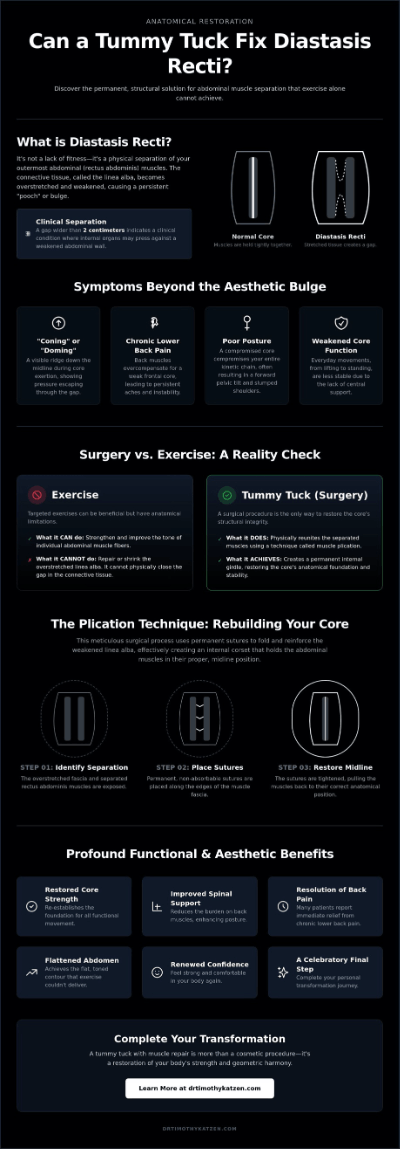
These muscles are held together by the linea alba, a tough band of connective tissue. During pregnancy or periods of significant weight gain, this tissue undergoes extreme tension. If the gap between these muscles exceeds two centimeters, it's classified as a clinical diastasis. At this stage, the "pooch" you see isn't necessarily excess fat. It's often your internal organs pressing against a thinned, weakened abdominal wall that can no longer provide the necessary containment. Many people spend years in physical therapy wondering if they can ever truly close this gap, eventually leading them to ask, can a tummy tuck fix diastasis recti when traditional methods fail?
I see this as a pivotal moment in a person's physical odyssey. Whether you've achieved a massive weight loss goal or completed your family, the presence of diastasis recti can feel like an unfinished chapter. The weakened tissue allows for a protrusion that disrupts the geometric harmony of your torso. A clinical assessment is essential because we must differentiate between simple skin laxity and this deep, internal separation of the fascia.
The Role of the Linea Alba and Fascia
The linea alba acts as the central anchor for your entire abdominal wall, providing the tension required for core stability. Think of it as a high-performance biological fabric. Once this fascia is overstretched beyond its elastic limit, it loses the ability to "shrink" back to its original state. This is a vital distinction. While fat can be burned through metabolic activity, overstretched connective tissue is a permanent anatomical change. This biological reality is often why patients ask, can a tummy tuck fix diastasis recti. They realize that no amount of caloric deficit can repair a structural tear in their core's foundation.
Symptoms Beyond the Aesthetic Bulge
The impact of this separation extends far beyond how you look in form-fitting clothing. You might notice "coning" or "doming" when you try to sit up or lift something heavy, which is a clear sign of intra-abdominal pressure escaping through the gap. Because your front abdominal wall is compromised, your lower back muscles are forced to overcompensate, leading to chronic aches and poor posture. A weak core affects every functional movement, from how you stand to how you breathe. Restoring this integrity is about reclaiming your physical strength as much as it is about your silhouette.
How a Tummy Tuck Repairs Muscle Separation
When we address the structural compromise of your core, we view the tummy tuck as a comprehensive, three part intervention. It isn't merely about the surface. To achieve a truly transformative result, I focus on the removal of excess skin, the contouring of localized fat, and, most importantly, the repair of the underlying musculature. While many patients initially seek this procedure for aesthetic reasons, the most profound changes occur beneath the surface where we restore the abdominal wall's functional integrity.
The question of whether can a tummy tuck fix diastasis recti is answered through a technique called muscle plication. Unlike exercise, which can strengthen individual muscle fibers, surgery is the only method to physically reunite the separated halves of the rectus abdominis. By bringing these muscles back to their original, midline position, we create a stable foundation that supports your entire torso. Understanding When Is a Tummy Tuck Necessary? often comes down to recognizing when the connective tissue has lost its biological "snap" and requires a surgical bridge to regain its shape.
The Plication Technique Explained
During the procedure, I meticulously fold the overstretched fascia and secure it with permanent, non-absorbable sutures. This process acts as an "internal girdle," pulling the muscles tight and eliminating the internal pressure that causes the abdominal bulge. This mechanical reinforcement is far more effective than liposuction alone, as it addresses the actual volume and position of the abdominal cavity. The sutures are designed to remain in place indefinitely, ensuring that the repair survives the rigors of daily life and physical activity. This step is the key to achieving a flat, firm profile that feels as strong as it looks.
Full vs. Mini Tummy Tuck for Diastasis
It's important to distinguish which approach best suits your unique anatomy. A mini tummy tuck is sometimes appropriate for patients with minor separation located strictly below the navel. However, because diastasis recti typically extends from the ribcage down to the pubic bone, most of my patients require a full abdominoplasty. A full repair allows me to address the entire length of the muscle wall, including the area around the umbilicus, or belly button. This comprehensive approach ensures that the geometric restoration of your midsection is complete and balanced. Understanding your specific anatomy is the first step toward a functional core, and you can explore our approach to these specialized repairs at drtimothykatzen.com.
Surgery vs. Exercise: When Is a Tummy Tuck Necessary?
I often meet patients who have spent years dedicated to specialized postpartum or post-weight loss fitness programs. They've mastered the engagement of the transverse abdominis (TVA) and can hold a plank with impressive precision. Yet, despite their strength, the physical gap remains. It's a common point of confusion. Patients often ask, can a tummy tuck fix diastasis recti when physical therapy hasn't delivered the desired silhouette? The answer lies in the distinction between muscle tone and structural integrity. While exercise is vital for functional movement, it cannot repair a biological tear in the connective tissue.
To understand if your condition has reached the limits of conservative treatment, you can perform a simple assessment at home known as the "Three-Finger Rule." While lying on your back with knees bent, gently press your fingers into the midline of your abdomen as you perform a small crunch. If you can fit three or more fingers into the space between the muscle banks, or if you notice a significant "sinkhole" effect, you're likely dealing with a surgical-grade separation. Interestingly, traditional abdominal exercises like crunches or sit-ups can actually worsen this bulge. These movements increase intra-abdominal pressure, which pushes your internal organs against the weakened fascia, further stretching the very gap you're trying to close.
Limits of Physical Therapy
It's important to recognize that fascia and connective tissue don't respond to training the same way muscle fibers do. Muscles can hypertrophy and grow stronger, but overstretched collagen in the linea alba doesn't "shrink" back through repetition. This creates a significant psychological toll. I see many individuals who feel they've "done everything right" yet still look five months pregnant at the end of the day. Clinical research supports the transition from conservative to surgical care in these cases, highlighting The Functional Benefits of Core Reconstruction for those who have reached the limits of traditional training. When the structural anchor is gone, surgery becomes the only path to anatomical restoration.
Identifying Surgical Grade Diastasis
Beyond the "Three-Finger Rule," there are other clinical indicators that your journey requires a surgical intervention. Many of my patients with severe diastasis also present with umbilical hernias, where a small portion of the intestine or fatty tissue pokes through the weakened area around the belly button. This isn't just an aesthetic concern; it's a functional failure of the abdominal wall. Identifying these issues is the first step in moving from frustration to resolution. I view the tummy tuck not as a shortcut, but as the final, celebratory step in your long odyssey toward reclaiming a body that feels both stable and strong.
The Functional Benefits of Core Reconstruction
When we discuss the restoration of your midsection, we are talking about a fundamental bio-mechanical reset. While the visual transformation is often what brings patients through my doors, the functional shift is what truly changes their daily lives. For years, your body has likely been compensating for a compromised center. Once the structural integrity of the abdominal wall is restored, every movement, from standing up out of a chair to lifting a child, becomes more efficient and less taxing on your frame. Many patients realize that the answer to can a tummy tuck fix diastasis recti involves more than just a flat stomach; it involves the reclamation of their physical agency.
By reuniting the separated muscle banks, we create a stable internal pressure system. This stability is essential for proper breathing, digestive health, and even circulatory efficiency. You aren't just looking better; you are providing your internal organs with the support they were designed to have. This procedure marks the transition from a state of physical vulnerability to one of profound core strength, allowing you to re-engage with an active lifestyle without the constant fear of injury or strain.
Relieving Chronic Back Pain
The relationship between your core and your spine is symbiotic. When the abdominal muscles are separated, they can no longer provide the necessary anterior support for your torso. This forces your lower back muscles to work double time to keep you upright, leading to the chronic, nagging pain that many post-transformative patients know all too well. By restoring the abdominal "girdle" through muscle plication, we immediately rebalance the load on your spine. This structural correction often leads to a significant reduction, or even a total resolution, of chronic lower back pain, making daily activities feel effortless once again.
Posture and Pelvic Health
A weakened core often results in a characteristic "anterior pelvic tilt," where the pelvis rotates forward and the lower back arches excessively. This misalignment affects your entire kinetic chain, from your neck down to your knees. Furthermore, the core and the pelvic floor work together to manage intra-abdominal pressure. A 2018 study in the Journal of The American Society of Plastic Surgeons found that a tummy tuck with diastasis recti repair can significantly reduce urinary incontinence. By tightening the abdominal wall, we provide better support for the pelvic organs, improving control and long-term pelvic health. If you are ready to experience these life-changing benefits, I invite you to schedule your personal consultation to discuss your functional recovery.
Your Transformation Journey with Dr. Katzen
Choosing to address your core integrity is a profound decision that marks the transition from enduring a physical limitation to celebrating your strength. In my practice, I don't view the surgical repair of the abdominal wall as a standalone medical event. Instead, I see it as a dedicated partnership in a transformative process. Many individuals come to me after years of searching for a definitive answer to can a tummy tuck fix diastasis recti, often having exhausted every non-surgical avenue. My role is to provide the clinical expertise and meticulous care required to bring your personal odyssey to a successful, life-changing conclusion.
Every transformation begins with a personalized consultation where we perform a detailed anatomical assessment. We don't just look at the muscle gap; we evaluate the geometric balance of your entire torso. For many patients, particularly those who have achieved significant weight loss, the most harmonious results come from combining diastasis repair with 360 body contouring. This comprehensive approach ensures that every angle of your silhouette is restored, providing a level of renewal that goes far beyond a simple repair. You deserve a result that reflects the hard work you've put into your health journey.
The Importance of a Specialist’s Eye
Repairing a compromised core requires more than technical proficiency; it requires a specialized eye for the unique behavior of post-transformative tissue. When you've undergone a major physical shift, your skin and fascia have a different quality than those who haven't experienced such tension. I've dedicated my career to this specific niche of body sculpting, focusing on the artistry involved in recreating a natural, athletic abdominal contour. My commitment to board-certified excellence and safety means that we prioritize your long-term well-being at every stage. We aren't just seeking a flat profile; we're seeking a result that looks and feels inherently yours.
Taking the Final Step in Your Odyssey
I often tell my patients that surgery is the celebratory conclusion of their health journey. It's the moment where your physical form finally aligns with your internal sense of vitality. The emotional recovery that follows a successful core reconstruction is often just as significant as the physical healing. When you no longer have to hide behind loose clothing or manage chronic discomfort, a new sense of confidence emerges. If you've been wondering can a tummy tuck fix diastasis recti and provide the stability you've lost, I invite you to take this final step. You can begin your restoration by visiting drtimothykatzen.com to schedule your consultation and start the next chapter of your life.
Reclaiming Your Strength and Silhouette
Your journey toward physical renewal shouldn't be stalled by a structural limitation that exercise simply cannot bridge. We've explored how muscle separation is a clinical reality of the fascia, requiring a precise surgical intervention to restore your core's foundation. By choosing a path of anatomical restoration, you're not just flattening your abdomen; you're resolving chronic pain and reclaiming the functional stability your body deserves. This is about more than a silhouette; it's about your quality of life.
When patients ask me, can a tummy tuck fix diastasis recti, I don't just point to the aesthetic results. I highlight the permanent internal girdle created through meticulous plication. As a board-certified specialist in post-weight loss transformation and advanced body contouring, I'm dedicated to providing the world-renowned expertise and empathetic care you need for life-changing results. This is the celebratory final step of your long personal odyssey.
Schedule your personalized consultation with Dr. Katzen today to begin your core reconstruction. Let's work together to restore your integrity and confidence. You've already done the hard work of transformation; now, it's time to complete the picture with a core that feels as strong as it looks.
Frequently Asked Questions
Can I fix diastasis recti without surgery?
You can improve the functional strength of your core through physical therapy, but you cannot anatomically close a severe separation without intervention. While targeted exercises support the surrounding muscles, they don't repair the overstretched connective tissue of the linea alba. Many patients find that the only definitive answer to can a tummy tuck fix diastasis recti is a surgical repair that physically reunites the separated muscle banks.
Is a tummy tuck for diastasis recti covered by insurance?
Most insurance providers consider a tummy tuck a cosmetic procedure and do not provide coverage for the surgery. However, partial coverage may be available if the procedure is deemed medically necessary due to documented ventral hernias or chronic skin infections. It's essential to consult with your provider regarding their 2026 guidelines, as the muscle repair component is rarely covered on its own without these specific medical complications.
How long is the recovery after a tummy tuck with muscle repair?
Recovery from this comprehensive repair typically involves a two to six week period of restricted activity to ensure the internal sutures remain secure. Most of my patients require at least two weeks away from work to focus on their initial healing and comfort. While you'll be walking shortly after the procedure, you should avoid heavy lifting and strenuous core exercises until your body has fully stabilized its new geometry.
Will my diastasis recti come back if I get pregnant again?
Yes, a subsequent pregnancy can re-stretch the abdominal muscles and potentially compromise the results of your surgical repair. While the sutures provide a permanent internal girdle, the biological tissue remains susceptible to the extreme pressure of carrying a child. I generally recommend that patients wait until they've completed their families before undergoing a tummy tuck to ensure their results remain stable and celebratory over the long term.
How do I know if my bulge is fat or diastasis recti?
You can often distinguish the two by checking for "coning" or "doming" when you engage your core muscles. If you notice a ridge or a soft gap along your midline when sitting up or performing a small crunch, it's likely a muscle separation. Unlike localized fat, which you can typically pinch, diastasis recti feels like an internal pressure pushing outward through a weakened abdominal wall. A clinical assessment is the most reliable way to confirm your anatomy.
Is the muscle tightening part of a tummy tuck painful?
The muscle plication component introduces a significant feeling of tightness in the midsection, which many patients describe as intense muscle soreness. We manage this discomfort through a combination of advanced surgical techniques and a personalized pain management plan designed for your comfort. Most individuals find that the temporary soreness is a small price to pay for the profound functional benefits and the restoration of their core's integrity.
Can a tummy tuck fix an umbilical hernia at the same time?
Yes, I frequently repair umbilical hernias during the same procedure as the muscle tightening. Because an umbilical hernia often occurs at the site of the muscle separation, it's highly efficient to address both issues simultaneously. This combined approach ensures that we not only flatten the abdomen but also resolve the underlying structural defect that allows tissue to protrude through the navel, providing a more comprehensive and safe result.
What is the best age to have a tummy tuck for muscle repair?
There isn't a single "best" age; rather, the ideal time is when you've reached a stable weight and finished having children. Whether you're in your thirties or your sixties, the primary requirements are good overall health and a commitment to the recovery process. I've helped patients at various stages of life reclaim their core strength and finally ask can a tummy tuck fix diastasis recti to complete their personal odyssey of physical transformation.