High BMI Tummy Tuck Risks: What to Know Before Surgery
10/13/2026
Could a BMI number alone tell you whether a tummy tuck is safe for you? It’s understandable to worry that a higher number may rule out surgery or mean more complications. High BMI tummy tuck risks can include concerns with anesthesia, wound healing, infection, and blood clots, but BMI alone doesn’t determine risk.
This article explains how BMI may affect surgical safety, why it’s only one part of an assessment, and what other health and lifestyle factors can shape readiness. A tummy tuck is a body-contouring procedure, not a weight-loss operation, so your overall health and weight stability also matter when considering timing and potential results.
We’ll explore the risks in clear, balanced terms and outline questions to bring to a consultation. At J. Timothy Katzen, M.D.’s board-certified plastic surgery practice, candidacy is a personalized clinical conversation, not a judgment based on one number. If you’ve been through significant weight loss, your goals and concerns deserve to be heard with care.
Key Takeaways
- High BMI tummy tuck risks can include healing and clotting concerns, but individual risk depends on more than BMI alone.
- Use BMI as one screening measure, not a complete picture of your health or surgical readiness.
- Prepare for an individualized assessment by gathering your medical history, medication list, prior procedure details, goals, and recovery-support plan.
- Ask how your health, weight stability, and desired procedure may shape the timing and scope of surgery.
- Depending on your circumstances, next steps may include a tailored surgical plan, health optimization, or reassessment later.
Table of Contents
- High BMI and tummy tuck surgery: what the risk question really means
- Which tummy tuck risks may be affected by a higher BMI?
- Is a tummy tuck automatically unsafe with a high BMI?
- How to prepare for an individualized tummy tuck risk assessment
- Tummy tuck options and next steps when BMI is a concern
High BMI and tummy tuck surgery: what the risk question really means
It’s reasonable to ask whether a tummy tuck is safe for you. The question isn’t an admission that you’re unhealthy, and it shouldn’t invite shame or assumptions. BMI, or body mass index, is calculated from height and weight. It can help screen for potential health considerations, but it doesn’t describe your full health, fitness, or surgical risk.
A useful distinction: BMI is one screening measure. A surgical risk assessment considers your health history, examination, planned procedure, and recovery needs together.
A tummy tuck, also called abdominoplasty, removes excess abdominal skin and may include tightening the abdominal wall. Like any operation, it carries risks at every BMI. Research reviews in plastic surgery have found associations between higher BMI and increased complication risk, but an association doesn’t predict an individual outcome. Your health, the operation being considered, and other risk factors all matter.
Does BMI alone determine tummy tuck candidacy?
No single number can establish whether surgery is safe or appropriate for every person. BMI may inform screening and prompt closer assessment, but it doesn’t account for the full clinical picture. A surgeon considers your overall health, medical history, physical examination, goals, and the changes you hope to address. Candidacy should be discussed individually, not reduced to a judgment about your body.
Why patients ask about high BMI tummy tuck risks
It’s natural to want clear information about complications, anesthesia, wound healing, and recovery, especially if you’ve heard that BMI can affect risk. These concerns deserve a direct, respectful discussion, not a prediction based on one measurement. A systematic review and meta-analysis has reported higher complication risk among patients with obesity undergoing plastic surgery, while individual risk still varies.
For some people, excess abdominal skin after major weight changes can contribute to discomfort, difficulty with clothing or hygiene, and self-consciousness. Those experiences matter when discussing goals, alongside medical considerations. Understanding potential benefits and risks can help you decide whether to explore surgery now, prepare further, or revisit the decision later. No assessment can promise a particular result, but a careful review can clarify the options.
Which tummy tuck risks may be affected by a higher BMI?
A higher BMI may be associated with a greater chance of certain complications, but it doesn’t make any outcome inevitable. Research findings aren’t uniform: an American Society of Plastic Surgeons report describes a study that found no significant increase in complications among the obese patients it examined. That finding offers useful context, but it can’t predict an individual’s risk or settle the question for every patient. Studies may differ in who was included, how procedures were performed, and which complications were measured.
Risk reflects the interaction of a patient’s health, the scope of surgery, and the details of care, not BMI in isolation. A surgeon considers these factors together rather than treating a risk association as a certain outcome.
Healing, wound complications, and fluid collection
After a tummy tuck, the incision needs time to heal. Wound-healing problems can include an incision that closes slowly or opens in part. Infection may cause increasing redness, warmth, pain, or drainage. A seroma is a pocket of fluid that collects beneath the skin. Higher BMI may be one factor associated with these concerns, but incision length, the extent of tissue removal, circulation, and individual health can also influence healing.
Follow-up visits allow the surgical team to monitor healing and respond to concerns. Contact your care team about changes that worry you rather than trying to assess a possible complication on your own.
Anesthesia, blood clots, and other medical considerations
Anesthesia and blood-clot risks are assessed individually. Before surgery, clinicians may consider factors such as heart or lung conditions, diabetes, blood pressure, smoking, medications, personal or family clot history, and how long you may be less mobile during recovery. These are factors to assess, not assumptions about your health or predictions that a complication will occur.
After surgery, sudden shortness of breath, chest pain, or a painful, swollen leg needs urgent medical assessment. For severe or sudden symptoms, seek emergency care. Your surgical team can explain which changes to watch for and how to reach them during recovery.
Understanding these risks is one part of planning. A conversation with Dr. Katzen can connect the evidence to your health history, goals, and proposed tummy tuck. Learn more about Dr. Katzen’s tummy tuck approach as you consider what to discuss.
Is a tummy tuck automatically unsafe with a high BMI?
No. A higher BMI alone doesn’t establish that a tummy tuck is either safe or unsafe for every person. It can be a meaningful screening factor, but it isn’t an individual prediction. Research may identify a risk association across a group, while your own outlook depends on your health, the procedure being considered, and the care surrounding it. The high BMI tummy tuck risks discussed earlier are possibilities to assess, not outcomes to assume.
Why there is no one-size-fits-all answer
A surgeon brings together your medical history, physical examination, goals, and the amount and location of tissue involved in the planned procedure. Conditions such as diabetes or high blood pressure, medications, smoking, prior surgery, and weight stability may also shape the discussion. BMI isn’t irrelevant, but it can’t provide enough detail to make a complete plan.
Two people with a similar BMI may have different health histories, body composition, abdominal concerns, and recovery needs. The procedure’s scope matters, too. A more extensive operation may involve different considerations than a more limited plan. Your surgeon can explain how these details affect the balance between potential benefits, such as addressing excess skin or changes to abdominal contour, and surgical risks.
When a surgeon may recommend waiting
If an evaluation identifies a concern that could affect anesthesia, healing, or recovery, your surgeon may recommend additional testing, coordination with another clinician, or time to address the issue before proceeding. This could involve better management of a medical condition or reviewing medications and other risk factors. The recommendation should relate to your specific health and surgical plan, not blame.
Waiting can be disappointing, especially after you’ve spent time considering surgery. But postponement is a planning decision intended to clarify or improve the conditions for care, not a personal rejection. There’s no universal target weight or timeline that applies to everyone. Any recommendation about weight change or timing should be individualized with your clinical team.
Proceeding, preparing first, or reconsidering later can each be reasonable, depending on the circumstances. Only an in-person clinical assessment can determine which plan fits your health and goals. A thoughtful consultation should leave you with a clear explanation of the factors involved, the options available, and what further evaluation, if any, would help guide your decision.
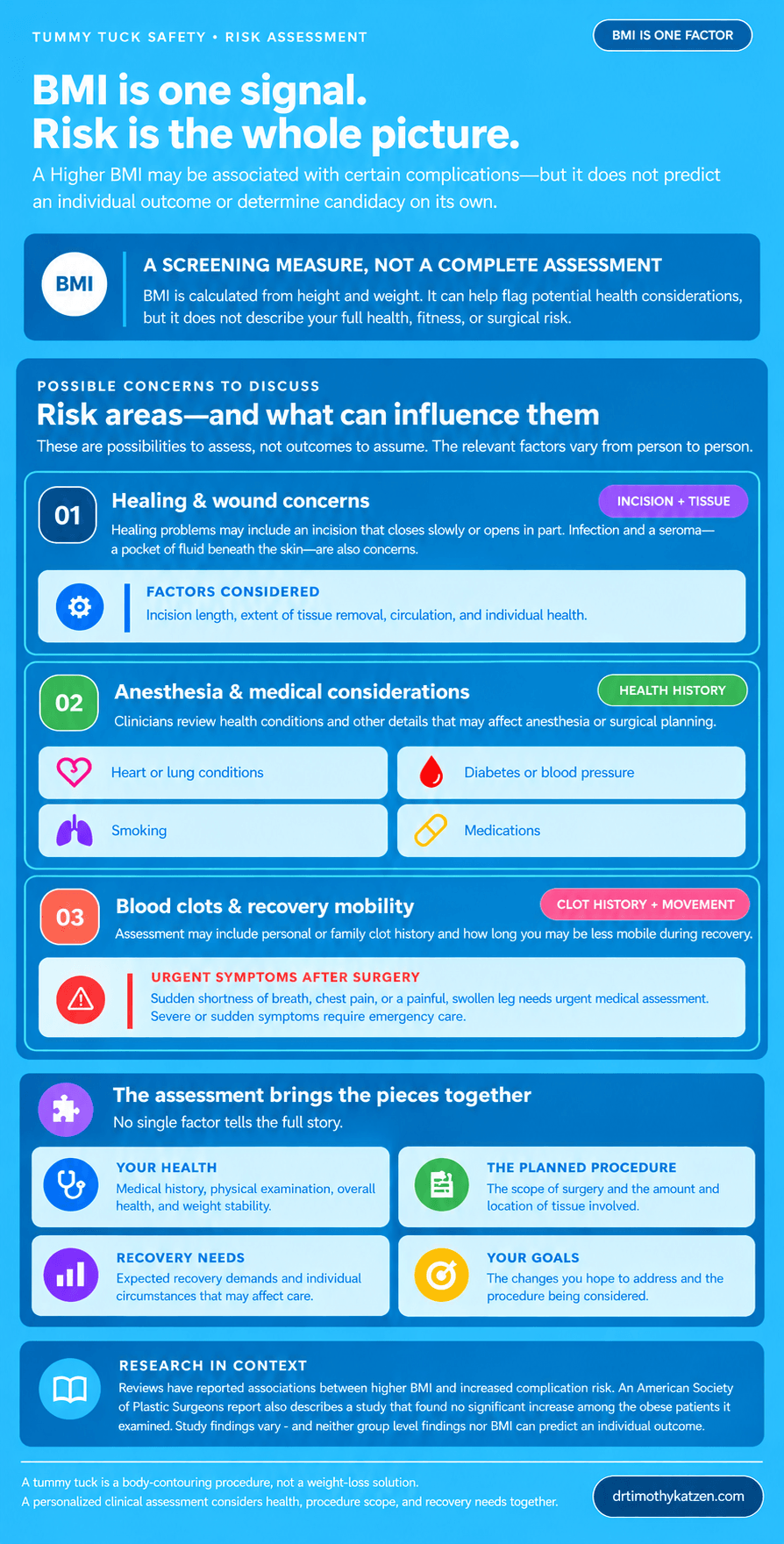
Infogram of Tummy Tuck Safety: The Whole Picture
How to prepare for an individualized tummy tuck risk assessment
A little preparation can help your consultation focus on the details that matter to your health, goals, and recovery. Bring accurate information rather than trying to decide which details are relevant. If you’re concerned about high BMI tummy tuck risks, an open conversation gives your surgeon a clearer foundation for assessing your situation.
Useful surgical planning brings together your medical history, medications, prior procedures, current health, goals, and recovery support.
What health information should you bring?
Make a list of prescription and over-the-counter medications, vitamins or supplements, allergies, known health conditions, and previous operations. Include abdominal procedures and any changes in weight, especially after significant weight loss. Be candid about nicotine use and recent health changes, too. Sharing these details isn’t about judgment; it helps the clinical team understand your circumstances and plan an appropriate evaluation.
If you have relevant medical records or information from clinicians involved in your care, bring them or ask how they can be shared. Your surgeon may request records, tests, or further assessment based on your history and examination. The clinical team determines what additional evaluation is appropriate for you.
Questions to discuss with the surgeon
Consider writing down questions before your appointment. For example:
- Which parts of my health history influence the proposed procedure or recovery plan?
- What will follow-up involve, and how are concerns or complications assessed?
- Could a different procedure plan or timing better fit my goals and health?
- Would addressing a health concern before surgery be advisable in my case?
It’s also useful to discuss what you hope to change, such as excess skin after weight loss, and what recovery support you’ll have at home. Clear goals help guide a realistic discussion of procedure scope and recovery needs. Don’t stop or change medications on your own; ask the appropriate clinician how to manage them around surgery.
A thorough assessment is a conversation, not a pass-or-fail judgment based on one number. Dr. Katzen’s practice specializes in tummy tuck and body contouring, including care for patients after significant weight loss. Discuss your tummy tuck goals and health considerations to learn more about your options.
Tummy tuck options and next steps when BMI is a concern
A BMI concern doesn’t point to one automatic next step. After reviewing your health and goals, your surgeon may discuss proceeding with a tailored plan, addressing specific health factors before surgery, or reassessing later. Each path has its own considerations. A recommendation to wait isn’t a rejection, and proceeding isn’t automatically the right choice; the decision depends on your individual assessment and the balance of potential benefits and risks.
How personal goals and procedure scope shape the plan
The discussion starts with what you hope to change and what the examination shows. The amount and location of excess skin, changes in abdominal tissue, and whether muscle tightening may be relevant all help shape the conversation. The extent of surgery matters because different plans involve different areas and considerations for healing and recovery.
A tummy tuck is a body-contouring procedure, not a weight-loss operation. If your weight is changing or you’re considering weight-loss treatment, share that with your surgeon so timing and goals can be discussed in context. The right plan depends on your anatomy, health, and priorities; no specific technique or result can be assumed before an assessment.
Depending on the findings, a plan may be tailored to address your goals, or the discussion may focus first on optimizing a health concern or allowing more time before reassessment. These are individualized pathways, not interchangeable procedures or a ranking of which choice is best for everyone.
Taking the next step with Dr. Katzen
Dr. Katzen is a board-certified plastic surgeon whose practice specializes in tummy tuck and advanced body contouring, including procedures for patients after significant weight loss. An individualized consultation can bring your health history, abdominal changes, desired outcome, and concerns about high BMI tummy tuck risks into one focused conversation.
Use that discussion to understand how the proposed procedure’s scope relates to your goals, which risks deserve attention in your situation, and whether proceeding, preparing first, or reassessing later is the most appropriate next step. The purpose is to clarify your options and build a plan around your circumstances, without reducing candidacy to a single number.
Discuss your tummy tuck goals with Dr. Katzen.
Make your next step an informed one
High BMI tummy tuck risks deserve an honest, individualized discussion, not an assumption based on one number. BMI can inform screening, but your overall health, surgical goals, and the extent of the procedure help shape a fuller assessment. Depending on your circumstances, the next step may be a tailored plan, health optimization, or reassessment later.
Dr. Katzen is a board-certified plastic surgeon specializing in tummy tuck and advanced body contouring, with experience caring for patients after significant weight loss. A consultation can help you discuss your health history, concerns, and goals, then understand which options may be appropriate for you.
Discuss your tummy tuck goals with Dr. Katzen. Your questions deserve a thoughtful, respectful conversation, and clarity is a meaningful first step toward deciding what comes next.
Frequently Asked Questions
Is a tummy tuck safe with a high BMI?
It depends on your health and the procedure being considered; a higher BMI alone can’t determine whether surgery is safe for you. High BMI tummy tuck risks may include concerns involving healing, infection, anesthesia, or blood clots, but these are possibilities, not guaranteed outcomes. A surgeon assesses your medical history, examination, goals, and recovery considerations in person before discussing whether to proceed, prepare further, or revisit surgery later.
What BMI is too high for a tummy tuck?
There’s no single official BMI cutoff that applies to every surgeon or patient. Many surgeons prefer a BMI of 30 or below; some may consider patients up to 35 individually when other health factors are favorable. Elective tummy tuck surgery above a BMI of 40 is generally uncommon. These figures describe reported practice patterns, not a guarantee of candidacy or a substitute for an individualized surgical assessment.
Does a higher BMI increase tummy tuck complications?
Higher BMI has been associated in research with increased complication risk, but findings vary across studies and don’t predict what will happen to one person. Potential concerns include wound-healing problems, infection, fluid collection beneath the skin, and blood clots. BMI isn’t the only factor: overall health, medications, nicotine use, procedure extent, and recovery needs also inform risk. Ask your surgeon which concerns are most relevant to your situation.
Can I have a tummy tuck if I have diabetes or high blood pressure?
Having diabetes or high blood pressure doesn’t automatically determine whether you can have surgery. The clinical team will consider how well each condition is managed, your overall health, medications, and any related concerns that could affect anesthesia or healing. Share your diagnosis and current treatment openly, and don’t stop or adjust medication on your own. Your surgeon may recommend further evaluation or health optimization before making a plan.
Should I lose weight before a tummy tuck?
A tummy tuck is a body-contouring procedure, not a weight-loss operation. Your surgeon may discuss weight change or stability if it could affect surgical safety, timing, or the durability of your contour. There isn’t one target weight or timeline that fits everyone, so avoid setting a surgical goal without individualized medical guidance. Share any current weight-loss plans and changes with your surgeon before deciding on next steps.
What complications should I ask about before a tummy tuck?
Ask how your health and planned procedure may affect wound healing, infection, seroma, blood clots, anesthesia, and recovery. Find out what follow-up involves, which symptoms need prompt attention, and how the care team evaluates concerns after surgery. Your personal risk depends on more than BMI, so ask the surgeon to explain which complications are most relevant to your history and what steps are part of your care plan.
Can I still have a tummy tuck after significant weight loss if my BMI is high?
Possibly, but significant weight loss and a higher BMI don’t establish candidacy on their own. A surgeon will consider your current health, weight changes, remaining abdominal skin and tissue, goals, and the extent of surgery being discussed. J. Timothy Katzen, M.D., a board-certified plastic surgeon specializing in tummy tuck and advanced body contouring, has experience with patients after significant weight loss. An in-person assessment can help clarify your options.