How Long Should You Wait for a Tummy Tuck After Childbirth?
10/1/2026
The calendar alone can’t tell you when your body is ready for a tummy tuck. If you’re wondering how long to wait for tummy tuck after childbirth, you’re right to consider more than the number of months since delivery. Your body may still be changing, breastfeeding may affect your plans, and caring for a baby can make surgical recovery especially demanding.
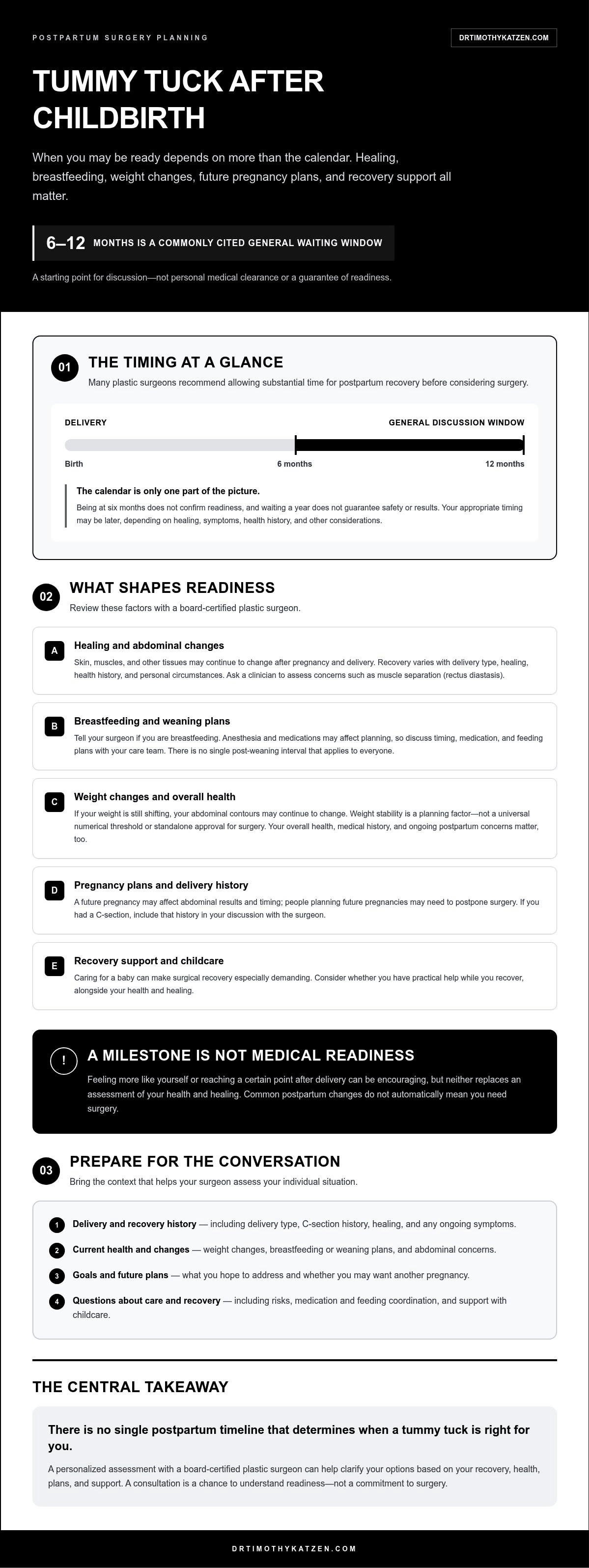
Many plastic surgeons recommend waiting at least 6 to 12 months after giving birth, but that’s a general guideline, not a guarantee of safety or a schedule that suits everyone. Readiness can also depend on whether you’ve finished breastfeeding, your weight has stabilized, your tissues have healed, and you have practical support while you recover. If you’ve had a C-section or may want another pregnancy, those are important points to discuss, too.
In this article, you’ll learn why postpartum timing is individualized, which factors to review with a surgeon, and how to plan around breastfeeding and childcare. A personalized assessment with a board-certified plastic surgeon can help clarify your options without obligating you to move forward before you feel ready.
Key Takeaways
- There’s no single answer to how long to wait for tummy tuck after childbirth. General timelines aren’t personal medical clearance.
- Review your recovery progress, health history, weight changes, and breastfeeding plans with your surgeon.
- Consider how a future pregnancy could affect your abdominal results and timing before making a decision.
- Prepare for a consultation by noting your delivery and recovery history, current goals, and questions about risks and recovery support.
- A consultation with a board-certified plastic surgeon can help assess your readiness without committing you to surgery.
Table of Contents
- How Long to Wait for Tummy Tuck After Childbirth: The General Guidance
- How Postpartum Healing, Breastfeeding, and Weight Stability Affect Timing
- Pregnancy Plans and Other Factors That Can Change Tummy Tuck Timing
- How to Tell Whether You May Be Ready to Discuss a Tummy Tuck
- Planning Your Next Step With a Tummy Tuck Surgeon


How Long to Wait for Tummy Tuck After Childbirth: The General Guidance
If you’re asking how long to wait for tummy tuck after childbirth, a commonly cited general timeframe is at least 6 to 12 months after delivery. This allows time for your body to recover and postpartum changes to settle. It’s a starting point for discussion, not a universal rule or a guarantee that surgery is safe or appropriate on a particular date.
A tummy tuck, also called abdominoplasty, is an operation that reshapes the abdomen by addressing excess tissue. Readiness for elective surgery involves more than reaching a certain month postpartum. Your healing, overall health, weight changes, breastfeeding plans, and ability to manage recovery all matter. A board-certified plastic surgeon can assess these factors with you and discuss an individualized plan. An assessment is an opportunity to understand your options, not a commitment to surgery.
Why there is no single postpartum tummy tuck timeline
Recovering from childbirth and being ready for elective abdominal surgery are related, but they aren’t the same milestone. Pregnancy and delivery affect people differently, and recovery can vary with delivery type, healing, health history, and personal circumstances. Even if you feel well, your surgeon will need to assess your situation rather than rely on a calendar alone. An in-person evaluation can help determine whether your recovery and health support considering surgery.
What a commonly quoted waiting period can and cannot tell you
The 6 to 12 month timeframe can help explain why surgeons generally advise allowing substantial time for postpartum recovery before considering a tummy tuck. It cannot confirm that you’re ready at six months, or that waiting a year guarantees safety or results. Your appropriate timing may be later, depending on healing, ongoing symptoms, medical history, or other considerations your surgeon identifies.
In brief: 6 to 12 months is a commonly cited general waiting window, not individual medical clearance. If you’re approaching that point, or aren’t sure how your recovery affects timing, a conversation with a plastic surgeon can help clarify what to consider next. Your readiness should be determined through an assessment of your health and circumstances, not by a month count alone.
How Postpartum Healing, Breastfeeding, and Weight Stability Affect Timing
Postpartum timing depends on how your body is recovering, not just how much time has passed since delivery. Before elective abdominal surgery, a surgeon assesses your healing and overall health to understand whether your body is ready for an operation and recovery. This is one reason the answer to how long to wait for tummy tuck after childbirth can differ from person to person.
Postpartum healing and abdominal changes
Your abdominal skin, muscles, and other tissues may continue to change after pregnancy and delivery. The pace and extent of those changes vary, and common postpartum differences don’t automatically mean you need surgery. If you’re concerned about muscle separation, sometimes called rectus diastasis, mention it during an evaluation rather than trying to diagnose it yourself. A clinician can assess your abdomen and discuss whether your concerns are appropriate for a tummy tuck.
A recovery milestone is not the same as medical readiness for surgery. Feeling more like yourself or reaching a certain point after delivery can be encouraging, but neither replaces an assessment of your health and healing.
Breastfeeding, weight changes, and overall health
Breastfeeding and plans to wean are important to discuss during a consultation. Surgical planning may involve anesthesia and medications, so tell your surgeon whether you’re currently breastfeeding and ask how timing, medication, and feeding plans should be coordinated with your care team. There isn’t a single post-weaning interval that applies to everyone. Ask your surgeon what current clinical guidance means for your circumstances.
Weight changes matter, too. If your weight is still shifting, your abdominal contours may continue to change, which can affect the timing of an elective procedure and how its potential results are considered. Weight stability is a planning factor, not a universal numerical threshold or standalone approval for surgery. Your overall health, medical history, and any ongoing postpartum concerns belong in the same conversation.
Johns Hopkins Medicine notes that candidates should be in good physical condition and that people planning future pregnancies may need to postpone the surgery. That guidance underscores why a surgeon needs to understand your broader plans, not only your current recovery.
To prepare, write down any ongoing symptoms or changes you’ve noticed, your breastfeeding or weaning plans, and whether your weight is still changing. A consultation with a board-certified plastic surgeon can help you review these factors and decide what questions to address next, without obligating you to proceed.
Pregnancy Plans and Other Factors That Can Change Tummy Tuck Timing
Family plans can shape the timing of a tummy tuck because a future pregnancy may stretch the abdominal skin and muscles again, changing the contour after surgery. That doesn’t mean there’s one medically correct choice for everyone. It means your surgeon should understand what you’re considering so you can weigh timing, potential changes to results, and your priorities together.
Should you wait until you are finished having children?
Some people prefer to postpone surgery until they don’t expect to become pregnant again, while others are still deciding or have a different timeline in mind. Share your realistic family-planning expectations, including any uncertainty, during your consultation. Your surgeon can explain how a future pregnancy might affect your abdomen and discuss whether waiting makes sense for you. This is a planning conversation, not a judgment about your personal choices.
| Your current plans | What to discuss with your surgeon |
|---|---|
| You’re considering another pregnancy | How pregnancy could change abdominal tissues and affect the timing or appearance of results. |
| You don’t anticipate another pregnancy | Whether your recovery, health, and other readiness factors support discussing surgery now. |
| You’re unsure | How to weigh your current concerns against the possibility of future changes, without feeling pressured to decide immediately. |
How personal recovery and health circumstances matter
Pregnancy plans are only one part of the picture. Tell your surgeon about your delivery and recovery, including any complications, ongoing symptoms, current medications, and relevant medical conditions. These details help the medical team assess your circumstances and determine whether further evaluation or a change in timing should be considered. Don’t stop or adjust prescribed medication without guidance from the clinician managing it.
Recovery also has a practical side. A tummy tuck can affect how much you can lift and do while healing, so think through who could help with childcare, household tasks, and your baby’s day-to-day needs. If support is limited, say so. It may affect when surgery is manageable, even if other aspects of your recovery are progressing well.
There’s no calendar formula that can resolve all these considerations. If you’re wondering how long to wait for tummy tuck after childbirth, bring your family plans, medical history, and support situation into the discussion. A personalized assessment can help you understand your options without treating any one choice as right for everyone.
How to Tell Whether You May Be Ready to Discuss a Tummy Tuck
A readiness checklist can help you organize your thoughts, but it can’t determine whether surgery is appropriate. If you’re asking how long to wait for tummy tuck after childbirth, use the questions below as a starting point for a conversation with a qualified plastic surgeon, not as a way to clear yourself for surgery.
Questions to ask yourself before booking a consultation
- How is my recovery going? Consider whether your postpartum healing feels established and whether you have symptoms or health concerns that still need attention from your medical team.
- Are my weight and plans changing? Think about whether your weight is still shifting, whether you’re breastfeeding or planning to wean, and whether another pregnancy may be part of your future.
- What support would I have? Consider how you’d manage appointments, childcare, and household responsibilities during recovery. If help is limited, that’s useful information to raise, not a reason to feel pressured.
- What do I want to address? Note the abdominal changes that concern you and what you hope to understand about a tummy tuck.
- What is my health history? Be prepared to discuss delivery-related complications, medical conditions, and medications with your surgeon.
Your answers don’t need to be perfect or final. They can help you identify questions and decide whether you’re ready to learn more.
What a surgeon evaluates during an assessment
A surgeon will discuss your goals, abdominal concerns, recovery, health history, medications, and plans for breastfeeding or future pregnancies. An examination may help assess your abdominal tissues and inform whether a tummy tuck is appropriate to consider. The surgeon also evaluates timing and potential risks in light of your health and circumstances.
No checklist, photograph, or month count can confirm candidacy on its own. Only a qualified surgeon can assess whether the procedure and timing may be suitable for you and what options to discuss. The consultation is a chance to get clear, personalized information, not an obligation to proceed.
Before the visit, jot down your delivery and recovery history, current goals, and questions about timing, risks, and the practical demands of healing. To organize those questions, prepare questions for a personalized consultation.
Planning Your Next Step With a Tummy Tuck Surgeon
A thoughtful consultation can turn the question of how long to wait for tummy tuck after childbirth into a discussion about your health, recovery, and priorities. You don’t need to arrive with a decision made. The goal is to share the relevant details and understand what a surgeon recommends for your circumstances.
What to bring to a postpartum tummy tuck consultation
A short written summary can make it easier to cover the important points, especially if you’re balancing appointments with caring for a baby. Consider noting:
- When you gave birth, how delivery and recovery went, and any ongoing symptoms or concerns.
- Your current medications, relevant medical history, and any delivery-related complications.
- Whether you’re breastfeeding, considering weaning, or have questions about how feeding plans may affect timing.
- Whether you may want another pregnancy, or are still uncertain about future family plans.
- The abdominal changes you’d like to discuss and what matters most to you in considering a tummy tuck.
Bring questions, too. You might ask how your health history affects timing and surgical risks, what recovery may involve, what support you’ll need at home, and whether there are other appropriate options to consider. Be specific about practical concerns, such as who could help with childcare while you recover.
Making an informed decision without rushing
Your surgeon can review your goals, medical history, and recovery, then explain whether the timing and procedure may be appropriate to consider. Ask for clarification if a recommendation is unclear, and take time to think it over. You can also discuss what factors might need attention before making a decision. An initial conversation is for individualized guidance, not pressure to schedule surgery.
There’s no failure in deciding to wait. You may want more time for healing, to finish breastfeeding, to see how your weight changes, or to arrange dependable support at home. Those are meaningful considerations in planning, and a personalized assessment can help you understand them without treating a particular date as a guarantee of safety or results.
If you feel ready to explore your questions, discuss your goals with Dr. Katzen’s practice. A conversation with a board-certified plastic surgeon can help you understand your options and choose an informed next step.
Choose a Next Step That Feels Right for You
The answer to how long to wait for tummy tuck after childbirth depends on more than the calendar. Your healing, breastfeeding plans, weight changes, health history, future pregnancy plans, and recovery support all help shape the conversation. A commonly cited timeframe can offer context, but it can’t confirm that you’re personally ready.
You don’t need to have every decision made before speaking with a surgeon. A consultation can help you understand how your circumstances may affect timing, risks, and planning, and choosing to wait is a valid outcome. J. Timothy Katzen, M.D., is a board-certified plastic surgeon whose practice emphasizes personalized preoperative assessment and follow-up.
If you’d like individualized guidance without pressure to proceed, discuss your postpartum goals with Dr. Katzen’s practice. Request a consultation to discuss your recovery, goals, and questions about tummy tuck timing.
Frequently Asked Questions
How long should I wait for a tummy tuck after giving birth?
There’s no single waiting period that’s right for everyone. If you’re asking how long to wait for tummy tuck after childbirth, understand that general timelines are starting points, not personal medical clearance. A surgeon will consider your healing, overall health, breastfeeding plans, weight changes, and whether you may want another pregnancy. A board-certified plastic surgeon can assess these factors and discuss timing based on your circumstances.
Can I get a tummy tuck while breastfeeding?
Breastfeeding should be discussed with your surgeon before planning a tummy tuck. Your feeding plans, health, and the medications involved in surgery and recovery may all affect the timing conversation. Don’t rely on a fixed interval from a general article as a substitute for medical advice. Ask your surgeon whether postponing surgery is advisable, how breastfeeding fits into planning, and whether you should coordinate with the clinician who supports your postpartum care.
Do I need to wait until I have finished having children?
Not necessarily, but if you expect another pregnancy, discuss whether postponing a tummy tuck may better fit your plans. Pregnancy can change abdominal skin and muscles, which may affect surgical results. This isn’t a rule that applies identically to every family. Share what you’re considering, even if you’re uncertain, so your surgeon can explain how timing may relate to your goals and what questions deserve further consideration.
Does my weight need to be stable before a postpartum tummy tuck?
Weight stability is one factor a surgeon may consider, since substantial changes can alter abdominal contours and affect planning. There’s no universal weight target or timeline that confirms candidacy for everyone. Be open about recent weight changes and your goals, including whether you expect further changes. Your surgeon can assess your health and discuss whether it may be helpful to wait before deciding about surgery.
What happens if I have a tummy tuck before my body has finished recovering?
Having surgery before you’re medically ready may raise concerns related to healing, overall health, or changes that are still underway. The specific risks depend on your individual circumstances, so a general timeline can’t predict them. Tell your surgeon about ongoing symptoms, delivery-related complications, breastfeeding, medications, and recovery concerns. An individualized assessment can help determine whether further recovery or evaluation should come before considering elective surgery.
How do I know if I am ready for a tummy tuck after childbirth?
Readiness is assessed through a discussion of your recovery, health history, breastfeeding plans, weight changes, future pregnancy plans, and goals, along with an appropriate examination. A checklist can help you prepare, but it can’t confirm candidacy or predict surgical risks. A consultation with a board-certified plastic surgeon can help you understand your options and timing. You can use that conversation to gather information without feeling obligated to proceed.