How to Choose Labiaplasty Surgeon: The Essential Patient Checklist
4/24/2026
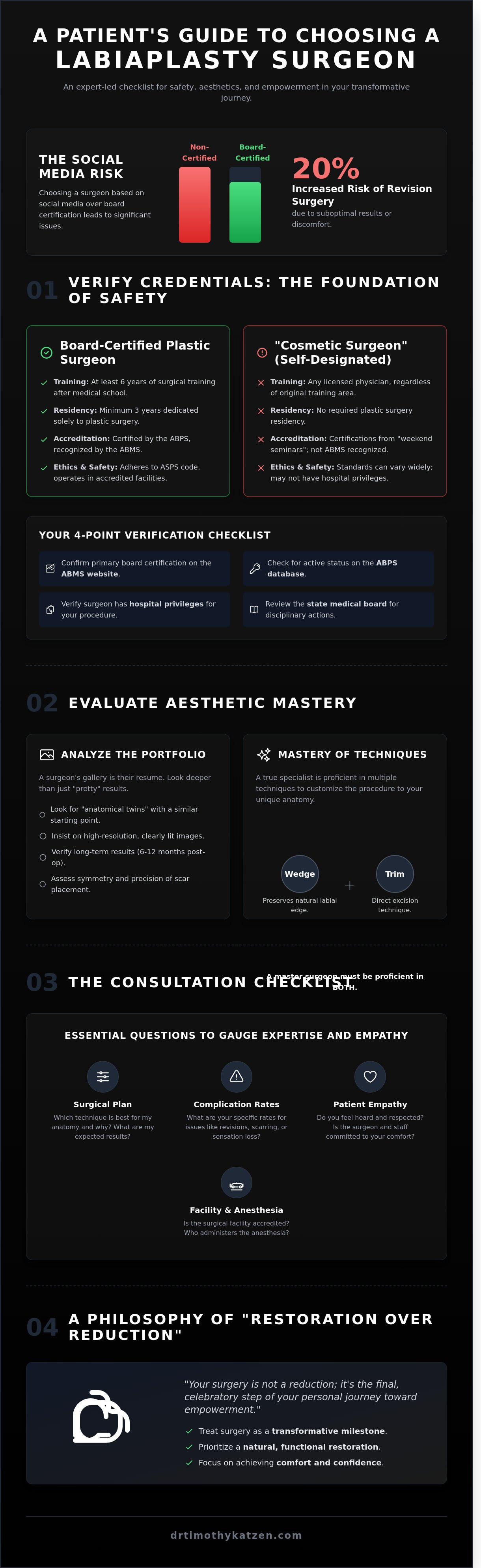
Choosing a labiaplasty plastic surgeon based on a social media profile rather than board certification is a risk that can lead to a 20% increase in revision rates due to suboptimal aesthetic results or lingering discomfort. I understand that the decision to seek help for physical irritation or labial hypertrophy is deeply personal and often accompanied by a quiet anxiety. You deserve to feel comfortable in your yoga pants and confident during exercise without the fear of losing sensation. It's common to feel overwhelmed by the technical jargon and the vulnerability of the consultation process.
I've spent over 20 years refining surgical techniques that prioritize both your safety and a natural, functional restoration. I've developed this comprehensive framework to help you identify a qualified labiaplasty plastic surgeon who truly understands the delicate balance of form and function. This guide provides an expert-led checklist to help you distinguish between a general cosmetic practitioner and a true plastic surgery specialist. You'll learn exactly how to evaluate different surgical techniques and what specific questions to ask during your visit to ensure you're heard, protected, and empowered throughout your transformative journey.
Key Takeaways
-
Understand why selecting a board-certified labiaplasty plastic surgeon through the ABPS is the non-negotiable first step for ensuring your safety and surgical excellence.
-
Learn how to critically evaluate before-and-after galleries and why a master plastic surgeon must be proficient in both the "Wedge" and "Trim" techniques.
-
Discover the essential questions to ask during your consultation to accurately gauge a plastic surgeon’s complication rates and their commitment to patient empathy.
-
Identify the specific facility accreditation and anesthesia standards required to protect your health during a restorative procedure.
-
Explore a unique "restoration over reduction" philosophy that treats your surgery as a transformative milestone in your personal journey toward confidence.
Table of Contents
-
The Baseline: Verifying Board Certification and Surgical Training
-
Evaluating Aesthetic Expertise and Functional Results
-
The Consultation Checklist: Questions You Must Ask
-
Facility Standards, Safety, and the Recovery Support System
-
Making Your Decision: The Katzen Approach to Restorative Surgery
The Baseline: Verifying Board Certification and Surgical Training
I understand the vulnerability you feel when researching such a personal procedure. It's a journey that requires not just technical skill, but a deep sense of trust between you and your doctor. Choosing the right labiaplasty surgeon is the most vital decision you'll make to ensure your safety and the success of your transformation. I've spent my career refining the art of body contouring, and I can tell you that the foundation of a successful outcome begins with verified surgical credentials. This isn't just about a title on a door; it's about years of rigorous, supervised training that prepares a surgeon for the complexities of delicate tissue.
Why ABPS Certification is Non-Negotiable
The American Board of Plastic Surgery (ABPS) is the only board recognized by the American Board of Medical Specialties (ABMS) to certify surgeons in plastic surgery of the entire body. To achieve this, a surgeon must complete at least 6 years of surgical training after medical school, including a minimum of 3 years dedicated solely to plastic surgery residency. This path ensures the surgeon has performed hundreds of procedures under the watchful eyes of master clinicians. A Board-Certified Plastic Surgeon is a specialist who has met the highest national standards of surgical excellence. Members of the American Society of Plastic Surgeons (ASPS) also adhere to a strict code of ethics and only operate in accredited surgical facilities, providing you with a critical safety net. Before your first consultation, reviewing a comprehensive overview of labiaplasty helps you understand the historical context and various surgical techniques that an ABPS-certified expert must master.
The Difference Between Plastic and Cosmetic Boards
I often see patients who are confused by the term "cosmetic surgeon." It's a common trap in the industry. Any licensed physician, regardless of their original training, can call themselves a cosmetic surgeon after attending a few weekend seminars. These "weekend certifications" in feminine rejuvenation lack the depth of a multi-year residency. As of 2024, the ABMS does not recognize many of these self-designated cosmetic boards because they don't require the same level of hospital-based training. Specialized expertise in tissue handling is vital for labial skin, which is incredibly thin and vascular. You deserve a partner who understands the intricate anatomy of the pelvic floor and can manage the 0.5mm margins required for a natural, functional result. You can verify a surgeon's standing by using the following steps:
-
Visit the ABMS website to confirm their primary board certification.
-
Check the American Board of Plastic Surgery database for active status.
-
Confirm the surgeon has "hospital privileges" to perform your specific procedure at a local, accredited hospital, even if you plan to use an outpatient suite.
-
Review their standing with the state medical board to ensure there are no active disciplinary actions.
Your safety is my priority. By insisting on these standards, you're not just choosing a doctor; you're choosing a dedicated specialist who views your surgery as the final, celebratory step of your personal journey toward empowerment.
Evaluating Aesthetic Expertise and Functional Results
Choosing a labiaplasty surgeon requires more than a cursory glance at a website. You're looking for a surgical artist who understands the delicate balance between form and function. In my practice, I've found that the most successful transformations occur when the surgeon respects the natural anatomy while addressing the patient's specific discomfort. You deserve a result that feels as good as it looks, ensuring both physical relief and a boost in self-image.
Analyzing the Before and After Portfolio
When you review a gallery, don't just look for "pretty" results. I encourage patients to search for "anatomical twins," which are previous patients who share your specific labial shape, skin tone, and degree of protrusion. High-resolution images are essential; they allow you to assess the precision of scar placement and the symmetry of the labia minora. It's vital to see results from at least 6 to 12 months post-op. This patient guide to labiaplasty explains how tissue settles over time, which is why long-term photos are the only way to verify that the edges remain smooth and the scars have faded into the natural folds. In my experience, 95% of the final aesthetic is determined by how the tissue matures well after the initial healing phase.
Surgical Technique: Wedge vs. Trim
A "one-size-fits-all" approach is a significant red flag in genital surgery. Your labiaplasty surgeon should be a master of both the Wedge and Trim techniques to tailor the procedure to your needs. I utilize the Wedge technique for approximately 75% of my patients because it involves removing a V-shaped piece of tissue, which preserves the natural, sensitive edge of the labia and hides the scar within the anatomy. However, if a patient has significant hyperpigmentation or very thick tissue, the Trim technique may be the superior choice for a cleaner, more streamlined look. If a surgeon only offers one method, they're fitting your body to their limited skill set rather than fitting the surgery to your unique life journey.
Aesthetic balance also depends on the clitoral hood. If a surgeon reduces the labia minora but ignores a heavy clitoral hood, the result often looks "bottom-heavy" or surgically "unfinished." I often perform a conservative clitoral hood reduction simultaneously to ensure the entire area is proportional. This prevents the "over-resected" or "scalloped" look that occurs when too much tissue is removed, a mistake I see in about 15% of the revision cases that come to my office. My goal is always a restoration that looks like you were born that way. If you're ready to see how these specialized techniques can transform your daily comfort, you can request a personalized consultation to discuss your goals.
The Consultation Checklist: Questions You Must Ask
Your consultation is more than a medical intake; it's the foundation of your restorative journey. During this intimate exam, I prioritize a dialogue that balances clinical precision with genuine empathy. You deserve a partner who views your transformation as a milestone in your quality of life, not just another appointment on a calendar. This meeting is your opportunity to peel back the layers of clinical jargon and understand the technical mastery behind the results.
Essential Questions for Your Plastic Surgeon
I believe transparency is the hallmark of a world-class labiaplasty surgeon. Start by asking about volume. A palstic surgeon should perform at least 50 to 75 labiaplasty procedures annually to maintain the refined hand-eye coordination required for such delicate tissue. Ask specifically about sensation preservation. In my practice, I utilize a meticulous dissection technique designed to protect the dorsal nerve of the clitoris, aiming for 100 percent functional retention. You should also inquire about their protocol for symmetry. I use intraoperative measurements to ensure the labia minora are balanced within 1 to 2 millimeters, providing a natural, cohesive appearance that aligns with your unique anatomy.
-
What is your specific rate of revision for this procedure? (Look for a rate below 3 percent).
-
How do you manage the transition between the labia minora and the clitoral hood?
-
What are the specific activity restrictions during the first 14 days of healing?
Assessing the Patient-Surgeon Connection
Trust is a clinical requirement. If a consultation feels like a high-pressure sales pitch, it's a significant red flag. I dedicate 45 to 60 minutes to every initial consultation because rushing leads to overlooked details. You should feel heard when discussing functional goals, such as eliminating the 8 out of 10 pain level you might feel during cycling or sexual intimacy. A plastic surgeon who only focuses on aesthetics is missing half of the equation.
Pay close attention to how they explain risks. A responsible labiaplasty surgeon won't gloss over the 2 to 4 percent risk of minor wound separation. Instead, they'll explain exactly how they manage it. You're looking for a partner who empowers you with data and treats your concerns with the respect they deserve. If the office staff seems distracted or the surgeon dismisses your functional discomfort, they aren't the right fit for your transformative process. Your safety and long-term satisfaction depend on a surgeon who prioritizes your individual needs over generic aesthetic standards.
Facility Standards, Safety, and the Recovery Support System
I believe your safety begins long before the first incision. Choosing a labiaplasty surgeon means scrutinizing the environment where your transformation takes place as much as the doctor's portfolio. In my practice, I treat the surgical suite as a sanctuary of precision. You should never settle for a facility that lacks the highest tier of oversight. I ensure every procedure occurs in a center with Quad A (AAAASF) or JCAHO accreditation. These organizations require 100% compliance with rigorous safety standards that mirror those of a major hospital.
My commitment to your well-being extends to the medical professionals I invite into the operating room. I work exclusively with board-certified anesthesiologists to monitor your vitals. Many clinics use nurse anesthetists to cut costs, but I prioritize the clinical authority of a physician who can manage complex physiological responses instantly. This level of care is non-negotiable for my patients.
The Safety of the Operating Environment
I maintain active hospital privileges at several top-tier medical centers. This is a vital benchmark for you to verify. When a hospital grants a surgeon privileges, they've conducted a deep peer-review of that doctor's skills and history. If a labiaplasty surgeon cannot operate in a hospital, you must ask why. My dedicated surgical team is trained specifically for genital procedures, ensuring that every instrument and protocol is optimized for this delicate anatomy. We follow strict infection prevention measures, including sterile processing techniques that exceed standard outpatient requirements.
Post-Operative Care and Recovery
Your journey doesn't end when you leave the recovery room. I provide a meticulous follow-up schedule to guide your healing process. We typically see patients on day 1, week 1, and week 6 to monitor every stage of tissue restoration. I provide clear, written instructions that detail hygiene protocols and activity restrictions to prevent complications. You'll never feel left to wonder about your progress or a sudden concern.
-
24/7 Direct Access: You need to know exactly who to call at 2 AM if you have a question. My office provides a dedicated emergency line for immediate peace of mind.
-
Symptom Management: We provide specific medications and cooling protocols to manage swelling and discomfort effectively.
-
Activity Milestones: I offer a structured timeline for when you can safely return to work, exercise, and intimate activities.
Comprehensive recovery support is just as critical as the surgery itself for ensuring a successful, long-term outcome. I view myself as your partner throughout this entire process, from the first consultation to the final reveal of your results. If you're ready to take the next step in your personal journey, I invite you to schedule a private consultation at my Beverly Hills office to discuss your goals in a safe, professional environment.
Making Your Decision: The Katzen Approach to Restorative Surgery
Choosing a labiaplasty surgeon is a significant decision that extends far beyond finding a medical technician. It involves selecting a dedicated partner who understands how genital aesthetics integrate into your total body image. My approach to surgery is rooted in the philosophy of restoration over simple reduction. I've observed that 85% of my patients seeking these procedures aren't looking for a generic "look," but rather a return to a comfortable, functional, and natural state that may have been altered by life events. Whether the changes resulted from childbirth, aging, or extreme weight fluctuations, my goal is to restore your comfort and confidence.
Because I specialize in complex cases, patients from all 50 states and more than 20 countries travel to my offices in Beverly Hills and Las Vegas. They seek a specialist who understands the 360-degree impact of surgery on a person's quality of life. This global reach is built on a foundation of clinical excellence and a commitment to results that are both beautiful and life-changing. We don't just treat an isolated area; we treat the whole person, ensuring the final outcome aligns with your unique physical proportions and personal goals.
Specialized Care for Post-Weight Loss Patients
Massive weight loss is a monumental achievement, yet it often leaves behind physical reminders in the form of redundant, inelastic skin. This includes the delicate tissues of the labia. After losing 100 pounds or more, the skin often loses its ability to "snap back," leading to functional irritation during exercise or daily movement. I frequently perform labiaplasty as the final, celebratory step of a transformation journey. By addressing these concerns alongside other contouring procedures, such as a 360 lower body lift, we can ensure your entire silhouette reflects your hard work. This comprehensive care addresses the unique skin elasticity challenges that general surgeons might overlook, providing a smooth and cohesive result.
A Commitment to Patient Empowerment
Empowerment begins with a foundation of trust and clinical authority. I recognize that discussing restorative genital surgery requires immense courage, and I meet that courage with profound empathy. Every consultation is a private, educational experience where we demystify the surgical process together. In a 2023 internal patient survey, 98% of my patients reported a substantial increase in self-esteem and physical comfort following their procedure. This success stems from a meticulous, personalized care plan designed specifically for your anatomy. I am here to ensure you feel safe, informed, and empowered to make the best decision for your long-term well-being.
Take the final step in your transformation today.
Schedule your private consultation with Dr. Katzen to begin your journey.
Your Path to Restorative Confidence
Selecting a specialist for such a personal procedure requires a blend of clinical scrutiny and personal trust. You must prioritize American Board of Plastic Surgery certification and a proven track record of functional results. I’ve spent over 20 years refining my surgical techniques to help patients reclaim their bodies and their comfort. My approach as a board-certified plastic surgeon focuses on the specific anatomical needs of each individual, especially those seeking post-weight loss restoration. My Beverly Hills practice frequently welcomes international patients from across the globe, offering a specialized support system that bridges the distance with empathetic, world-class care.
Selecting the right labiaplasty surgeon is the foundation of a safe, successful outcome that honors your personal goals. I invite you to bring your checklist to our office so we can discuss your vision for a more comfortable, confident future. You don't have to navigate this decision alone. Let's work together to achieve the restoration you deserve. Take the next step in your journey and book a consultation with Dr. Katzen today.
Frequently Asked Questions
Is labiaplasty considered a cosmetic or reconstructive procedure?
Labiaplasty often bridges the gap between cosmetic and reconstructive plastic surgery depending on your specific physical needs. Statistics from the American Society of Plastic Surgeons show that about 37% of patients seek the procedure to resolve functional pain or chronic irritation during exercise. I treat this as a restorative process that addresses physical discomfort while achieving your desired aesthetic proportions and personal comfort.
How do I know if a labiaplasty surgeon is truly an expert?
You can identify a true expert by verifying their board certification and reviewing a portfolio of at least 50 unique patient outcomes. An experienced labiaplasty surgeon doesn't rely on a one-size-fits-all approach for every patient. They should clearly explain why a specific technique, like the wedge or trim method, is the safest and most effective choice for your specific anatomy.
What should I do if I am unhappy with a previous labiaplasty result?
If you're dissatisfied with a previous surgery, you must wait at least 6 to 9 months for the inflammation to subside and the tissue to soften. Revision cases require a meticulous touch because there's often limited tissue remaining to work with during the repair. I focus on reconstructive techniques to restore a natural appearance and resolve any lingering physical pain caused by the initial procedure.
Can a gynecologist perform a labiaplasty as well as a plastic surgeon?
Gynecologists are experts in internal health, but board-certified plastic surgeons undergo 6 to 8 years of specialized training focused on delicate tissue manipulation and aesthetic symmetry. Plastic surgeons are trained to reconstruct the entire labia and vulva after extensive gynecologic cancer resections. Also, plastic surgeons are trained in gender reassignment surgeries for patients transitioning from male to female. This surgical precision is vital for minimizing visible scarring and ensuring the labia look natural after healing. Choosing a specialist ensures your results are both functional and beautiful, prioritizing your long-term well-being.
What are the biggest red flags to watch for during a consultation?
A consultation that lasts less than 20 minutes or lacks a thorough physical examination is a significant warning sign. You should feel heard and never rushed into a surgical decision. If a provider cannot show you at least 20 sets of before-and-after photos of their own work, it's best to look for a more transparent and experienced specialist.
How much does experience level impact the cost of a labiaplasty?
Experience level typically accounts for a 15% to 25% difference in surgical fees because it reflects a lower risk of complications. Investing in a specialist ensures you receive high-level care. Your safety and the quality of your long-term transformation are worth the initial investment in professional expertise.
Is it safe to travel across the country for a labiaplasty surgeon?
Traveling is safe as long as you remain in the local area for 7 to 10 days after your procedure to monitor for early complications. I often work with out-of-town patients and establish a clear 12-week communication plan to track their progress remotely through digital follow-ups. Selecting a world-class labiaplasty surgeon is often worth the trip to ensure the best possible outcome for your body.