How to Know If You Have Diastasis Recti: A Specialist’s Guide to Self-Testing
9/14/2026
Did you know that 2026 research indicates nearly 60 percent of women still experience abdominal separation six weeks after childbirth? For many, this isn't a temporary postpartum phase but a lasting structural shift that persists even after you have reached your goal weight. If you are struggling with a midsection that feels unstable or a persistent bulge that won't flatten despite your best efforts, you're likely searching for answers on how to know if you have diastasis recti. I understand the profound frustration of feeling disconnected from your own body, especially when your dedication to fitness doesn't seem to reflect in the mirror.
It's exhausting to manage chronic lower back pain and a core that feels like it has lost its foundation. You deserve a definitive answer on whether you're facing stubborn tissue or a true separation of the linea alba. This specialist's guide will provide the exact steps to identify abdominal separation through a clinical self-test. We will explore the critical differences between fat and muscle separation, providing a clear path toward reclaiming the strong, flat abdomen that serves as the final, celebratory milestone of your transformative journey.
Key Takeaways
- Understand the anatomical reality of diastasis recti as a structural thinning of the linea alba rather than a simple lack of muscle tone.
- Follow a step-by-step specialist's method on how to know if you have diastasis recti using a clinical at-home self-test to measure abdominal separation.
- Identify why symptoms like a persistent midsection bulge and chronic lower back pain are often rooted in core instability rather than body fat.
- Learn why traditional exercises like crunches can be counterproductive, potentially widening the gap by increasing lateral tension on weakened tissue.
- Explore how a Tummy Tuck provides a definitive, long-term solution for severe separation by surgically restoring the abdominal wall through muscle plication.
Table of Contents
- What is Diastasis Recti? Understanding the Structural Separation
- How to Perform a Diastasis Recti Self-Test at Home
- Common Symptoms: How Diastasis Recti Affects Your Daily Life
- The Sit-up Trap: Why Traditional Exercise Often Fails
- Surgical Restoration: Repairing the Core with a Tummy Tuck
What is Diastasis Recti? Understanding the Structural Separation
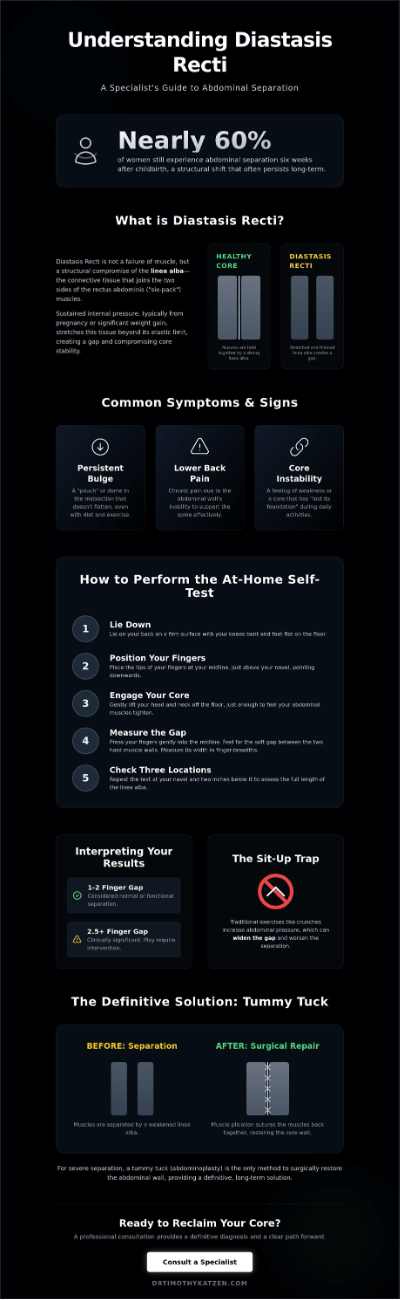
When you look in the mirror and see a persistent bulge despite your dedication to fitness, it's natural to feel a sense of betrayal by your own body. I often speak with patients who have spent months, or even years, trying to "exercise away" a midsection that refuses to flatten. To understand Diastasis recti, we must look past the muscle and focus on the connective tissue. This condition isn't a sign of weakness or a lack of willpower. It's a structural compromise where the two large parallel bands of the rectus abdominis muscles, commonly known as the "six-pack," lose their midline connection.
Ideally, these muscles meet perfectly at the center of your abdomen, held together by a sturdy band of fascia. When internal pressure becomes too great, this fascia thins and stretches, creating a gap. If you are wondering how to know if you have diastasis recti, you are essentially looking for evidence of this internal widening. This separation is driven by sustained intra-abdominal pressure that exceeds the tissue's ability to maintain its shape, leading to a functional breakdown of your core's integrity.
The Critical Role of the Linea Alba
The linea alba is the vertical seam of connective tissue that runs from your breastbone to your pubic bone. Think of it as the foundational anchor for your entire abdominal wall. During events like pregnancy or significant weight gain, this tissue is forced to expand. While our bodies are remarkably resilient, the linea alba has a physical limit. Once it's overstretched beyond its elastic threshold, it loses the ability to "snap back" to its original position. I describe this to my patients as a permanent geometric change. Because this is a tissue failure rather than a muscle failure, no amount of traditional strengthening can fully bridge a wide gap once the structural integrity is gone.
Who is at Risk? Beyond Pregnancy
While most literature focuses on the postpartum experience, I frequently treat individuals who have undergone massive weight loss. Rapid changes in body volume create a similar geometric strain on the abdominal wall. When a person carries significant weight, the abdominal wall expands to accommodate visceral and subcutaneous fat. After the weight is lost, the stretched linea alba remains, leaving a "pouch" that diet and cardio cannot resolve. Men are also susceptible, particularly those who have carried excess weight in the midsection or those who engage in improper heavy lifting that creates extreme internal pressure. Regardless of the cause, the resulting instability is a physical reality that requires a specialized approach to repair.
How to Perform a Diastasis Recti Self-Test at Home
Performing a self-assessment is the most empowering first step you can take toward reclaiming your core integrity. To begin, find a flat, firm surface like a yoga mat or a carpeted floor. Lie on your back with your knees bent and your feet flat on the ground. This position neutralizes your spine and allows for a more accurate reading of your abdominal wall's current state. I recommend doing this in a quiet space where you can focus on the tactile sensations of your muscles.
Place your fingers at the midline of your stomach, just above the navel, with your palm facing toward your face. While keeping your lower body relaxed, slowly lift your head and neck slightly off the floor. You don't need to perform a full crunch; the goal is simply to engage the rectus abdominis muscles. As you lift, press your fingers gently into the midline. You are looking for a gap between the two muscle bellies. This process is the most direct way to understand how to know if you have diastasis recti without specialized imaging.
Repeat this measurement at three specific locations to get a full picture of the separation. Test two inches above the navel, directly at the navel, and two inches below. Assessing all three zones is vital because the separation can vary in severity along the length of the linea alba. If you find a deep or wide gap, you might consider consulting with a specialist to discuss your findings and explore structural repair options.
Interpreting Your Results: Width vs. Depth
A gap of one to two finger-breadths is often considered functional or within a normal range for many individuals. However, if you can fit 2.5 fingers or more into the space, the separation is clinically significant. While width is a primary metric in Diastasis Recti Rehabilitation, the depth of the gap is equally telling. If your fingers sink deep into your abdomen with little resistance, it indicates that the connective tissue has thinned significantly. This loss of tension prevents the core from providing the necessary internal support.
Identifying Visual Doming or Coning
During your self-test or even during daily movements like sitting up in bed, watch for a specific visual cue known as coning or doming. This appears as a vertical ridge or a bread-loaf shape protruding from the center of your stomach during physical exertion. It happens because your core can no longer manage intra-abdominal pressure, forcing the abdominal contents to push against the weakened midline. Coning is the most reliable visual indicator of structural DR.
Common Symptoms: How Diastasis Recti Affects Your Daily Life
After you have navigated the initial steps of a self-test, the next stage in understanding your body is recognizing how a split core manifests in your everyday life. Diastasis recti is far more than a cosmetic frustration; it's a functional deficit that impacts your mobility, comfort, and long-term health. If you're still questioning how to know if you have diastasis recti, look closely at how your midsection behaves throughout the day. A telltale sign is a persistent protrusion or "pooch" that refuses to flatten, even if you've reached a low body fat percentage through rigorous dieting and exercise.
This abdominal separation creates a significant geometric imbalance within your torso. Think of your core as a pressurized cylinder that protects your internal organs and stabilizes your spine. When the front wall of that cylinder is compromised, the internal pressure shifts, forcing your lower back to bear an unnatural load. This structural failure is a primary driver of chronic lower back pain that often feels resistant to massage or physical therapy. Many of my patients also report co-occurring pelvic floor issues, such as stress incontinence. Because these muscle groups work in tandem, a weakness in the abdominal midline often translates to a loss of integrity throughout the entire pelvic cradle.
Functional Limitations and Postural Imbalance
A compromised midline fundamentally alters your posture and the way you move through the world. Without the support of the rectus abdominis, many individuals develop an anterior pelvic tilt, where the pelvis tips forward and the lower back arches excessively. This postural shift makes it difficult to stand tall or feel confident in your physical presence. Daily activities that require core engagement, like lifting heavy groceries, picking up a toddler, or even getting out of a car, become noticeably more difficult. You might feel a sense of internal instability, as if your core lacks the "anchor" it once had to protect you during physical exertion.
The Emotional Impact of the Persistent Pooch
The psychological toll of living with a post-weight loss bulge is profound and often overlooked in clinical settings. It's heartbreaking to work through a transformative weight loss journey only to feel like the final result is still out of reach. I see many patients who feel that their body doesn't accurately represent their health or their effort because of a belly that still looks "pregnant." Framing this as a structural tissue issue rather than a fitness failure is the first step toward emotional recovery. Restoring your abdominal wall is about more than just a flat stomach; it's about regaining your sense of self and finally finishing the odyssey you started years ago.
The Sit-up Trap: Why Traditional Exercise Often Fails
If you've been diligently performing hundreds of crunches to flatten your stomach only to see your midsection become more prominent, you've likely fallen into the "sit-up trap." It's a common misconception that strengthening the abdominal muscles will automatically pull a separated midline back together. In reality, traditional exercises like sit-ups and crunches create intense lateral tension that can actually widen the gap. When you contract these muscles without a stable foundation, you're effectively pulling the two sides of the rectus abdominis further apart. This thins the already compromised linea alba even more, making the separation worse over time.
During these movements, you might notice a distinct ridge or bulge forming down the center of your torso. This isn't muscle growth; it's your internal organs being pushed against a weakened midline. This visual cue is one of the most practical ways for how to know if you have diastasis recti during your daily routine. Bracing for a heavy lift or performing leg raises increases intra-abdominal pressure to a level that the connective tissue simply cannot contain. Recognizing this lack of control during exercise is a key component in how to know if you have diastasis recti and understanding why your current routine isn't yielding results.
High-Pressure Exercises to Avoid
I advise my patients to be extremely cautious with high-impact core movements. Exercises such as full sit-ups, double leg lifts, and heavy twisting movements like Russian twists can be detrimental. These motions place excessive strain on the vertical seam of your abdomen. If you see "doming" or "coning," which is that bread-loaf shape we discussed earlier, it's a clear signal from your body to stop the movement immediately. Continuing to push through these exercises can turn a mild separation into a significant structural failure. If you're struggling to find a workout that feels safe, scheduling a professional evaluation can help you determine the safest path forward.
When Physical Therapy Reaches a Plateau
Physical therapy is a vital tool for improving the function of the deep core and pelvic floor. It can teach you how to manage pressure and move more efficiently. However, there's a biological limit to what exercise can achieve. PT can strengthen the muscle bellies, but it cannot shrink or "heal" connective tissue that has been overstretched beyond its elastic limit. Many individuals reach a plateau where their core feels stronger, yet the physical gap and the associated "pooch" remain unchanged. At this stage, it's important to recognize that you haven't failed; rather, your tissue has reached its structural limit. Achieving a truly flat, integrated midsection often requires a surgical reset to restore the geometry of the abdominal wall.
Surgical Restoration: Repairing the Core with a Tummy Tuck
Once you have utilized the specialist's guide on how to know if you have diastasis recti and confirmed a significant structural gap, it's time to look toward a permanent resolution. For many of my patients, a Tummy Tuck is not merely a cosmetic choice; it's a functional necessity. While the term "tummy tuck" often brings to mind the removal of excess skin, the most critical component for those with abdominal separation is the internal repair of the abdominal wall. This procedure, known medically as an abdominoplasty, serves as the definitive solution for severe diastasis recti that exercise cannot reach.
I view this surgery as the celebratory final step in a patient's post-transformation odyssey. Whether you have completed a massive weight loss journey or finished your childbearing years, your body has undergone a profound geometric shift. A Tummy Tuck allows us to reset the clock on your anatomy. By addressing the separation at its source, we restore the internal support system that was lost, providing a foundation for both a flat, tight aesthetic and a strong, functional core. It's about moving from a feeling of being "broken" to a state of physical integrity.
How Muscle Plication Restores Structural Integrity
The cornerstone of a successful repair is a technique called muscle plication. During this process, I bring the separated rectus abdominis muscles back to the midline and secure them with permanent sutures. This creates what I often describe as an "internal corset." Unlike the overstretched fascia of the linea alba, these sutures provide immediate and lasting structural support. This intervention is life-changing, particularly for post-weight loss patients. It doesn't just flatten the stomach; it pulls the waistline in and provides the tension necessary for the core to function as a single, unified unit once again. This is a level of structural reinforcement that no amount of physical therapy can replicate.
The Katzen Approach to Total Body Transformation
My approach to body sculpting is rooted in the belief that every patient requires a personalized surgical plan that respects their unique history. For those who have experienced significant physical changes, a standard procedure is often insufficient. I specialize in advanced techniques, including the 360 lower body lift, to ensure that the entire torso is harmonized after a major life event. When we address diastasis recti, we aren't just fixing a gap; we're reclaiming your physical identity. I encourage you to view this surgery as a powerful tool for recovery. It's the moment where your external appearance finally aligns with the strength and health you've worked so hard to achieve.
Reclaiming Your Core Integrity
Understanding the state of your abdominal wall is the first step in resolving the persistent bulge and discomfort that often follows a major life transformation. You've learned that diastasis recti is a structural breakdown of the linea alba, rather than a failure of your fitness routine. By mastering the clinical self-test, you now possess the essential knowledge of how to know if you have diastasis recti and whether your symptoms require a more permanent intervention. While exercise can improve function, it cannot bridge a wide structural gap in the connective tissue once the elasticity is lost.
As a world-renowned specialist in post-weight loss surgery and advanced body contouring, I've dedicated my practice to helping individuals finish their odyssey with life-changing results. My board-certified expertise ensures that your surgical plan is as unique as your journey, prioritizing both your aesthetic goals and your long-term functional well-being. You don't have to live with a core that feels unstable or disconnected. Take the final step in your transformation and consult with Dr. Katzen today to explore how we can restore your physical identity together. It's time to celebrate the body you've worked so hard to achieve.
Frequently Asked Questions
Can diastasis recti go away on its own without surgery?
While mild cases may improve within the first year postpartum through targeted physical therapy, a significant structural separation rarely resolves on its own. Once the connective tissue of the linea alba has been overstretched beyond its elastic limit, it loses the ability to retract. For many, this results in a permanent gap that requires a Tummy Tuck to restore the abdominal wall's original integrity and function.
How many fingers wide is considered a bad case of diastasis recti?
In my clinical practice, I consider a gap of 2.5 finger-breadths or more to be a significant case. However, the width is only one part of the equation. We must also assess the depth and tension of the underlying tissue. A severe case often involves both a wide gap and a lack of resistance, where the fingers sink deeply toward the spine, indicating profound thinning of the protective fascia.
Is it ever too late to fix abdominal separation after pregnancy?
It's never too late to address abdominal separation, whether your last pregnancy was two years ago or twenty. The structural nature of the condition means the gap remains until it's physically repaired. Many of my patients seek a Tummy Tuck decades after childbirth as the final step in their personal odyssey. Restoring your core integrity can improve your quality of life and physical comfort at any age.
Can men get diastasis recti, and how is it different?
Men can certainly develop this condition, often due to rapid weight changes, visceral fat accumulation, or improper heavy lifting techniques. While the underlying anatomy of the separation is identical to that seen in women, the presentation in men is often masked by abdominal fat. Men typically seek answers on how to know if you have diastasis recti when they notice a vertical ridge appearing during exercise or struggle with unexplained lower back instability.
What happens if you leave diastasis recti untreated for years?
Leaving a significant separation untreated can lead to a cascade of functional issues over time. Without a stable midline, your body compensates by overtaxing the lower back and pelvic floor muscles. This often results in chronic lumbar pain, poor posture, and even digestive issues or urinary incontinence. Addressing the structural failure early prevents these compensatory patterns from becoming permanent lifestyle limitations that diminish your overall well-being.
Does insurance cover the cost of a Tummy Tuck for diastasis recti repair?
Insurance providers typically categorize a Tummy Tuck as a cosmetic procedure, even when it involves the repair of diastasis recti. While the functional improvements to your core are significant, most policies do not consider muscle plication a medical necessity. UnitedHealthcare's 2026 commercial medical policy, for example, does not consider the repair of diastasis recti to be a reconstructive procedure. I recommend reviewing your specific policy's criteria before proceeding.
Will a Tummy Tuck fix the back pain caused by my abdominal separation?
For many patients, a Tummy Tuck provides substantial relief from chronic lower back pain. By suturing the separated muscles back to the midline, we restore the abdominal wall's ability to support the spine and manage intra-abdominal pressure. This surgical reset corrects the geometric imbalance that forced your back muscles to overcompensate. Reclaiming this structural integrity often leads to a transformative improvement in daily comfort and physical stability.
What is the difference between a hernia and diastasis recti?
A hernia is an actual hole or tear in the abdominal fascia through which organs or tissue can protrude, often requiring urgent medical attention. In contrast, diastasis recti is a thinning and widening of the connective tissue without a full tear. While both conditions can cause a visible bulge, they require different surgical approaches. Knowing how to know if you have diastasis recti versus a hernia is a critical distinction we make during a professional evaluation