Is a Tummy Tuck Safe for Seniors? Risks, Candidacy, and Recovery
10/13/2026
META: Explore the safety of tummy tuck for seniors. Learn about surgical risks, candidacy criteria, anesthesia, and recovery planning to make an informed choice.
The safety of tummy tuck for seniors depends less on age itself than on overall health and readiness for recovery. It’s understandable to have questions about anesthesia, healing, and possible complications as you get older. But chronological age alone doesn’t determine whether surgery is appropriate.
A tummy tuck is a major procedure, so candidacy needs to be considered individually. Your medical history, how well ongoing conditions are managed, the scope of surgery, and the help available during recovery all matter. An individualized assessment can distinguish general concerns about aging from risks that are specific to you.
This article explains what clinicians consider when evaluating older adults, which complications to discuss, and how anesthesia planning and recovery support can inform a decision. A consultation with Dr. Timothy Katzen gives you an opportunity to discuss your health, goals, procedure options, and recovery needs.
Key Takeaways
- The safety of tummy tuck for seniors depends on personal health, functional ability, procedure scope, and recovery circumstances, not age alone.
- Understand which health history and surgical factors may affect risks such as infection, blood clots, and wound-healing problems.
- Compare a more limited plan with a more extensive operation, while recognizing that neither approach suits everyone.
- Prepare for an evaluation by organizing your goals, medical history, medications, and questions for the surgeon.
- Plan practical recovery support in advance, including help with daily activities, transportation, and follow-up care.
Table of Contents
- Is a Tummy Tuck Safe for Seniors? Why Age Alone Does Not Decide
- Which Health Factors Can Change Tummy Tuck Risks for Older Adults?
- How Do Health Status and Procedure Scope Compare With Age?
- How Can Seniors Prepare for a Safer Tummy Tuck Evaluation?
- What Should Seniors Expect From Tummy Tuck Recovery and Next Steps?
Is a Tummy Tuck Safe for Seniors? Why Age Alone Does Not Decide
Considering surgery later in life can bring practical questions: How might anesthesia affect me? Could healing take longer? Would an existing health condition change the risks? These concerns deserve an individual discussion, rather than a decision based on age alone.
A tummy tuck, also called abdominoplasty, is surgery that addresses selected abdominal skin and tissue concerns. The Abdominoplasty overview describes the procedure and its general approaches, but general information cannot determine whether surgery is appropriate for you. That requires a clinical assessment of your health, goals, and proposed operation.
What does “senior” mean in surgical decision-making?
There is no single age threshold that measures health or surgical fitness for everyone. People of the same age may have very different medical histories, mobility, energy, and ability to manage daily activities. A surgeon considers these factors alongside your goals and the extent of the operation being discussed.
Age alone cannot establish whether someone is a suitable surgical candidate. It does not guarantee candidacy, either. The safety of tummy tuck for seniors depends on individualized medical judgment and factors that can only be understood through a personal evaluation.
Why might an older adult consider a tummy tuck?
Some people are concerned about persistent abdominal skin or changes in contour after weight loss, pregnancy, or other life experiences. Others may not be bothered by these changes. Motivations differ, so it’s important to describe your own priorities rather than assume a particular outcome.
Start by identifying what matters to you: which abdominal concerns you hope to address, what changes you expect, and what recovery demands you can accommodate. In a consultation with Dr. Katzen, you can discuss those goals alongside your health history and the potential scope of a tummy tuck.
This article provides general information about safety and candidacy. It can help you prepare for a conversation, but it cannot replace an examination or a personalized assessment by a qualified plastic surgeon. The decision should reflect your circumstances, not a broad label such as “senior.”
Which Health Factors Can Change Tummy Tuck Risks for Older Adults?
A careful assessment looks beyond age to factors that may influence surgery and healing. For the safety of tummy tuck for seniors, the surgical team considers how your health history, physical function, procedure plan, and recovery circumstances interact. A health condition does not automatically rule out surgery, but it may affect planning or need further discussion.
How medical history and physical function inform evaluation
Heart and lung health, diabetes, previous operations, and current medications help shape an individual risk assessment. Your clinician may ask how well ongoing conditions are managed and review medicines or supplements that could affect surgery. Don’t stop or change a medication on your own; discuss it with your care team.
Daily function matters as well. Mobility, nutrition, and your ability to follow post-operative instructions can inform recovery planning. Smoking and any difficulty with routine activities are also important to discuss openly. These details help the team understand your starting point and what support may be useful at home.
What anesthesia and surgical risks should patients understand?
Anesthesia risk varies with personal health and the planned operation. The surgical and anesthesia teams assess these factors together and explain the approach for your situation. Tell them about previous reactions to anesthesia, current medications, and existing conditions so these details can be considered.
As with other major operations, a tummy tuck can involve complications. Potential risks include bleeding, infection, wound-healing problems, blood clots such as venous thromboembolism, and anesthesia-related concerns. The American Society of Plastic Surgeons outlines possible tummy tuck risks; your own risk profile may differ from general information.
Personal risk depends on the interaction between your health, physical function, procedure plan, and recovery circumstances. The extent of surgery matters: a more involved operation may place different demands on the body than a more limited plan. Neither option is right for everyone. Ask how the proposed scope relates to your goals and health.
Recovery arrangements belong in the safety conversation, too. Consider whether you’ll have help with daily tasks and a way to attend follow-up visits. Sharing these practical details during a personalized tummy tuck evaluation with Dr. Katzen can connect your health history and goals to a discussion of procedure scope and recovery needs.
How Do Health Status and Procedure Scope Compare With Age?
Chronological age provides context, but it doesn’t give a complete picture of surgical readiness. People of the same age may differ in medical history, energy, mobility, and support at home. A thoughtful evaluation considers the whole person and the operation being discussed, rather than treating older adults as uniformly frail or uniformly fit.
Age versus overall health: what is the meaningful distinction?
Health status and functional reserve describe how you are doing now and how well you may manage the demands of surgery and recovery. Clinicians consider these factors alongside your goals and discuss candidacy for a tummy tuck in light of your circumstances. No single age or health detail answers the question by itself.
| Factor | What it can tell the care team |
|---|---|
| Chronological age | Provides context, but doesn’t independently determine candidacy. |
| Health status | Medical conditions and how they are managed may affect planning. |
| Functional reserve | Mobility and ability to manage daily activities help frame recovery needs. |
| Recovery support | Practical help at home can be part of post-operative planning. |
How can the planned operation affect the discussion?
The proposed scope matters. A more limited plan may involve different operative demands than a more extensive tummy tuck, which can involve broader tissue treatment and a different recovery burden. The surgeon considers your goals, potential benefits, health factors, and recovery demands together. A smaller plan is not automatically safe for everyone, and a larger one is not automatically unsuitable for every older adult.
Combining a tummy tuck with another procedure can also change the overall plan. It may affect factors such as operative duration and the care needed afterward, so discuss potential benefits and added considerations in the context of your health and priorities. The decision should not rest on age-based assumptions.
For the safety of tummy tuck for seniors, the useful comparison is not simply “young versus old.” It is the relationship between personal health, functional reserve, procedure scope, and recovery resources. A consultation with Dr. Katzen can help clarify how these elements relate to your goals and the plan being considered.
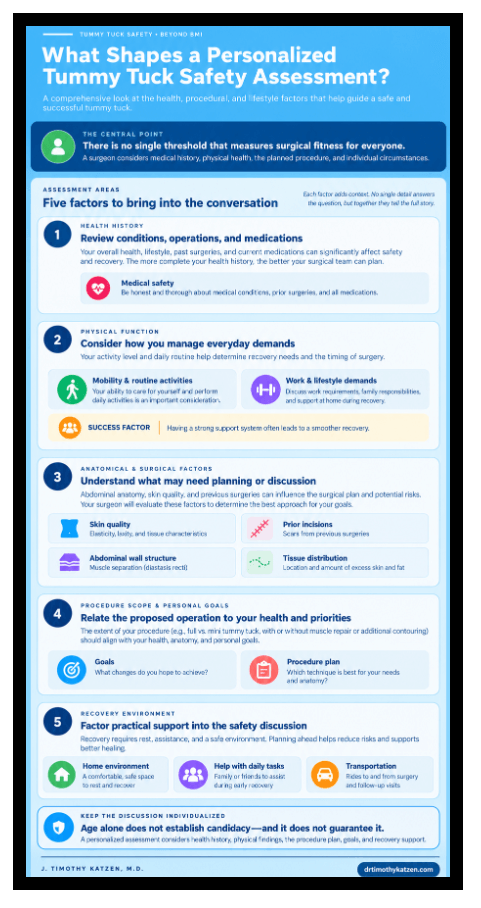
Infogram of What Shapes Candidacy for a Tummy Tuck
How Can Seniors Prepare for a Safer Tummy Tuck Evaluation?
Preparing for a consultation can make the discussion more focused. The aim isn’t to prove you’re ready for surgery. It’s to give Dr. Katzen a clear picture of your goals, health, and recovery needs so you can review potential benefits and risks together. This individualized conversation is central to assessing the safety of tummy tuck for seniors.
What information should patients bring to a consultation?
Use this sequence to organize the discussion:
- Clarify your goals. Describe the abdominal changes you hope to address and what a satisfying, realistic outcome would mean to you.
- Summarize your health history. Note relevant diagnoses, changes in your health, and previous surgeries or anesthesia experiences.
- Prepare a medication list. Include prescriptions, over-the-counter medicines, vitamins, and supplements. Be candid about nicotine use, too. Don’t stop or adjust anything without direction from your care team.
- Write down your questions. Include concerns about personal risks, the proposed procedure, assessment, recovery, and follow-up.
- Think through practical support. Consider your mobility and daily routine, who could help at home, and how you would get to follow-up visits.
Share complete and current details, including changes that might seem minor, such as a new symptom or a recent medication change. Be realistic about the support you can count on during recovery.
What questions help clarify personal benefits and risks?
Ask how your medical history and the proposed procedure influence the risk-benefit discussion. You can also ask what preoperative assessment is appropriate, whether your history calls for input from another specialist, and what recovery assistance and follow-up may be needed. Testing and specialist input depend on your health history and the treating team’s clinical judgment; they aren’t the same for every patient.
If an answer is unclear, ask for an explanation in everyday terms. Make sure you understand the reasoning behind the proposed plan, how its scope relates to your goals, and what practical preparations may help you follow post-operative instructions. A useful evaluation considers both medical details and the realities of your day-to-day life.
Use the consultation to raise questions openly, without feeling pressured to decide before you’re informed. Discuss your goals and questions with Dr. Katzen as part of a personalized tummy tuck evaluation.
What Should Seniors Expect From Tummy Tuck Recovery and Next Steps?
Recovery is individual. It can vary with your health, the extent of the tummy tuck, how your body heals, and your surgical team’s instructions. Instead of relying on a standard timeline, ask what to expect with the specific plan being considered and how to prepare for each stage of healing.
How can recovery support contribute to readiness?
Think through practical needs before surgery is scheduled. Depending on the plan, you may need someone to help with everyday tasks while you rest and follow your care instructions. Consider arranging:
- Help at home: Identify who can assist with meals, errands, or household responsibilities during the early recovery period.
- Transportation: Plan how you’ll get to and from appointments, especially if you won’t be able to drive.
- Follow-up access: Make sure you can attend scheduled visits and reach your care team if questions or concerns arise.
- A suitable home setup: Consider whether your usual sleeping and living arrangements will work with any movement guidance from your surgeon.
Discuss mobility, home responsibilities, and available support openly. If help is limited, say so. That information can help the team discuss whether the proposed plan and recovery arrangements fit your circumstances. Follow your surgeon’s instructions, and promptly report concerning symptoms or unexpected changes to your care team rather than trying to manage them alone.
When is it time to discuss an individualized plan?
A personal clinical assessment brings together your health history, goals, the procedure being considered, and your readiness for recovery. Age by itself cannot establish whether surgery is suitable, and no general article can predict an individual outcome. Asking detailed questions about safety is a normal part of making an informed decision.
Use the conversation to clarify what recovery may involve for you, what support you’ll need, and how the care team will guide follow-up. The decision should leave room to weigh your priorities alongside potential risks and recovery demands. A personalized evaluation with Dr. Katzen can help you explore those questions without assuming that one plan fits every patient.
Learn about tummy tuck care with Dr. Katzen and discuss your goals, health, risks, and recovery readiness as part of an individualized consultation.
Take the Next Step With a Personalized Safety Discussion
The safety of tummy tuck for seniors cannot be determined by age alone. Your overall health, functional ability, planned procedure, and recovery support all contribute to an individualized assessment. A thoughtful discussion can also clarify potential risks and whether your goals align with the demands of surgery and healing.
Bring your health history, medication list, questions, and recovery plans to the conversation. You don’t need every answer before you begin. Asking about anesthesia, procedure scope, and follow-up is a natural part of informed decision-making.
At J. Timothy Katzen, M.D., tummy tuck is a primary service at a board-certified plastic surgery practice. A personalized evaluation gives you an opportunity to discuss your health, goals, and recovery needs. Discuss your goals and questions with Dr. Katzen.
Your next step can be a conversation, not a commitment. Clear information and an individualized plan can help you make a decision grounded in your needs and priorities.
Frequently Asked Questions
Is a tummy tuck safe for seniors?
Safety can’t be determined by age alone. The safety of tummy tuck for seniors depends on an individual assessment of overall health, medical history, functional ability, anesthesia considerations, the planned procedure, and recovery support. Some older adults may be candidates, while health factors may make surgery unsuitable for others. A consultation helps weigh potential benefits and risks in the context of your circumstances, without guaranteeing a particular outcome.
What is the age limit for a tummy tuck?
There isn’t one age limit that determines candidacy for every patient. A clinician considers age alongside medical conditions, medications, mobility, personal goals, and the extent of surgery being considered. A birth date alone can’t establish whether an operation is appropriate. Discuss your health and desired outcome in a personalized consultation so the surgical team can assess your circumstances rather than rely on a universal cutoff.
Does age increase the risks of anesthesia for a tummy tuck?
Anesthesia risk varies from person to person and should be assessed in light of health history, medications, functional status, and the planned operation. Older age may prompt the care team to examine these factors carefully, but age alone doesn’t describe an individual’s full risk. Share previous anesthesia experiences and current health concerns so your surgical team can explain the assessment and precautions relevant to your situation.
What medical conditions can affect tummy tuck candidacy in older adults?
Heart or lung conditions, diabetes, medications, prior surgery, and other health factors can influence surgical planning, but their significance varies by person. Share complete, current information with your care team, including changes in your health and all medicines or supplements you take. The clinician can explain whether additional assessment or adjustments to the proposed plan may be appropriate. General information can’t determine individual eligibility.
How can seniors prepare for a tummy tuck consultation?
Bring a current list of prescription and over-the-counter medicines, supplements, relevant diagnoses, and details of prior surgeries. Write down your goals and questions about potential risks, anesthesia, the planned procedure, and recovery. Be ready to describe your daily function and the help you may have at home. These details help the surgeon consider your situation and explain which assessments or planning steps may apply.
What are the main risks of a tummy tuck for older adults?
Potential risks include bleeding, infection, wound-healing problems, blood clots, and anesthesia-related complications. The likelihood and impact of these risks vary with a person’s health and the procedure being considered. Ask your surgeon which concerns are most relevant to your history, how they factor into the plan, and which post-operative symptoms require prompt medical attention. Follow your care team’s instructions for reporting concerns.
How long does recovery take for seniors after a tummy tuck?
Recovery varies with the procedure, your health, and your surgeon’s instructions, so there isn’t one timeline for all older adults. Before surgery, discuss help with daily tasks, transportation to follow-up visits, activity guidance, and how to raise concerns with your care team. Follow your personalized instructions and avoid judging your progress by another patient’s experience. Contact your care team about unexpected symptoms or changes.