Non-Surgical Diastasis Recti vs. Surgery: Which Restores Your Core?
9/14/2026
You can perform every specialized core exercise in the book and still struggle with an abdominal bulge that refuses to flatten. It's a frustrating reality for many, but the truth is that muscle strength cannot always overcome a structural failure in your connective tissue. When you're weighing the merits of non-surgical diastasis recti treatment vs surgery, it's vital to understand that your "pooch" might not be a result of a lack of effort. It could be a physical gap that exercise simply cannot bridge.
I've spoken with many individuals who feel betrayed by their own bodies, dealing with persistent lower back pain and a midsection that feels disconnected from their true selves. You've likely tried the "safe" exercises and the binders, yet the results remain elusive. I want to help you find the clarity you deserve by explaining the critical differences between physical therapy and surgical repair. We'll explore the anatomical reality of your core to determine if your case is a matter of muscle tone or a structural separation that requires a more definitive, celebratory step in your restorative journey.
Key Takeaways
- Understand that diastasis recti is a structural thinning of the fascia, meaning core exercises alone may not close the gap if the tissue is severely stretched.
- Learn the critical distinctions in results and longevity when comparing non-surgical diastasis recti treatment vs surgery to determine if your condition requires muscular toning or structural repair.
- Discover why surgical muscle plication, often performed during a tummy tuck, is considered the gold standard for permanently restoring abdominal integrity.
- Evaluate the trade-offs between zero-downtime physical therapy and the transformative, long-term stability provided by surgical intervention.
- Explore how a comprehensive, 360-degree approach to abdominal restoration can address the unique challenges faced after significant weight loss or pregnancy.
Table of Contents
- Understanding Diastasis Recti: More Than Just a Cosmetic Bulge
- The Limits of Non-Surgical Treatments: What Physical Therapy Can and Cannot Do
- Surgical Repair: The Gold Standard for Structural Abdominal Restoration
- Non-Surgical vs. Surgery: A Direct Comparison of Results and Recovery
- The Katzen Approach: Total Abdominal Restoration After Weight Loss
Understanding Diastasis Recti: More Than Just a Cosmetic Bulge
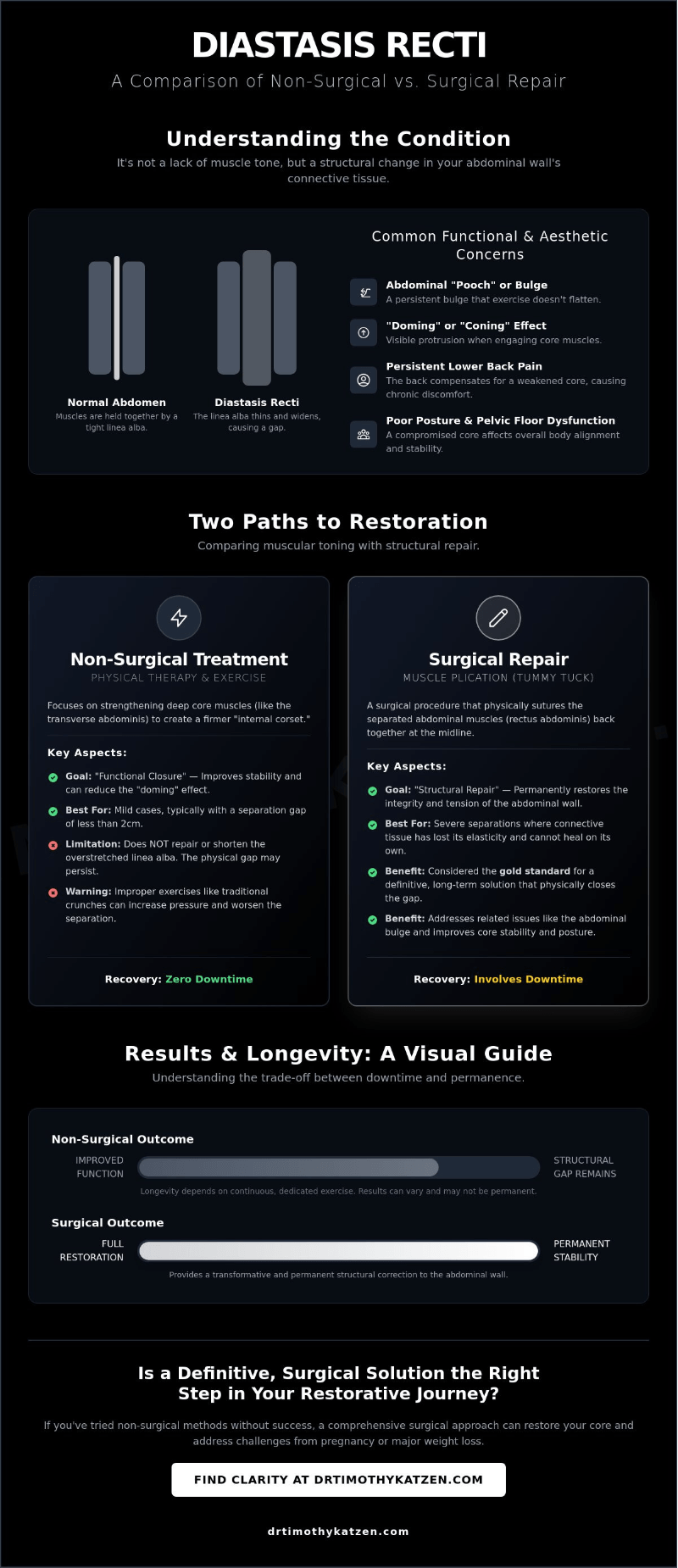
I often see patients who feel a deep sense of frustration, believing their post-baby or post-weight loss "pooch" is a personal failure of discipline. You've likely spent months, perhaps years, performing every abdominal exercise imaginable, only to find that the bulge remains. This is because diastasis recti is not merely a lack of muscle tone; it is a fundamental structural change in your abdominal wall. When we talk about understanding diastasis recti, we are looking at the thinning and widening of the linea alba, the connective tissue that holds your abdominal muscles together. It is a genuine medical condition that affects your stability and quality of life.
When this tissue loses its integrity, you might notice a distinct "doming" or "coning" effect when you sit up in bed or lift something heavy. This happens because your internal pressure is pushing against a weakened central seam that can no longer contain it. This structural failure leads to more than just aesthetic concerns. It ripples through your entire body, causing persistent lower back pain, poor posture, and even pelvic floor dysfunction. It is a complex issue that requires a nuanced perspective when evaluating non-surgical diastasis recti treatment vs surgery.
The Role of the Linea Alba
The linea alba serves as the primary anchor of the abdominal wall. During pregnancy or significant weight gain, this central tendon is stretched beyond its elastic limit. Much like a rubber band that has been pulled too far for too long, it can lose its ability to snap back. While muscles are highly adaptable and can be strengthened through resistance, overstretched fascia is a different biological challenge entirely. It lacks the contractility of muscle fiber, which is why structural gaps often persist despite intense physical training. When the anchor point is compromised, the entire core loses its ability to generate tension.
Functional vs. Aesthetic Concerns
Living with a compromised core affects your daily life in ways that go far beyond how you look in a swimsuit. A weak core makes simple tasks like walking, lifting a child, or even standing for long periods feel exhausting. Your back often takes the brunt of the work that your abdominals should be doing, leading to a cycle of chronic discomfort. Beyond the physical, the psychological impact of a permanent bulge can be heavy, especially after you've worked so hard to lose weight. You may find yourself constantly trying to "suck it in" to create a sense of stability, but this is a temporary mask for a structural problem that deserves a permanent solution.
The Limits of Non-Surgical Treatments: What Physical Therapy Can and Cannot Do
I see many patients who come to my office after months of dedicated effort in specialized physical therapy. I deeply respect the commitment required for diastasis recti rehabilitation; it is a vital first step for many individuals seeking to regain their strength. However, when we analyze the choice between non-surgical diastasis recti treatment vs surgery, we must be honest about what exercise can actually achieve. Specialized programs like the Tupler Technique or pelvic floor therapy focus on "functional closure." This means you are strengthening the deep transverse abdominis muscles to create a firmer internal corset. While this improves stability and can reduce the "doming" effect, it doesn't necessarily shorten or repair the overstretched linea alba.
One of the most pervasive misconceptions I encounter is that traditional "crunches" or sit-ups will pull the muscles back together. In reality, these movements often increase intra-abdominal pressure. This pressure pushes your internal organs against the weakened fascia, which can actually worsen the separation. True rehabilitation requires a meticulous focus on pressure management rather than just muscle contraction. If the connective tissue has lost its structural integrity, even the strongest muscles cannot fully close the gap.
The Reality of "Closing the Gap" Naturally
Success with non-surgical methods depends heavily on the initial degree of your separation. Clinical consensus suggests that patients with a gap of less than 2cm are often the ideal candidates for physical therapy. In these mild cases, improving muscle tone can provide enough support to mask the structural deficit. However, for those who have experienced massive weight loss, the connective tissue has often been stretched beyond its biological point of no return. In such instances, the skin and fascia have lost their elasticity. It's physically impossible for exercise to restore the original anatomy when the tissue itself has failed.
Modern Non-Invasive Technologies
In recent years, High-Intensity Electromagnetic (HIFEM) treatments have gained popularity for muscle toning. These devices induce thousands of "supramaximal" contractions to build the rectus abdominis. While these technologies are excellent for enhancing definition and strength, they are not a permanent fix for a structural gap. Similarly, abdominal binders and waist trainers provide external support and can serve as a helpful reminder to engage your core. They don't, however, remodel the underlying tissue. If you find that your progress has plateaued despite these interventions, it may be time to consult with a specialist about a more permanent structural solution.
Surgical Repair: The Gold Standard for Structural Abdominal Restoration
When the connective tissue of the linea alba has been stretched beyond its biological limit, no amount of exercise can physically pull those muscles back together. This is where the conversation regarding non-surgical diastasis recti treatment vs surgery reaches its most critical point. While physical therapy focuses on the function of the muscles, surgical intervention addresses the structure of the abdominal wall itself. Muscle plication is the surgical cornerstone of this transformation, involving the meticulous internal suturing of the abdominal fascia to close the gap permanently.
I often perform this repair as part of a Tummy Tuck, which provides the most comprehensive access to the entire abdominal wall. Depending on the extent of your separation, we may utilize a mini-tummy tuck for issues localized below the navel, or a full abdominoplasty for a complete restoration from the pubic bone to the ribs. Unlike the variable tension of muscle fibers, surgical sutures provide a fixed, reliable anchor that restores the integrity of your core once and for all.
The Plication Technique Explained
During the plication process, I carefully realign the rectus abdominis muscles and secure them with permanent, high-strength sutures. This technique creates a new internal corset that immediately restores intra-abdominal pressure and provides the stability your spine has been missing. By using permanent sutures to create a tight internal corset, I can ensure the results are structural and enduring. This repair not only flattens the abdomen but also provides the functional foundation necessary for you to return to an active, pain-free lifestyle.
Addressing Excess Skin and Fat
Tightening the internal structure often leaves a surplus of skin that no longer fits the new, smaller dimensions of your torso. This is why skin removal is a vital component of the restorative process. By combining muscle repair with liposuction and skin excision, I can achieve a contoured, geometric refinement of the midsection that exercise alone could never produce. Additionally, this surgical access allows me to address common secondary issues like an umbilical hernia, which frequently occurs at the site of the muscle separation. This all-encompassing approach ensures that your physical transformation is both functional and aesthetically celebratory.
Non-Surgical vs. Surgery: A Direct Comparison of Results and Recovery
Choosing the right path for your body requires a clear understanding of the trade-offs involved in each approach. When we weigh the merits of non-surgical diastasis recti treatment vs surgery, we are comparing two very different journeys. Physical therapy is a non-invasive commitment that requires zero downtime but demands lifelong maintenance to keep the muscles engaged and the "functional closure" intact. Surgery, by contrast, requires a recovery period of approximately 2 to 4 weeks, but it offers a permanent structural resolution that doesn't rely on constant exercise to maintain the internal alignment of your core.
I believe in being entirely transparent about the investment of time and energy. While non-surgical paths have a lower entry cost, many of my patients find that the emotional cost of persistent dissatisfaction eventually outweighs the convenience of exercise. Surgery involves the standard risks associated with any major procedure, yet for those with significant separation, it is often the only way to achieve the flat, firm abdomen they've worked so hard to uncover. It's a choice between managing a condition and truly correcting it.
The Decision Matrix: Which One Do You Need?
You can perform a simple assessment at home to gauge the extent of your separation. Known as the "finger test," you lie on your back with knees bent and gently press your fingers into the midline above your navel as you perform a small crunch. If you can fit three or more fingers into the gap, or if you feel a soft, deep space, you likely have a significant separation. I generally recommend surgery for patients with a gap wider than 3cm, those with visible skin laxity, or individuals who also have a symptomatic umbilical hernia. If your separation is mild and your skin remains resilient, starting with a dedicated physical therapy program is a wise and conservative first step.
Recovery Realities
If you choose the surgical path, the first 48 hours are focused on rest and gentle, assisted walking to promote circulation. You'll wear a specialized compression garment, which is essential for supporting the new internal contours and minimizing swelling. This garment is also a staple in many physical therapy programs to provide external feedback. While you'll be back to light daily activities within two weeks, I advise against heavy lifting or strenuous core workouts for at least 6 to 8 weeks. This patience ensures that the permanent sutures have ample time to integrate with your tissue, securing your results for the long term. If you're ready to move past the limitations of exercise alone, you can schedule a consultation with me to discuss your specific needs.
The Katzen Approach: Total Abdominal Restoration After Weight Loss
When you've lost a significant amount of weight, the victory is often bittersweet. You've conquered the scale, yet your body remains a map of your previous life, marked by loose skin and a core that feels fundamentally unstable. In my practice, I view abdominal restoration not as a simple cosmetic fix, but as the final, celebratory step of your long personal odyssey. My 360-degree philosophy ensures that we don't just tighten the front; we address the entire circumference of your midsection to create a harmonious, balanced result that reflects your hard-earned health.
Many practitioners offer standard procedures, but these often fall short for patients who have undergone massive physical changes. A traditional tummy tuck might address skin on the surface without fully repairing the deep, complex separation of the abdominal wall. When you are navigating the choice of non-surgical diastasis recti treatment vs surgery, it's essential to realize that post-weight loss tissue requires a specialized level of care. I focus on the geometric, three-dimensional restoration of your torso, ensuring that the internal repair is as meticulous as the external sculpting.
Expertise in Complex Body Contouring
I have spent my career working with individuals who have lost 100 pounds or more. These cases involve a level of tissue laxity and structural compromise that requires more than just basic suturing. Repairing a severely compromised abdominal wall is a methodical process. It demands a surgeon who understands the unique tension and blood supply of post-weight loss skin. My personalized care plans are designed to ensure that your core isn't just fixed, but fully reconstructed to support your new, active life. We look at the underlying anatomy to ensure the muscle plication is deep and enduring.
Your Consultation: What to Expect
During our initial meeting, I'll perform a thorough evaluation of both your core function and your aesthetic goals. We'll discuss the width of your separation and the quality of your skin to determine the most effective path forward. Whether you are local or one of the many patients who fly in from across the country, I offer both in-person and virtual consultations to make this process as seamless as possible. This is your opportunity to ask questions and feel fully informed about the complexities of your potential procedure. It's time to close the gap between the person you've become and the body you see in the mirror. Schedule your consultation with Dr. Katzen to reclaim your core today.
Reclaim Your Strength and Confidence
Your journey toward a restored core is about more than just aesthetics; it's about regaining the functional foundation of your body. We've explored the anatomical reality of your abdominal wall and the clear distinction between non-surgical diastasis recti treatment vs surgery. While physical therapy provides a valuable baseline for muscle tone, it cannot replace the structural permanence of internal plication. For those who've navigated the challenges of significant weight loss or pregnancy, a surgical solution offers the final, celebratory step in your physical transformation.
As a Board-Certified Plastic Surgeon and world-renowned expert in post-weight loss body contouring, I'm dedicated to providing the specialized care your body deserves. My approach focuses on long-lasting core restoration through meticulous internal plication techniques that go beyond standard repairs. You don't have to settle for a "functional closure" that requires constant maintenance when a permanent structural solution is within reach.
Begin your transformation journey with a personalized consultation. Together, we can design a path that honors your hard work and finally restores the strength and silhouette you've earned.
Frequently Asked Questions
Can I fix diastasis recti years after my last pregnancy?
Yes, you can absolutely address abdominal separation regardless of how much time has passed since your last pregnancy. Connective tissue and muscle fibers don't have an "expiration date" for repair, though the approach may change based on your current tissue elasticity. Whether you are exploring non-surgical diastasis recti treatment vs surgery, the goal is to restore the structural integrity of your midline that didn't resolve naturally during your initial postpartum recovery.
How do I know if my diastasis recti is severe enough for surgery?
Surgery is typically recommended if your gap is wider than 3cm or if you're experiencing functional symptoms that don't respond to physical therapy. If you notice persistent "coning" when you move or suffer from chronic lower back pain and pelvic instability, these are signs of a structural failure. I often see patients who have achieved great muscle strength but still have a visible bulge because the fascia itself has been stretched beyond its biological limit.
Will insurance cover the cost of diastasis recti repair?
In most cases, insurance companies consider diastasis recti repair a cosmetic procedure and won't cover the costs. This is true even when the separation causes functional discomfort like back pain. While there are very rare exceptions for documented medical necessity involving large ventral hernias, you should generally expect this to be an out-of-pocket investment in your long-term well-being and physical restoration.
What exercises should I absolutely avoid if I have a muscle gap?
You should avoid traditional crunches, sit-ups, and heavy twisting movements that cause your abdomen to dome or bulge outward. These exercises increase intra-abdominal pressure, which can actually widen the gap by pushing against the weakened linea alba. Planks and heavy lifting should also be avoided until you've learned to properly engage your deep transverse abdominis muscles, as improper form can worsen the structural separation you're trying to fix.
Is it possible for the muscle separation to return after surgery?
It's very rare for a surgical repair to fail once the muscles have been secured with permanent, high-strength sutures. However, the results can be compromised by a subsequent pregnancy or significant weight gain, which puts extreme pressure on the internal plication. To ensure your results last a lifetime, I recommend waiting until you've finished having children and have reached a stable weight before moving forward with a surgical repair.
Can I have more children after undergoing diastasis recti repair?
You can safely have children after the procedure, but it's not ideal for the longevity of your results. A new pregnancy will naturally stretch the abdominal wall again, which may undo the meticulous internal work performed during your surgery. If you do become pregnant after a repair, your body will adapt, but you might find that you require a secondary revision later to restore your original surgical outcome.
How much does surgery for diastasis recti typically cost?
The cost of the procedure varies based on the complexity of the muscle repair and whether it's performed in conjunction with other contouring steps. Since every body is unique, the surgical plan must be tailored to your specific anatomy and the degree of your separation. We provide a comprehensive breakdown of all associated fees during your private consultation so you can make an informed decision about your restorative journey.
What is the difference between a tummy tuck and a diastasis repair?
A tummy tuck is an all-encompassing procedure that removes excess skin and fat while a diastasis repair is the specific internal suturing of the abdominal muscles. While a diastasis repair focuses on the structural gap, it's almost always performed as part of a tummy tuck. This is because tightening the internal muscles usually creates a surplus of loose skin that must be removed to achieve a smooth, firm, and geometric result.