Pregnancy After Abdominoplasty: Safety, Aesthetics, and Expert Guidance
10/5/2026
What if the surgical masterpiece you've achieved isn't a barrier to your next chapter, but a resilient foundation for it? I often meet patients who fear that the internal sutures of their muscle repair might "burst" or that their skin simply won't have the capacity to expand for a growing baby. It's natural to feel protective over the flat, contoured abdomen you worked so hard to attain. You might worry that pregnancy after abdominoplasty will undo years of discipline and surgical precision.
I want to reassure you that your body is remarkably adaptable. A previous tummy tuck does not compromise fetal safety or your ability to carry to term. In this article, I'll provide the clinical clarity you need to navigate this journey with confidence. We'll discuss the anatomical realities of abdominal expansion, address the common sensation of second-trimester tightness, and establish a strategic plan for maintaining your aesthetic results once your family is complete. Your personal odyssey is far from over; it's simply evolving into a new, celebratory phase of life.
Key Takeaways
- Understand that pregnancy after abdominoplasty is medically safe, as both your skin and repaired muscles possess the natural elasticity required for a healthy term.
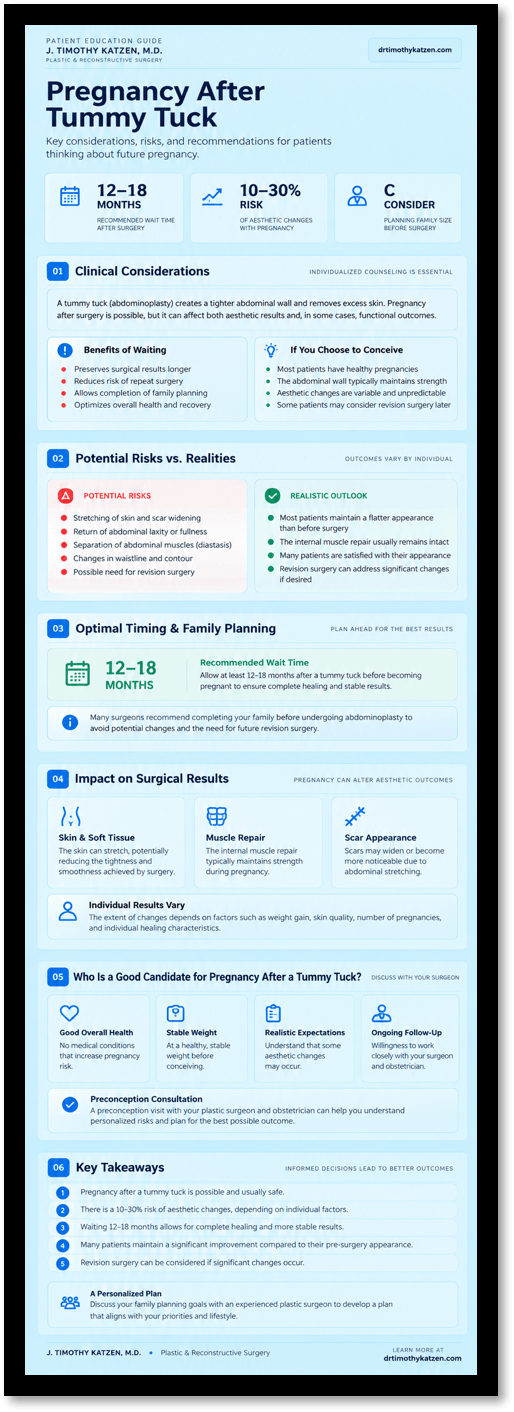
- Aim to wait between 12 and 18 months post-surgery before conceiving, allowing the internal surgical architecture to achieve its maximum structural integrity.
- Recognize that factors like genetics and controlled weight gain play a pivotal role in how your aesthetic results evolve during and after your pregnancy.
- View potential post-pregnancy changes not as a failure of surgery, but as an opportunity for a refinement procedure to restore your desired silhouette.
Table of Contents
- Clinical Safety: Can You Have a Healthy Pregnancy After Abdominoplasty?
- How Pregnancy Changes Your Tummy Tuck Results
- Optimal Timing: How Long Should You Wait After Surgery?
- Managing Your Body During Pregnancy Post-Tummy Tuck
- Restoring Your Transformation: Revision and Secondary Procedures


Clinical Safety: Can You Have a Healthy Pregnancy After Abdominoplasty?
The question I hear most often is whether the body can truly handle the demands of gestation after such a significant structural change. I can tell you with absolute certainty: yes, pregnancy after abdominoplasty is entirely safe for both you and your baby. Your body remains a biological marvel capable of incredible adaptation, even after we've refined its contours. While the skin and muscles have been tightened, they haven't lost their fundamental ability to expand when prompted by the hormonal shifts of pregnancy. Your internal organs and the uterus have ample room to move and expand within the abdominal cavity without restriction.
The Integrity of Muscle Plication
Many patients worry about the internal "corset" I create during surgery. During an abdominoplasty, I use permanent sutures to perform rectus plication, which brings the abdominal muscles back into their proper geometric alignment. You might imagine these sutures could "snap" under pressure, but that simply isn't how the body functions. The fascia, the tough connective tissue surrounding your muscles, acts as a flexible support system. As your uterus grows, this fascia naturally stretches. While the muscle repair may soften slightly to accommodate your child, it provides a stable environment that supports your core throughout the process without "ripping" or failing.
Fetal Development and Space
I want to dispel the myth that a "tight" stomach will restrict the baby's growth or lead to complications like pre-eclampsia. Clinical research confirms that pregnancy after abdominoplasty does not increase the risk of fetal growth restriction. The baby will find the space it needs, and the skin will continue to grow at a cellular level to meet the new demand. You might notice a sensation of "tightness" or feel "fuller" earlier in your second trimester than you did in previous pregnancies. This is a sensory experience rather than a physical limitation, occurring because we've removed the redundant skin that once allowed for an easy initial expansion. Abdominoplasty does not affect the ability to carry to full term.
I've found that acknowledging these sensations early on helps alleviate the anxiety that often accompanies these physical changes. You aren't "too tight" for a baby; your body is simply responding to the expansion with a different sensory profile. Trust in the resilience of your surgical results and the natural wisdom of your body during this transformative time.
How Pregnancy Changes Your Tummy Tuck Results
Watching the silhouette you've worked so hard to achieve begin to shift can feel like a loss of control. You've likely viewed your tummy tuck as the final, celebratory step of a long personal odyssey. It's vital to approach these changes with grace rather than anxiety. While pregnancy after abdominoplasty will inevitably stretch the tissues, the degree of change is highly individual. Your genetics, the amount of weight you gain, and your baseline skin quality are the primary architects of your post-pregnancy look.
I specifically want to address my patients who have undergone massive weight loss. Your skin has already endured significant trauma, which often compromises its underlying elasticity. This means your tissues might not retract as tightly after delivery compared to someone with "virgin" skin. This isn't a failure of your surgery; it's a biological reality of tissue dynamics. If you're feeling uncertain about how your previous transformation will hold up, scheduling a personalized evaluation can provide peace of mind and a clear plan for the future.
The Skin and Scars
As your abdomen expands, your surgical scar will naturally experience increased tension. While the scar itself rarely "bursts," it may widen or become slightly more prominent during the third trimester. I often recommend keeping the area well-hydrated to maintain suppleness. You might also notice new stretch marks. Since a tummy tuck removes the most damaged skin from the lower abdomen, any new marks usually appear on the remaining upper abdominal skin. Understanding the typical body changes during pregnancy can help you distinguish between normal expansion and cause for concern.
Recurrence of Diastasis Recti
The core of a tummy tuck involves repairing diastasis recti, the separation of the "six-pack" muscles. Pregnancy can re-separate these muscles as the uterus pushes outward. Some women maintain a remarkably flat profile after delivery, while others experience a recurrence of the bulge. This often depends on the tensile strength of your fascia. There is a distinct anatomical difference between skin laxity, where the skin is simply loose, and structural failure, where the internal muscle repair has stretched. Knowing which one you're experiencing is the first step toward planning any future restoration.
Optimal Timing: How Long Should You Wait After Surgery?
I often tell my patients that patience is the final ingredient in a successful surgical transformation. While your body begins to look its best around six months, the internal architecture is still hard at work. For those planning a pregnancy after abdominoplasty, the "Gold Standard" recommendation is to wait at least 12 to 18 months post-operatively. This window isn't arbitrary; it's based on the biological reality of how your body repairs itself at a cellular level. Internal scars and the fascia-the connective tissue I tighten during muscle repair-require this time to reach their full tensile strength.
Conceiving too early, such as within the first three to six months, can lead to significant physical challenges. During this early phase, your tissues are still in the inflammatory and proliferative stages of healing. If the abdomen begins to expand before these tissues have matured, you may experience heightened discomfort and a higher risk of the surgical scar widening or thickening. Consulting with your obstetrician and following the American College of Obstetricians and Gynecologists guidelines on preparing for pregnancy will ensure your body is ready for the metabolic and physical demands of gestation. If an "accidental" pregnancy occurs shortly after your procedure, please reach out to me immediately. We can coordinate with your OB/GYN to monitor your incision and muscle repair as your journey progresses.
The Healing Timeline
The first six months after surgery are dedicated to tissue building and initial scar formation. From month six to twelve, you enter the remodeling phase, where the scar tissue softens and becomes more flexible. This flexibility is what allows your abdomen to expand comfortably during pregnancy. I also emphasize the importance of reaching a stable weight before conceiving. Entering pregnancy at your post-surgical "goal weight" provides a more predictable baseline for your skin and muscle response, ensuring the best possible long-term outcome for your silhouette.
Planning Your Family and Your Surgery
I view plastic surgery as a celebratory step, but the sequence of that step matters for your lifestyle goals. If you anticipate starting or expanding your family within a year, it's often wiser to delay your tummy tuck. This allows you to enjoy your results without the immediate interruption of pregnancy-related changes. Many patients find that the "Mommy Makeover" approach-combining abdominal contouring with breast restoration-is the most rewarding path once their childbearing years are officially complete. This strategic timing ensures that your surgical investment remains a permanent part of your personal odyssey.
Managing Your Body During Pregnancy Post-Tummy Tuck
Maintaining the integrity of your surgical results during pregnancy requires a proactive, partnership-based approach. While your body is naturally equipped to handle the expansion, your choices during these nine months will influence how well your skin and muscles retract after delivery. Pregnancy after abdominoplasty is not a period where you must simply wait and see; it's a time to actively support your tissues. By focusing on stability and support, you can protect the geometric refinements achieved during your initial procedure.
Consistency is vital. I encourage my patients to view this chapter as a continuation of their wellness journey. While you cannot prevent every physical change, you can certainly mitigate the long-term impact on your abdominal contour. If you find yourself concerned about specific changes as they occur, scheduling a virtual check-in can help us monitor your progress and provide tailored advice for your unique anatomy.
Diet and Weight Management
Your obstetrician will establish a target weight gain range based on your baseline health. Staying within these clinical parameters is the most effective way to minimize permanent skin stretching. Rapid or excessive weight gain places mechanical stress on the dermal layers, which can lead to new laxity that may not fully resolve post-partum. I recommend a nutritional focus on collagen-supporting foods, such as those rich in Vitamin C, zinc, and lean proteins. These nutrients provide the building blocks your skin needs to maintain its resilience as it expands to accommodate your growing child.
Physical Comfort and Support
Many women experience a pronounced sensation of "tightness" in the second and third trimesters. This occurs because the abdominal wall is more restricted than in a typical pregnancy. Maternity support belts are an excellent tool for alleviating this pressure. These garments redistribute the weight of the uterus, reducing the pull on your surgical scars and repaired muscles. Additionally, gentle movement is beneficial. Consider the following to maintain your core health:
- Prenatal Yoga: Focuses on flexibility and controlled breathing to help the abdominal wall adapt to new dimensions.
- Pelvic Floor Exercises: Maintains internal support without placing direct strain on the rectus plication.
- Walking: Promotes circulation, which is essential for tissue health and scar maintenance.
Distinguishing between normal pregnancy discomfort and surgical concerns is important. You should report sharp, localized pain at the incision site or a sudden loss of muscle support to your surgeon. However, general pressure, Braxton Hicks contractions, and typical fetal movement fall under the care of your obstetrician. Open communication between your medical team ensures that both your pregnancy and your surgical results are managed with the highest level of care.
Restoring Your Transformation: Revision and Secondary Procedures
I view pregnancy not as an event that ruins a tummy tuck, but as a natural, meaningful chapter in your life's odyssey. If pregnancy after abdominoplasty has altered your initial results, a secondary procedure serves as a sophisticated refinement rather than a start from scratch. A revision abdominoplasty focuses on addressing the specific changes caused by gestation, such as new skin laxity or a minor recurrence of muscle separation. Unlike your first transformation, which may have involved massive weight loss and significant tissue removal, a revision is often a more targeted intervention. My goal is to restore the precise, 360-degree contour we previously achieved, ensuring your silhouette aligns with your post-motherhood lifestyle.
Timing is the most critical factor when considering a restoration. I recommend waiting at least six months after childbirth before we discuss surgical options. This window allows your body to fully recover from the metabolic demands of pregnancy and breastfeeding. Your skin needs this time to naturally retract, and your weight should be stable. This ensures that the adjustments I make are based on your true post-pregnancy baseline. By waiting until your internal environment has settled, we can achieve a more predictable and lasting outcome.
Options for Post-Pregnancy Refinement
Not every patient requires a full secondary tummy tuck. Depending on the extent of the changes, we might consider a mini revision to address only the lower abdominal area. Liposuction is also a powerful tool in my repertoire; it allows me to sculpt away persistent fat deposits that often accumulate in the flanks or upper abdomen during pregnancy. If you had a C-section, I can often incorporate the resulting scar into your revision. This allows me to smooth out any shelving or irregularities, creating a seamless, flat profile once again. We will tailor the intervention to the specific geometric changes your body has experienced.
The Final Step in the Journey
Reclaiming your body after the transformative experience of motherhood is a deeply personal and celebratory process. It's about more than just aesthetics; it's about feeling at home in your skin again. A secondary procedure is frequently less complex than the initial surgery because the foundational work on the abdominal wall has already been established. We are simply polishing the results to match your current goals. My role is to be your partner in this final phase, ensuring your transformation remains a source of confidence for the years ahead.
Schedule a consultation with Dr. Katzen to discuss your post-pregnancy options.
Embracing Your Body's Next Chapter
Your body's ability to nurture new life is a testament to its resilience, even after a significant physical transformation. We've established that pregnancy after abdominoplasty is clinically safe and that your surgical results, while they may shift, are not permanently lost. By waiting for the optimal healing window and managing your health proactively, you can navigate this chapter with peace of mind. Your previous surgery provides a stable foundation that adapts alongside you throughout this transition.
As a Board-Certified Plastic Surgeon and a pioneer in 360 lower body lifts, I've dedicated my career to helping patients achieve and maintain their aesthetic goals through every stage of life. Whether you're currently planning a family or seeking to restore your silhouette after childbirth, I'm here to serve as your dedicated partner. As a world-renowned body contouring specialist, I'll provide the expert guidance needed to refine your results. Your personal odyssey is a lifelong process, and I'm honored to help you navigate its most celebratory chapters with confidence and hope.
Refine Your Transformation-Consult with Dr. KatzenRefine Your Transformation-Consult with Dr. Katzen
Frequently Asked Questions
Can a tummy tuck cause complications during labor or delivery?
A tummy tuck does not cause medical complications during labor or delivery. The procedure involves the abdominal wall and skin, which are separate from the reproductive organs and birth canal. Your uterus will expand normally, and the mechanics of delivery remain unchanged. Obstetricians regularly manage patients who have had prior abdominal surgeries without increased risk to the mother or child during the birthing process.
Will I feel more pain during pregnancy because of my previous tummy tuck?
You might experience a heightened sensation of abdominal tightness rather than acute pain. Because the excess skin was removed during your previous surgery, the initial expansion in the second trimester can feel more restrictive. This is a sensory response to the skin and repaired muscles stretching to accommodate the baby. Most women find this sensation manageable and report that it subsides as the tissues gradually adapt.
Is a C-section safe if I've had an abdominoplasty?
Yes, a C-section is entirely safe for women who have undergone an abdominoplasty. Your obstetrician is trained to navigate various abdominal topographies and surgical histories. While the presence of scar tissue from a tummy tuck requires a meticulous approach, it does not prevent a safe surgical delivery. I recommend informing your OB/GYN about your muscle repair so they can be mindful of the internal sutures during the procedure.
What happens to my tummy tuck scar if I have a C-section?
Most obstetricians will attempt to perform the C-section through your existing tummy tuck scar to minimize new visible marks. If the C-section is performed lower or higher, you may end up with a secondary scar or slight distortion of the original line. In many cases, I can refine these combined scars during a post-pregnancy revision to restore the smooth, low-profile appearance we initially achieved for your silhouette.
Can I have another tummy tuck after my pregnancy is over?
You can certainly have a secondary procedure once you have finished having children and your body has recovered. A revision tummy tuck is a common way to address new skin laxity or muscle separation that occurred during pregnancy. This refinement is often less invasive than the original surgery. I typically recommend waiting at least six months after delivery or breastfeeding to ensure your tissues have reached a stable baseline.
Will my muscles "pop" if I get pregnant after a tummy tuck?
Your internal muscle repair will not "pop" or burst during pregnancy. The permanent sutures used in rectus plication are incredibly strong, and the surrounding fascia is naturally flexible. While the muscles may gradually separate again to accommodate the growing uterus, this is a slow, biological stretching process rather than a sudden mechanical failure. Pregnancy after abdominoplasty is supported by the inherent resilience of your abdominal wall architecture.
How much weight can I safely gain without ruining my tummy tuck?
I recommend adhering strictly to the weight gain ranges provided by your obstetrician, which typically fall between 25 and 35 pounds for a healthy BMI. Excessive weight gain is the primary factor that leads to permanent skin stretching and the loss of surgical definition. By maintaining a controlled, healthy weight, you provide your skin and muscles with the best chance of retracting naturally once your baby is born.
Does insurance cover a revision tummy tuck after pregnancy?
Insurance providers generally do not cover a revision tummy tuck after pregnancy, as it is classified as an elective cosmetic procedure. Even if your original surgery was part of a reconstructive odyssey after massive weight loss, post-pregnancy refinements are viewed as aesthetic enhancements. My office can provide a detailed breakdown of surgical fees and help you plan for this celebratory final step in your body's transformation journey.