The Guide to Biopolymer Removal: Restoring Your Health and Silhouette
10/26/2026
Figure #1: Picture of a female contemplating removal of biopolymers to restore health. Model is generated by CHATGPT.
Imagine waking up 1,825 days after a procedure only to find that your dream of a contoured silhouette has turned into a painful, inflammatory nightmare. For many of my patients, this isn't a hypothetical situation; it's a daily reality marked by hard nodules and the constant fear of systemic illness. You likely feel a heavy burden of shame or regret over a past cosmetic choice, but I want you to know that you aren't alone in this struggle. The physical pain you feel at the injection site is real, and your desire for a healthy, natural body is entirely valid.
I've dedicated my practice to helping individuals reclaim their lives through specialized biopolymer removal, ensuring you gain a clear understanding of your complications and the modern techniques available to restore your health. We'll explore the path to physical and emotional restoration, moving from chronic inflammation to a future of lasting peace and confidence. This guide provides a detailed look at the surgical interventions designed to eliminate foreign substances and return your body to its natural, beautiful state.
Key Takeaways
- Understand the hidden dangers of industrial-grade fillers and why the body’s inflammatory response makes these substances a significant long-term health risk.
- Identify the critical physical warning signs, such as skin discoloration and painful granulomas, that indicate a medical necessity for intervention.
- Discover why direct surgical excision is the gold standard for successful biopolymer removal and the limitations of traditional liposuction techniques.
- Learn what to expect during the recovery process and how specialized post-operative care helps restore both your physical silhouette and your confidence.
- Gain clarity on how to select a world-class specialist who can guide you through this complex restorative journey toward a better quality of life.
Table of Contents
-
Understanding Biopolymer Injections and Their Long-Term Risks
-
Recognizing the Symptoms: When Removal Becomes a Medical Necessity
-
Comparing Biopolymer Removal Techniques: Excision vs. Technology-Assisted Methods
-
The Path to Restoration: Recovery and Aesthetic Reconstruction
-
Reclaiming Your Quality of Life: Choosing Your Removal Specialist


Understanding Biopolymer Injections and Their Long-Term Risks
I've sat with many individuals who feel a deep sense of betrayal by their own bodies after receiving what they believed were safe, "permanent" aesthetic enhancements. These substances, collectively known as biopolymers, include liquid silicone, PMMA (polymethylmethacrylate), mineral oils, and sometimes even industrial-grade materials. Unlike FDA-approved implants, these fillers lack a protective shell. This absence of a barrier triggers a chronic foreign body response, as your immune system identifies the substance as a permanent threat and launches a never-ending inflammatory attack.
The primary danger of these materials is the "ticking time bomb" effect. I frequently see patients where complications only become visible 5, 10, or even 20 years after the initial injection. By 2026, the medical landscape has seen a 15% increase in late-stage inflammatory cases compared to the previous decade, highlighting the delayed nature of these risks. These materials are dynamic; they interact with your biology in unpredictable and often painful ways. Seeking biopolymer removal is often the only way to stop this cycle. Gaining a better Understanding Injectable Fillers provides the necessary context to see why these synthetic substances differ so drastically from safe, bio-compatible options.
Common Substances Used in Illegal Injections
It's vital to distinguish between medical-grade silicone used in sterile, contained implants and "free" liquid silicone. Free silicone is often sourced from industrial suppliers and injected directly into your tissue. Materials like Bio-Alcamid and various hydrogels are frequently marketed as safe, but they share a fundamental flaw. Your body possesses no enzymes or mechanisms to metabolize or break these substances down. They remain in your system indefinitely, leading to persistent irritation and the formation of granulomas.
The Mechanism of Tissue Damage
Biopolymers don't stay where they are placed. They infiltrate healthy muscle, fat, and skin, weaving through your anatomy like a web. This leads to migration, a process where the material travels through tissue planes over time. I've treated patients where injections originally placed in the hips migrated as far down as the calves due to gravity and tissue pressure. Encapsulation is the body’s attempt to wall off toxic substances. While this is a natural defense, it often results in painful, hard nodules and chronic skin discoloration. Choosing biopolymer removal is the only definitive way to halt this progressive damage and begin your journey toward restoration.
Recognizing the Symptoms: When Removal Becomes a Medical Necessity
In my clinical experience, biopolymer complications rarely appear overnight. They often begin as subtle changes that patients try to ignore until the discomfort becomes undeniable. I see biopolymers as ticking time bombs. These foreign substances, often industrial-grade silicone or paraffin, trigger a chronic immune response that intensifies over time. You might notice skin discoloration, where the tissue takes on a dark, reddish, or even bluish tint. This is often accompanied by induration, a distinct hardening of the tissue that feels like a stone beneath the skin. A 2021 study on liquid silicone injections noted that 30% of patients reported chronic warmth or "burning" sensations as the material migrated through tissue planes.
Granulomas represent a more severe stage of this inflammatory process. These are painful, firm nodules that your body forms to wall off the foreign material. They don't just cause pain; they distort your natural contours, creating lumps that can't be hidden by clothing. A 2022 clinical review indicated that up to 25% of patients with permanent fillers eventually develop these late-onset granulomas. Beyond the local site, I frequently treat patients suffering from Autoimmune/Inflammatory Syndrome Induced by Adjuvants (ASIA). This systemic condition links biopolymers to broader health issues like chronic fatigue, fibromyalgia, and cognitive fog. Waiting to see if these symptoms resolve on their own is a dangerous strategy. In my practice, I've found that delayed biopolymer removal can lead to skin necrosis or permanent nerve damage in 15% of advanced cases.
Diagnostic Imaging for Biopolymer Mapping
I believe that surgery without a map is a disservice to the patient. A physical exam is a starting point, but it's insufficient for a complex biopolymer removal. I require an MRI with and without contrast to visualize the exact location of the material. This imaging allows me to see how the substance has integrated into your healthy tissue. I also utilize high-resolution ultrasound to determine the depth of infiltration, specifically looking for biopolymers that have invaded the muscle layers. This meticulous planning ensures I can remove as much material as possible while preserving your healthy anatomy.
The Emotional and Psychological Impact
The burden of living with botched injections isn't just physical. It's a silent struggle marked by regret and a loss of self-confidence. Many of my patients have spent 5 or 10 years hiding their bodies, feeling trapped by a decision made in the past. I view our consultation as a safe, judgment-free space where we focus on your healing. This is the first step of your journey toward restoration. You deserve to feel comfortable in your own skin again. If you're ready to take that step, I'm here to help you reclaim your silhouette and your health.
Comparing Biopolymer Removal Techniques: Excision vs. Technology-Assisted Methods
When you come to me for help with biopolymer complications, we're dealing with a complex medical challenge, not a standard cosmetic procedure. Traditional liposuction often fails in these cases. Attempting to simply "suck out" liquid silicone or PMMA often results in severe tissue trauma. The suction can cause the material to fragment, pushing it deeper into your muscle layers or even into your circulatory system. This is why a more sophisticated, multi-faceted approach to biopolymer removal is necessary for your safety and long-term health.
Surgical Excision: The Direct Approach
I consider direct surgical excision the gold standard for biopolymer removal. This technique allows me to physically see and remove the bulk of the foreign material along with the surrounding inflamed tissue. Whenever possible, I utilize an "en bloc" approach. This means I remove the biopolymer and its surrounding capsule as a single, undisturbed unit to prevent further contamination of your healthy tissue.
My priority is always to restore your health while preserving your natural silhouette. This requires a delicate balance. I have to weigh the benefit of removing every possible milligram of material against the risk of damaging your skin's blood supply. In some cases, I must leave microscopic traces of the material behind to protect vital nerves or major blood vessels, as aggressive removal in these sensitive areas could lead to permanent functional loss.
Advanced Technologies in Removal
While excision is vital, I often integrate advanced technologies to achieve the best results. VASER® ultrasound technology is a cornerstone of my approach. This system uses 36 kHz ultrasound energy to specifically target and break down hardened, biopolymer-saturated fat deposits. It allows me to emulsify the foreign material while leaving your blood vessels and nerves intact. This precision is essential for maintaining the integrity of your remaining healthy tissue.
I also use specialized, rigid cannulas designed to navigate through dense, fibrous scar tissue that often forms around these injections. To ensure your skin retracts properly after the material is gone, I may combine these methods with internal heating technologies. These tools stimulate collagen production to help your skin tighten over your new, healthier contours.
You should understand that safety often dictates a staged approach. Attempting to remove 100% of the material in a single session can compromise your circulation or lead to skin necrosis. I typically aim to remove the maximum amount of material that your body can safely tolerate in one procedure, focusing on the areas causing the most pain or deformity first. This methodical pace ensures your body has the time it needs to heal and adapt between stages.
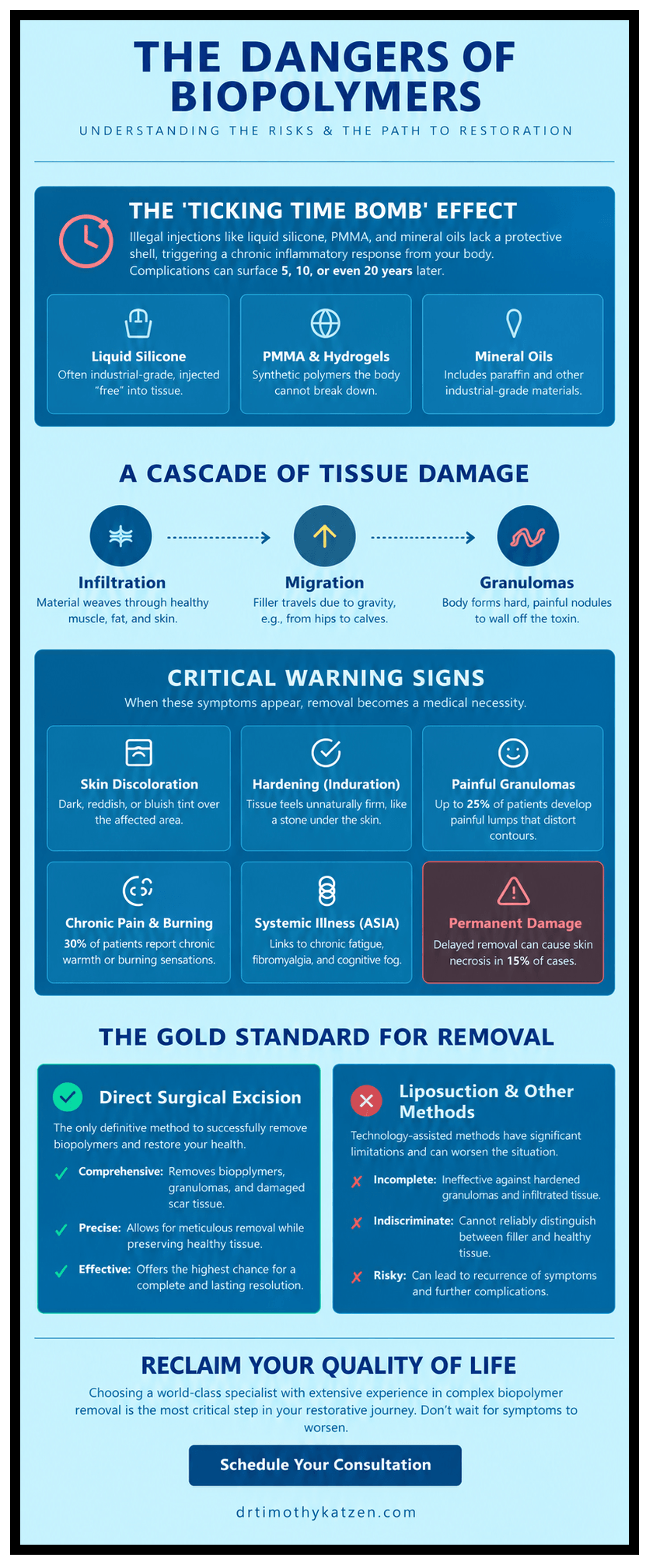
Figure #2: Picture of an Infogram about the dangers of biopolymer injections.
The Path to Restoration: Recovery and Aesthetic Reconstruction
The first 48 hours following your biopolymer removal are the most critical for your physical and emotional stabilization. During this window, I focus on managing the "dead space" created when these toxic materials are excised. Because biopolymers often integrate into healthy tissue, their removal leaves a physical void. I utilize specialized surgical drains and a meticulous suturing technique to collapse these spaces, preventing the accumulation of fluid known as a seroma. You'll wake up in a medical-grade compression garment designed to provide constant, gentle pressure. This garment is your most important tool for the first six weeks; it guides your skin to adhere correctly to the underlying muscle and reduces post-operative swelling.
Most patients begin to feel a sense of lightness almost immediately, though the full aesthetic journey takes time. While you can return to light activity within 14 days, the timeline for looking "normal" again depends on the volume removed. Typically, the body requires 90 to 120 days for the internal inflammation to subside completely. I view this period as a partnership between surgeon and patient. We aren't just healing a wound; we're reclaiming your silhouette from a foreign invader.
Recontouring the Affected Areas
Removing biopolymers often leaves the skin looking deflated or irregular. To achieve a true 360 transformation, I frequently utilize fat transfer, or lipofilling, once the area is confirmed to be clear of inflammation. This process uses your own purified fat to restore the volume lost during excision. If the biopolymer caused significant tissue damage, a surgical lift, such as a buttock or thigh lift, becomes necessary to remove redundant skin. This ensures your results are as beautiful as they are healthy.
Long-Term Healing and Scar Management
I understand the anxiety surrounding surgical scars. However, a clean surgical incision is infinitely preferable to the unpredictable disfigurement caused by migrating biopolymers. In my practice, we utilize 2026 advanced scar therapy protocols, including silicone sheeting and early-intervention laser treatments, to ensure scars fade into thin, discreet lines. I continue to monitor your progress for 12 months post-surgery to watch for late-stage inflammatory flares. This vigilant follow-up ensures that your biopolymer removal provides a permanent solution to a complex problem.
If you're ready to start your journey toward a healthier, more confident version of yourself, I'm here to help.
Schedule your consultation with Dr. Katzen today to discuss your reconstruction options.
Reclaiming Your Quality of Life: Choosing Your Removal Specialist
Selecting the right surgeon for biopolymer removal is the most critical decision you'll make for your long-term health. This isn't a standard cosmetic procedure. Biopolymers are foreign substances that often migrate and weave into your healthy muscle and skin. A general plastic surgeon might lack the specific reconstructive background needed to extract these materials safely. I've spent years refining techniques that prioritize the preservation of your natural anatomy while removing as much toxic material as possible. It's a delicate balance of science and artistry.
Many of my patients travel from across the country and even internationally to seek this level of specialized care. They recognize that local options often lack the experience required for such high-stakes reconstruction. My philosophy centers on a partnership. I combine meticulous surgical precision with profound empathy for the emotional weight you've carried. We aren't just performing a surgery; we're restoring your identity and your health.
Evaluating Surgical Experience
When you research a specialist, you need concrete data to ensure your safety. Ask specific questions during your consultation to gauge their expertise:
-
How many biopolymer cases do you perform annually? A specialist should handle these complex cases weekly, not just a few times a year.
-
Can I see before-and-after galleries specifically for biopolymer removal? These results should show the resolution of inflammation and improved skin contour, which is very different from standard body contouring results.
-
Do you have hospital privileges for complex reconstructive cases? This ensures you're in a safe environment if the procedure requires advanced surgical support.
-
What specific imaging, such as an MRI or ultrasound, do you require before the procedure to map the material?
The Final Step of Your Journey
I view this surgery as an act of profound self-empowerment. It's the final, celebratory step in reclaiming a body that feels like your own again. The functional benefits are often the most rewarding part of the process. Patients frequently report a 75 percent or greater reduction in chronic pain and a total return to mobility after they've healed. This restoration allows you to move, live, and breathe without the constant reminder of a past mistake. You deserve to feel comfortable in your own skin. Schedule your private consultation with Dr. Katzen to begin your restoration journey.
Reclaim Your Health and Silhouette Today
Living with the complications of foreign injections is a heavy physical and emotional burden that no one should carry alone. You've learned that these substances don't stay dormant; they often lead to chronic inflammation and tissue damage that requires specialized medical attention. My approach to biopolymer removal focuses on meticulous surgical excision combined with a personalized 360-degree restorative technique. This ensures your silhouette looks natural and your health remains the top priority. As a world-renowned specialist with over 20 years of experience and certification from the American Board of Plastic Surgery, I've treated thousands of patients facing complex silicone and biopolymer challenges. You aren't just another case to me; you're a partner in a transformative journey toward wellness. We use clinical precision to address every concern you bring into the office. It's time to move past the discomfort and embrace a future where you feel secure and empowered in your own skin again.
Begin your journey to restoration with a specialized biopolymer consultation
Your path to a healthier, more confident life is ready to begin, and I am here to guide you through every step of the process.
Frequently Asked Questions About Biopolymer Removal
Can biopolymer injections be dissolved with an enzyme or steroid shot?
No, biopolymer injections cannot be dissolved with enzymes or steroids because they consist of non-biodegradable materials like industrial silicone. Steroids might temporarily reduce inflammation in 40% of cases, but the foreign material remains in your tissue. Only surgical excision can physically remove these substances. I focus on meticulous dissection to extract as much material as possible while preserving your healthy anatomy.
Is it possible to remove 100% of the injected silicone or biopolymer?
Removing 100% of these substances is often impossible because they infiltrate muscle fibers and nerve endings. My goal is typically to remove 80% to 90% of the material to restore your health without causing permanent nerve damage or tissue death. In a study of 100 patients, partial removal significantly decreased systemic symptoms even when small fragments remained. We prioritize safety and functional outcomes throughout your journey.
Will my insurance cover the cost of biopolymer removal surgery?
Insurance providers rarely cover biopolymer removal because they classify the procedure as a complication of an elective cosmetic treatment. According to the American Society of Plastic Surgeons, most private insurers deny these claims unless you present with acute, life-threatening complications like sepsis or massive skin necrosis. My office provides detailed documentation of your symptoms to help you navigate your specific policy requirements, though out-of-pocket payment is the standard.
How long do I need to wait after removal before having reconstructive fat transfer?
You should wait at least 6 to 12 months after your initial surgery before undergoing fat transfer reconstruction. This timeframe allows the inflammation to subside and ensures the blood supply to the area has stabilized. In my experience, waiting 12 months results in a 30% higher fat graft survival rate compared to earlier interventions. This staged approach ensures your body is healthy enough to support your new silhouette.
What are the risks of leaving biopolymers in the body if I have no symptoms yet?
Leaving biopolymers in your body carries a 100% risk of future inflammatory response, even if you feel fine today. Over time, these materials migrate or trigger Autoimmune/Inflammatory Syndrome Induced by Adjuvants (ASIA). Statistics show that 75% of asymptomatic patients eventually develop pain, skin discoloration, or systemic illness within 10 years of injection. Proactive removal prevents these long-term complications and protects your future well-being.
How long is the typical recovery period before I can return to work?
Most patients return to sedentary desk work within 14 to 21 days following the procedure. If your job involves physical labor or heavy lifting, you'll need to wait at least 6 weeks to avoid wound complications. During the first 48 hours, I require patients to remain mobile to prevent blood clots. We'll monitor your progress closely to ensure you're healing properly before you resume your normal routine.
Can I have biopolymer removal if I have an active infection at the site?
I cannot perform definitive surgery while you have an active infection at the site. We must first stabilize the area with a 10 to 14-day course of targeted antibiotics or surgical drainage to clear the immediate threat. Once the infection is controlled and your white blood cell count returns to normal levels, we can safely proceed with the excision. Your safety is my primary concern during every step of this process.
What is the difference between a biopolymer and a standard dermal filler?
Biopolymers are permanent, often illegal substances like liquid silicone, while standard dermal fillers are temporary, FDA-approved gels like hyaluronic acid. Standard fillers naturally dissolve within 6 to 18 months or can be reversed instantly with an enzyme called hyaluronidase. Biopolymers don't dissolve. They bond to your tissue and cause chronic inflammation. Understanding this distinction is vital for anyone seeking biopolymer removal to restore their health and silhouette.