Tummy Tuck After Massive Weight Loss: Completing Your Transformation Odyssey
7/20/2026
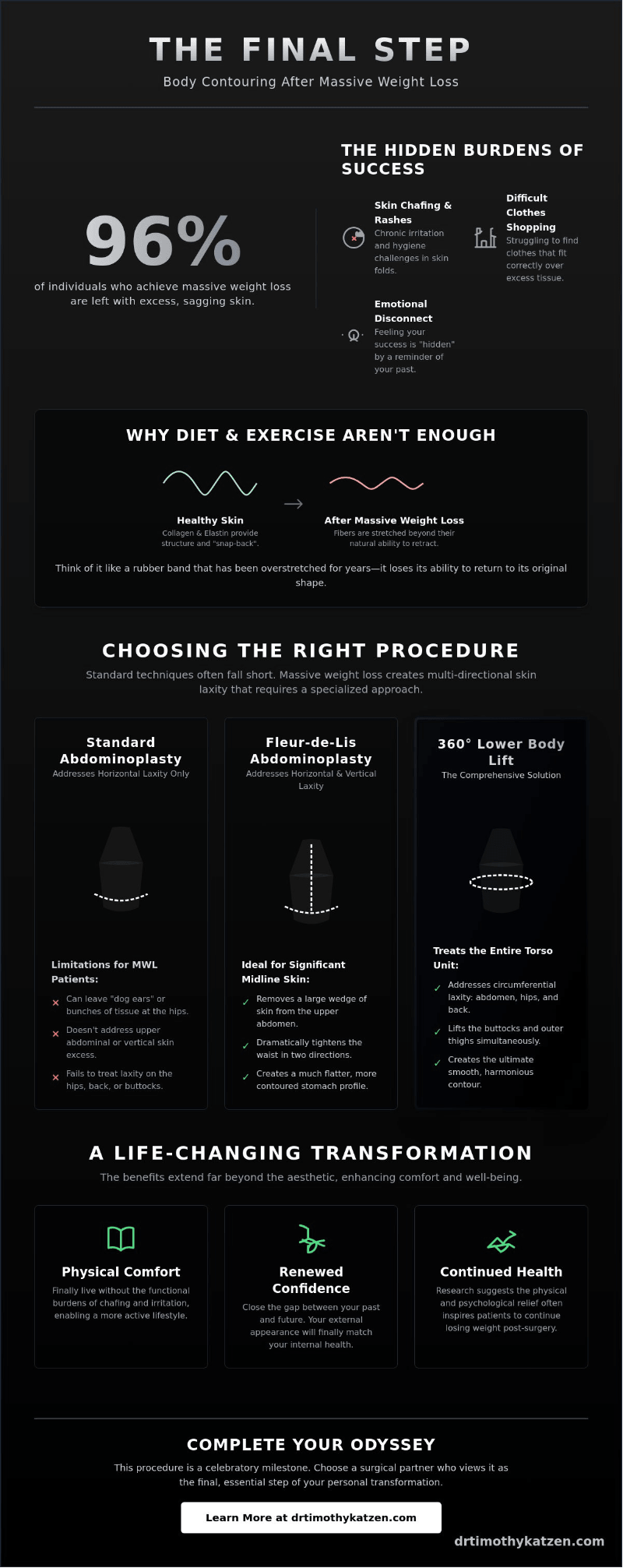
Did you know that approximately 96% of individuals who achieve substantial weight loss are left with significant amounts of sagging skin that cannot be resolved through diet or exercise? You've dedicated years to a grueling physical transformation, yet the mirror often fails to reflect the strength and discipline you've cultivated. It's deeply frustrating to experience persistent skin chafing or the struggle of finding clothes that fit correctly when you should be celebrating your success. If you're considering a tummy tuck after massive weight loss, you're likely looking for the final piece of a complex physical puzzle.
I understand that this procedure is far more than a cosmetic choice; it's the essential reconstructive closure of a life-changing odyssey. My goal is to help you discover how advanced body contouring can remove that heavy physical burden and finally reveal the smooth, contoured results of your hard work. We will explore how these specialized surgical techniques provide functional relief and create the aesthetic harmony you deserve to officially complete your journey and embrace your new silhouette.
Key Takeaways
- Understand why standard surgical techniques may not address the multi-directional skin laxity that follows a major physical transformation.
- Compare the specific functional and aesthetic benefits of advanced procedures, including the Fleur-de-Lis and the 360 Lower Body Lift.
- Learn how a tummy tuck after massive weight loss restores your physical comfort by addressing both horizontal and vertical skin excess.
- Prepare for your healing journey with realistic expectations for post-operative care and the essential role of compression garments.
- Discover how to choose a surgical partner who views your procedure as the final, celebratory step of your personal odyssey.
Table of Contents
- Beyond the Scale: The Physical Reality of Skin After Massive Weight Loss
- Why a Standard Abdominoplasty May Not Be Enough
- Comparing Advanced Techniques: Fleur-de-Lis vs. 360 Lower Body Lift
- The Road to Recovery: Navigating the Healing Process
- Completing Your Transformation with J. Timothy Katzen, M.D.
Beyond the Scale: The Physical Reality of Skin After Massive Weight Loss
Losing a significant amount of weight is a monumental triumph. It represents thousands of hours of discipline and a profound commitment to your long-term health. However, for many of my patients, the joy of reaching a goal weight is often tempered by a frustrating physical reality. Instead of the tight, athletic silhouette they expected, they find themselves carrying a heavy, literal reminder of their past. This excess skin is not a failure of effort; it's a physiological response to a massive transformation.
Approximately 96% of individuals who undergo dramatic weight loss are left with sagging tissue that simply cannot be resolved through further exercise. A abdominoplasty, or tummy tuck, is often the most effective way to address this. Choosing a tummy tuck after massive weight loss is about more than aesthetics. It's a reconstructive necessity to align your physical body with your new, healthier lifestyle. This surgery serves as the final, celebratory step of a long personal odyssey, allowing you to finally inhabit the body you worked so hard to achieve.
The Anatomy of Skin Laxity
Our skin relies on two primary proteins: collagen for structure and elastin for "snap-back" elasticity. When your body undergoes a massive weight loss transformation, which typically involves 50 pounds or more, these fibers are often stretched beyond their natural retractile capacity. Think of it like a rubber band that has been held at full tension for years; eventually, it loses the ability to return to its original shape. This results in the formation of a panniculus, which is the apron of excess skin and fat that hangs below the waistline. This tissue creates functional burdens, including persistent skin chafing, hygiene challenges, and chronic rashes in the skin folds.
The Emotional Impact of Hanging Skin
I frequently consult with patients who feel like their success is "hidden" beneath layers of hanging skin. It's a painful emotional disconnect. You feel light and energetic on the inside, yet the mirror shows a body that still looks and feels cumbersome. This skin can make finding clothes that fit correctly nearly impossible, often forcing you to buy larger sizes just to accommodate the extra tissue. Body contouring restores your self-image and confidence by removing these physical barriers. I view this procedure as a celebratory milestone that honors your dedication. It's about closing the gap between your past and your future, ensuring your external appearance finally matches your internal health.
Why a Standard Abdominoplasty May Not Be Enough
A standard abdominoplasty is an excellent procedure for many, but it often falls short for those who have experienced a profound physical transformation. When I evaluate a patient for a tummy tuck after massive weight loss, I look at more than just the front of the stomach. Standard techniques primarily address skin and muscle laxity on the anterior abdominal wall. However, massive weight loss creates "circumferential laxity," meaning the skin hangs from the hips, the outer thighs, and the lower back as well. If we only remove skin from the front, we risk leaving "dog ears," which are unsightly bunches of tissue at the ends of the incision, or creating an uneven, unbalanced result that doesn't honor your hard work.
Choosing the right procedure is vital because the benefits often extend beyond the immediate surgical outcome. Interestingly, research from the American Society of Plastic Surgeons indicates that many patients continue to lose weight in the years following their body contouring. This suggests that the physical and psychological relief provided by the surgery often jumpstarts a new level of activity and health. To ensure your results remain harmonious as your body continues to evolve, we must address the entire torso as a singular, geometric unit.
What is a 360 Lower Body Lift?
For patients with skin laxity that extends around their entire midsection, I often recommend a 360 Lower Body Lift. This circumferential approach involves an incision that travels entirely around the waist. It allows me to lift the abdomen, the hips, and the buttocks simultaneously. This procedure provides a comprehensive geometric change to your torso, creating a smoother transition from your waist to your legs. By tightening the gluteal region and lifting the outer thighs, we achieve a level of definition that a standard tummy tuck after massive weight loss simply cannot provide. If you're looking for a total refinement of your lower body, I recommend you review our approach to body sculpting to see how this fits your needs.
When a Panniculectomy is Not Enough
It's important to distinguish between a panniculectomy and a full tummy tuck. A panniculectomy is a functional procedure designed to remove the "pannus," or the hanging apron of skin, to resolve medical issues like chronic rashes or hygiene struggles. While it provides relief, it doesn't address the underlying muscle separation, known as diastasis recti, that often occurs during significant weight gain. A tummy tuck, however, includes muscle repair and aesthetic contouring to create a firm, flat midsection. A panniculectomy is often a medical necessity, while a tummy tuck provides the desired aesthetic refinement that truly completes your transformation.
Comparing Advanced Techniques: Fleur-de-Lis vs. 360 Lower Body Lift
If a standard abdominoplasty is a two-dimensional solution, advanced body contouring is three-dimensional. When I design a surgical plan for a tummy tuck after massive weight loss, I must account for the unique geometry of your new body. While we've discussed the circumferential benefits of a 360 lift, some patients require a different approach to address skin that hangs vertically and horizontally. This is where the Fleur-de-Lis technique and the 360 Lower Body Lift become the primary tools in our reconstructive kit. Understanding the distinction between these two is essential for setting realistic expectations for your final silhouette.
The choice between these procedures isn't about which is "better" in a general sense; it's about which matches your specific anatomical needs. In some cases, I may even recommend combining elements of both to achieve a total transformation. However, it's vital to acknowledge the trade-off involved. Achieving a more comprehensive, tight result often requires more extensive incisions. Most of my patients find that a well-placed, mature scar is a small price to pay for the profound relief of finally being free from the weight and discomfort of excess tissue.
The Fleur-de-Lis: Targeting Vertical Excess
The Fleur-de-Lis technique is specifically designed for patients who have significant skin laxity in two directions. While a standard tummy tuck pulls skin down toward the pubic area, the Fleur-de-Lis adds a vertical component. I use a "T" shaped incision that allows me to pull skin toward the midline of the abdomen as well as downward. This is the ideal approach for someone whose waistline is hidden by deep vertical skin folds. By removing this central "v" of tissue, I can restore a narrow, defined waist that horizontal tightening alone cannot reach. It requires extreme precision to ensure the vertical scar is perfectly centered and the tension is distributed evenly across your torso.
Choosing the Right Approach for Your Anatomy
Deciding on the right surgical path requires a methodical evaluation of your skin quality and distribution. During our consultation, we will look at how your skin behaves when you move. If your primary concern is skin that hangs over your beltline like an apron, a 360 Lower Body Lift may be the priority. If you can pinch several inches of skin horizontally across your midsection, the Fleur-de-Lis might be necessary. Consider these factors as you prepare for your transformation:
- Skin Distribution: Is your excess skin primarily concentrated in the front, or does it wrap around to your back and hips?
- Scar Tolerance: Are you comfortable with a vertical midline scar in exchange for maximum waistline narrowing?
- Aesthetic Goals: Do you prioritize a flat stomach, or are you looking to lift the buttocks and thighs as well?
- Skin Quality: Does your skin still have some remaining elasticity, or is it thin and prone to further sagging?
My role is to serve as your partner in this decision, providing the clinical authority needed to select the technique that will most effectively complete your tummy tuck after massive weight loss. Together, we will choose the path that honors your journey and delivers the functional and aesthetic results you have worked so hard to earn.
The Road to Recovery: Navigating the Healing Process
The transition from the surgical suite to your recovery space is a pivotal moment in your transformation. During the first 24 to 48 hours, our focus is entirely on stabilization and comfort. You'll likely feel a significant amount of tightness across your midsection; this is a natural result of the comprehensive tissue repositioning we've performed. We utilize a multimodal pain management strategy to ensure you're comfortable as you begin the healing process, allowing you to move through the initial clinical phase with confidence.
One of the most critical components of your healing is the compression garment. Because a tummy tuck after massive weight loss often involves extensive contouring, these garments provide the necessary external support to minimize swelling and help your skin settle smoothly over your newly tightened muscles. You'll wear this garment consistently for several weeks to protect your new geometric shape. Patience is your greatest ally during this time. Most of my patients plan for 4 to 6 weeks away from professional responsibilities to focus on their recovery. While I'll have you walking gently within the first day to promote circulation, you must avoid strenuous exercise or heavy lifting for at least 6 to 8 weeks to protect your internal repairs.
Managing Scars and Long-Term Results
I understand that concerns about scarring are common. While scars from such an extensive procedure are permanent, I place them strategically so they remain hidden beneath most undergarments and swimwear. To support the best possible aesthetic outcome, I recommend a dedicated scar care regimen once your incisions have closed. This typically includes the use of silicone sheets, consistent sun protection to prevent darkening, and keeping the skin deeply hydrated. It's vital to remember that the final results of a tummy tuck after massive weight loss may take 6 to 12 months to fully settle as the internal tissues soften and the swelling completely dissipates.
Physical and Emotional Milestones
Recovery is as much an emotional journey as it is a physical one. It's quite common to experience the "post-op blues" in the first few weeks. This is a normal physiological response to the fatigue of surgery and the temporary distortion caused by swelling. However, these feelings are usually replaced by a profound sense of victory the first time you try on a piece of "goal" clothing that previously wouldn't fit over excess skin. I encourage you to be patient with your body as it heals and your new silhouette emerges. If you're ready to plan your own transformation, you can request a consultation to discuss your recovery timeline and what to expect during your unique healing process.
Completing Your Transformation with J. Timothy Katzen, M.D.
J. Timothy Katzen, M.D. has dedicated his professional career to the highly specialized field of post-transformative body sculpting. He believes that a tummy tuck after massive weight loss is far more than a standard medical event; it's the final, celebratory step of a long and arduous personal odyssey. His practice has become a global destination for patients seeking a level of meticulous detail that general plastic surgery often overlooks. While many surgeons perform basic skin removal, he focuses on the complex, geometric balance of the entire torso. This is why the 360 lower body lift is his signature procedure, allowing him to address the circumferential changes that occur after a life-changing weight loss journey.
This approach combines clinical authority with a profound sense of empathy for the challenges you've faced. J. Timothy Katzen, M.D. understands that the decision to undergo surgery involves a significant amount of trust. Whether you're traveling from across the country or from an international location, the practice provides a foundation of safety and reassurance. We don't just look at the abdomen as a standalone area; we look at how every contour flows into the next, ensuring that your final result looks as natural and athletic as possible. This person-centric philosophy ensures that your individual needs and long-term well-being always take priority over generic aesthetic standards.
A Dedicated Partner in Your Odyssey
In this practice, the surgeon is more than just a technician; he's your partner in a transformative process. J. Timothy Katzen, M.D. applies meticulous attention to detail to create flowing, harmonious contours that honor the hard work you've already put in. We focus on restoring symmetry and achieving a geometric balance that reflects your new health status. I invite you to view our gallery of transformations, where you can see results from patients who have walked a similar path. These success stories reflect the hope and renewal that come when your physical body finally aligns with your internal strength and discipline.
Ready to Reveal Your Hard Work?
You have already conquered the most difficult part of your journey by achieving and maintaining your weight loss. Now, it's time to remove the final physical barrier that stands between you and the life you've envisioned. This board-certified practice is equipped to handle the complexities of a tummy tuck after massive weight loss with the highest standards of safety and expertise. We are ready to help you reveal the smooth, contoured midsection you have earned. Schedule your consultation with J. Timothy Katzen, M.D. to complete your journey.
Embracing the Final Step of Your Odyssey
Your weight loss was a monumental achievement that required immense discipline. Now, it's time for your physical form to finally reflect that victory. We've explored why a standard approach often falls short and how specialized techniques, such as the Fleur-de-Lis or the 360 Lower Body Lift, provide the geometric refinement necessary for a total transformation. A tummy tuck after massive weight loss is more than a surgery; it's the reconstructive bridge to your future self.
As a board-certified plastic surgeon specialized in post-weight loss reconstruction, J. Timothy Katzen, M.D. provides personalized care for national and international patients seeking world-renowned expertise in 360 Lower Body Lifts. He is here to ensure your results are as extraordinary as the journey that brought you here. You've already conquered the most difficult challenges. Let's work together to close this chapter and reveal the silhouette you've worked so hard to uncover.
Begin your final transformation—book a consultation with J. Timothy Katzen, M.D. You deserve a body that feels as light and capable as you do.
Frequently Asked Questions
How long after weight loss should I wait to have a tummy tuck?
You should wait at least 6 to 12 months after reaching a stable goal weight before undergoing a tummy tuck after massive weight loss. This duration is essential because it allows your skin and underlying tissues to adapt to your new, smaller frame. Weight stability is the most critical factor for a successful outcome; significant fluctuations after your procedure can stretch the newly tightened skin and compromise your final geometric results.
Will insurance cover my tummy tuck after massive weight loss?
Most insurance providers classify a tummy tuck as a cosmetic procedure, meaning it is typically not a covered benefit. However, a panniculectomy, which is the surgical removal of the hanging "apron" of skin, may be covered if it is deemed medically necessary. This usually requires documentation of persistent health issues such as chronic rashes, skin infections, or significant physical discomfort that hasn't responded to non-surgical treatments.
What is the difference between a 360 body lift and a tummy tuck?
A standard tummy tuck focuses primarily on the anterior abdominal wall, addressing skin and muscle laxity only in the front. In contrast, a 360 body lift is a circumferential procedure that addresses the entire midsection. This technique removes excess skin from the abdomen, hips, and lower back while simultaneously lifting the buttocks and outer thighs. It is often the preferred choice for patients who require a more comprehensive, all-encompassing physical change.
How much weight do you actually lose from the skin removal surgery itself?
Patients typically lose between 5 and 15 pounds of actual tissue weight during the procedure, though this varies based on the amount of excess skin present. It's important to remember that this is a reconstructive surgery rather than a weight loss method. The most significant benefit isn't the change on the scale but the functional relief and improved mobility that come from removing the heavy, cumbersome weight of the panniculus.
Can I combine a tummy tuck with a breast lift or arm lift?
Yes, combining procedures is a common approach to achieve a more complete transformation in fewer surgical sessions. Many patients choose to address multiple areas, such as the breasts or arms, alongside their abdominal contouring. For your safety, I carefully evaluate each case to determine if a combined surgery is appropriate or if staging the procedures 3 to 6 months apart would be a more prudent path for your long-term well-being.
How long do the results of a post-weight loss tummy tuck last?
The results of a tummy tuck after massive weight loss are intended to be permanent as long as you maintain a stable weight. While the surgical changes to your skin and muscles are lasting, your body will still be subject to the natural effects of aging and gravity. By committing to a healthy lifestyle and consistent physical activity, you can preserve your smooth, contoured silhouette and enjoy your new physical freedom for many years.
What kind of scarring should I expect from a Fleur-de-lis tummy tuck?
A Fleur-de-Lis tummy tuck results in a "T" shaped scar pattern, which includes a horizontal incision along the bikini line and a vertical incision up the midline of the abdomen. This vertical component is necessary to address significant skin laxity in both directions and create a more defined waistline. While the scarring is more extensive than a standard procedure, the scars typically fade and flatten significantly over 12 to 18 months with proper care.