What are Love Handles? Understanding the Science and Solutions for Flank Fat
4/24/2026
No amount of core exercises can physically shrink the expanded skin cells that often characterize the final stage of a massive weight loss journey. Many of my patients spend over 300 minutes a week in the gym only to realize that their biology has reached a structural plateau. They often come to me asking, "what are love handles and why won't they disappear?" These deposits, technically known as flank adiposity, represent a specific anatomical challenge that diet alone cannot resolve.
I recognize the frustration of seeing your hard-earned progress obscured by persistent bulges that show through your favorite clothes. It's a common hurdle for those who have lost 50 pounds or more, but it doesn't have to be your permanent reality. I promise to show you how medical contouring provides the definitive solution for a refined silhouette. We will explore the science of flank anatomy and the 360 degree surgical approaches that finally bridge the gap between your weight loss efforts and your aesthetic goals.
Key Takeaways
-
Understand what are love handles and why these stubborn subcutaneous fat deposits over the obliques often resist even the most dedicated diet and exercise routines.
-
Explore the biological role of genetics and caloric surplus in determining how your body stores adipose tissue, creating a blueprint for where fat persists.
-
Debunk the myth of spot reduction to understand why localized exercises cannot specifically burn flank fat, requiring a more systemic or clinical approach.
-
Discover how professional contouring solutions like liposuction provide the precision necessary to permanently refine your silhouette and restore balanced body proportions.
-
Learn how choosing a specialized surgeon can transform your physical results into a profound sense of empowerment and complete your personal transformation journey.
What Are Love Handles? Defining the Obstinate Flank Fat
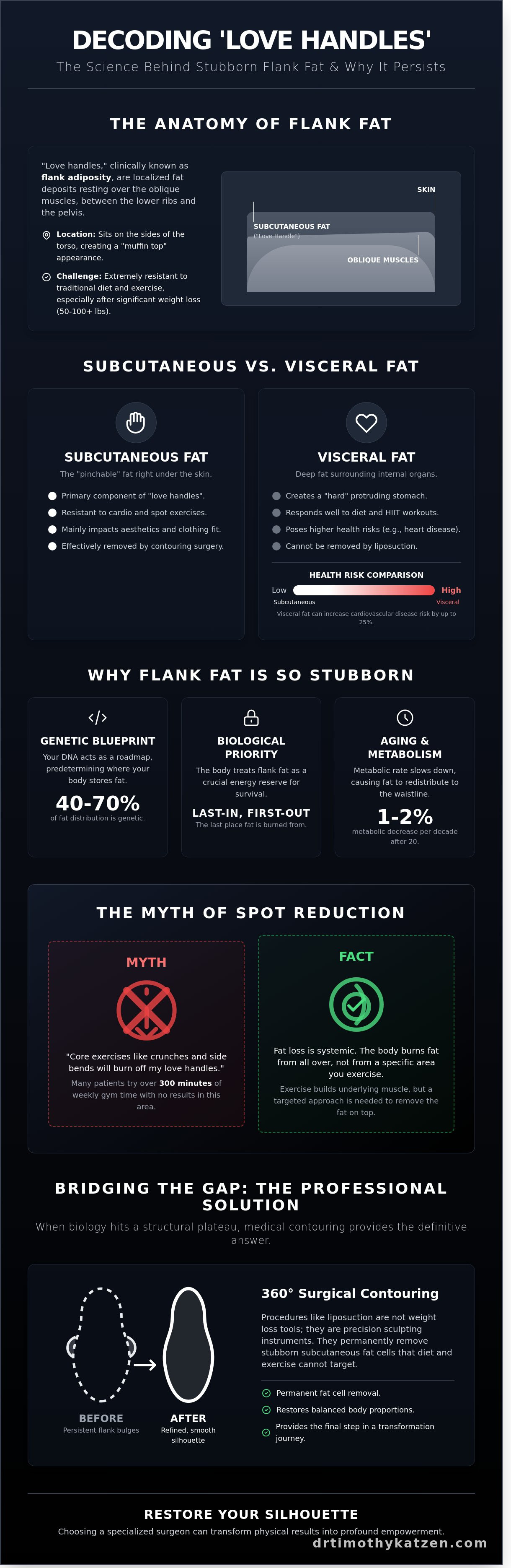
I have spent decades helping patients navigate the final stages of their body transformations, and few concerns are as persistent as the flank area. When patients ask me what are love handles, I explain that they are localized deposits of subcutaneous adipose tissue resting directly over the external oblique muscles. While the name suggests something affectionate, these fat pockets are often the source of significant emotional distress. They represent a specific type of stubborn fat that frequently survives even after a patient has lost 100 pounds or more through diet and exercise. This tissue is anatomically distinct from the central abdomen; it occupies the space between the lower ribs and the iliac crest of the pelvis.
The term is a clinical misnomer because it implies a soft, manageable trait. In reality, these deposits are chemically and structurally different from other fat types. I often see patients who have achieved a healthy Body Mass Index (BMI) but still struggle with a "muffin top" appearance. This occurs because the flank region acts as a primary storage site for excess energy in many genetic profiles. It's a biological "last in, first out" scenario where the body clings to these cells for survival, making them incredibly resistant to traditional weight loss methods.
The Anatomy of the Flank Region
To understand your body, you must look beneath the surface. The flank consists of the external and internal obliques, which provide the structural foundation for your midsection. Subcutaneous fat sits atop the deep fascia and just below the dermis. In my surgical experience, I've found that skin elasticity determines 50% of the aesthetic outcome in this area. When skin loses its structural integrity, usually after a 30% or greater change in body weight, the fat doesn't just sit there; it hangs. This creates a heavy, drooping effect that affects how clothing fits and how you feel about your silhouette.
Subcutaneous vs. Visceral Fat: What You Need to Know
Distinguishing between types of fat is the first step toward restoration. I use a simple "pinch test" during consultations to help patients understand their anatomy. If you can grasp the tissue between your fingers, it's subcutaneous fat. This is the "pinchable" fat that makes up love handles. Visceral fat, however, is hidden deep within the abdominal cavity, wrapping around organs like the liver. It's metabolically active and poses higher health risks, such as a 25% increased risk of cardiovascular disease according to long-term clinical studies.
-
Subcutaneous Fat: Located just under the skin; harder to lose through cardio alone; primary component of love handles.
-
Visceral Fat: Located deep in the belly; responds quickly to high-intensity interval training; creates a "hard" protruding stomach.
-
Health Impact: While visceral fat is more dangerous for your heart, subcutaneous flank fat often causes more significant psychological impact and physical discomfort in clothing.
Understanding what are love handles requires recognizing that they are a surface-level problem with deep anatomical roots. I view the midsection through a 360-degree lens. The flank is not an isolated island; it's a critical part of your body's continuous contour. Addressing it requires a sophisticated approach that respects both the muscle layers beneath and the delicate skin above.
The Root Causes: Why Fat Accumulates Around the Hips
To truly understand what are love handles, we must look at the body as a sophisticated energy management system. When you consume more energy than you expend, your body stores the excess in adipose cells. These cells don't just appear; they expand. For many, the hips and flanks serve as the primary "savings account" for this stored energy. I often explain to my patients that their genetics act as a biological blueprint. This DNA roadmap determines your fat distribution patterns before you're even born. Research suggests that genetic factors account for 40% to 70% of the variation in where we store fat.
The midsection is frequently the "first in, last out" region. This means it's the first place your body deposits fat during a caloric surplus and the very last place it recruits energy from during weight loss. This biological stubbornness is why many people who achieve significant weight loss still find themselves struggling with persistent flank pockets. As we age, the challenge intensifies. The metabolic rate typically slows by 1% to 2% per decade after age 20, which often leads to a noticeable redistribution of fat toward the trunk and waistline.
Hormonal Influences: Cortisol, Insulin, and Fat
Hormones serve as the primary directors of fat storage. Chronic stress triggers the release of cortisol, a hormone that a 2018 study in the journal Psychosomatic Medicine linked directly to increased abdominal fat. When cortisol remains elevated, it signals the body to protect itself by storing energy near vital organs. Insulin sensitivity also plays a critical role. If your body becomes resistant to insulin, it struggles to process sugars, leading to increased fat retention in the flanks. Gender also dictates these patterns; men often store fat in the midsection due to androgen distribution, while women may notice an increase in this area as estrogen levels fluctuate during perimenopause.
Lifestyle Factors and Modern Sedentary Habits
Our modern environment is often at odds with a lean silhouette. The "desk job effect" is a measurable phenomenon. Sitting for more than 8 hours a day has been linked to a 15% increase in waist circumference compared to those who are active throughout the day. Dietary triggers, specifically ultra-processed sugars, cause rapid insulin spikes that tell your body to store fat immediately. Furthermore, sleep is a vital component of metabolic health. Sleeping fewer than 6 hours per night can increase ghrelin levels by 14.9%, making it difficult to resist the cravings that lead to flank accumulation. For those who have reached their goal weight but still face these structural challenges, a 360-degree body contouring plan can provide the final refinement that diet alone cannot achieve.
The Myth of Spot Reduction: Why Crunches Aren't Enough
I frequently consult with patients who have spent years performing thousands of side crunches and oblique twists, only to find their midsections unchanged. These individuals are often fit, disciplined, and frustrated. They've fallen victim to the myth of spot reduction, the idea that you can burn fat in a specific area by exercising the muscle underneath it. In my practice, I explain that while you can certainly strengthen your obliques, the adipose tissue sitting on top of those muscles is entirely indifferent to your workout choice. A study published in the Journal of Strength and Conditioning Research followed participants through a six-week localized abdominal routine and found zero reduction in belly fat. Your body doesn't work like a menu where you can select which area to slim down first.
Fat loss is a systemic physiological process. When you exercise, your body mobilizes energy from fat cells located throughout your entire frame, not just the area you're targeting. This is why "love handle workouts" often lead to disappointment. You're building a stronger muscular foundation, but that foundation remains hidden beneath a layer of stubborn tissue. To truly understand what are love handles from a clinical perspective, we have to recognize that they are a symptom of your body's unique storage patterns, not a lack of core strength.
The Science of Fat Metabolism
Your body views fat as a global energy bank. When you create a caloric deficit, your endocrine system sends signals to release triglycerides into the bloodstream for fuel. However, the sequence of fat withdrawal is determined by genetics and hormones. For many, the flanks are the "first in, last out" storage site. You might notice your face or chest thinning out after just 4 weeks of dieting, while your waistline remains stagnant. This isn't a failure of your will; it's your biological blueprint. Changing your body shape requires more than just losing weight, it involves managing how your body distributes its remaining volume.
When Lifestyle Changes Reach a Plateau
I often see patients reach a point where diet and exercise can no longer alter their silhouette. This plateau typically occurs when a person is within 10 to 15 pounds of their goal weight. At this stage, the fat in the flank area is often dense with alpha-2 adrenergic receptors. These receptors act as biological locks that inhibit fat breakdown, making these pockets nearly impossible to eliminate through traditional cardio. Furthermore, for those who have achieved a 50-pound weight loss or more, the issue may not be fat at all. It's common for skin to lose its elastic fibers and sag over the hip bone. This skin laxity mimics the look of fat, and no amount of exercise can tighten that redundant tissue. In these cases, we shift our focus from weight loss to surgical restoration and contouring.
Professional Solutions: From Liposuction to the Tummy Tuck
I often meet patients who have reached their goal weight through incredible discipline, yet they remain frustrated by stubborn deposits around their midsection. When diet and exercise reach their limit, it's time to consider clinical restoration. Understanding what are love handles from a surgical perspective helps us choose the right path. These aren't just aesthetic concerns; they represent the final hurdle in your physical transformation. Whether we use precision sculpting or a more comprehensive lift, my goal is to align your appearance with the hard work you've already put in.
Liposuction for Targeted Flank Reduction
Modern liposuction techniques have evolved significantly since the early 1990s. Today, I use specialized technology to remove fat cells permanently from the subcutaneous layer. This procedure is ideal for the candidate who has good skin elasticity but cannot shift that last 1 or 2 inches of flank fat. When patients ask me what are love handles in a clinical context, I explain that they are often the most stubborn pockets of fat that require direct intervention. During the process, we target these cells to create a smoother, more defined transition from the ribs to the hips.
-
Permanent Fat Removal: Once we remove these adipocytes, they don't grow back, providing a stable foundation for your new shape.
-
Precision Contouring: We can sculpt the area to highlight natural muscle definition and the iliac crest.
-
Rapid Recovery: Most patients return to light activity within 48 to 72 hours, with full results visible as swelling subsides over 3 to 6 months.
The Tummy Tuck and 360 Body Lift
For my patients who have undergone massive weight loss, fat removal is often only half the battle. If you've lost 50 pounds or more, you likely have excess skin and weakened abdominal muscles. A 360 Lower Body Lift is my signature approach for these cases. This circumferential procedure addresses the abdomen, hips, and lower back in a single surgical event. We repair diastasis recti, which affects roughly 60% of postpartum women, and remove the redundant skin that liposuction alone cannot fix. This intervention restores your natural "V" or hourglass shape, providing a foundation of confidence that impacts every area of your life.
Your journey deserves a finish line that reflects your dedication. Book your personalized body contouring consultation today to explore which solution fits your goals.
Restoring Your Silhouette: The Path to Total Body Confidence
Achieving a balanced body contour is often the final hurdle in a grueling physical journey. For many of my patients, especially those who have lost 100 pounds or more, the persistent tissue around the midsection remains a source of distress. You might still wonder what are love handles doing on your frame after you've worked so hard to change your lifestyle. This isn't just about vanity; it's about psychological closure. A 2017 study in the journal Plastic and Reconstructive Surgery indicated that 95% of patients who undergo body contouring after massive weight loss experience a permanent boost in self-esteem and social functioning.
I view surgery as the celebratory final step of your transformation. It's the moment we remove the physical reminders of a past struggle to reveal the individual hidden beneath. We don't use cookie-cutter techniques here. Every incision and every stitch is part of a personalized 360-degree plan designed specifically for your unique anatomy and skin elasticity. Your body is unique. I treat it that way.
The Importance of Specialized Surgical Expertise
Choosing a board-certified plastic surgeon who specializes in massive weight loss is vital for your safety and results. Flank surgery for a standard patient is vastly different from the reconstructive needs of someone with significant skin laxity. During our consultation, I encourage you to ask how many circumferential body lifts I've performed in the last 12 months. You should also ask to see "before and after" photos of patients with a similar BMI history to yours. We must distinguish between purely aesthetic goals and the reconstructive necessity of removing heavy, hanging tissue that causes chronic skin irritation.
When you prepare for your consultation, consider these specific questions:
-
How do you manage the transition between the hip and the lower back?
-
What specific 360-degree techniques will you use to ensure symmetry?
-
How will you position the scars so they remain hidden by standard undergarments?
Embarking on Your Transformation
Setting realistic expectations is the foundation of a successful recovery. While I aim for perfection, the goal is significant restoration rather than an airbrushed ideal. Investing in professional body restoration provides long-term benefits that extend far beyond the mirror. Data from my practice shows that patients who complete their contouring journey are 60% more likely to maintain their goal weight over a five-year period. You aren't just buying a procedure; you're securing your future health.
Reclaiming your body is a profound act of self-love. Understanding what are love handles in the context of your specific weight loss journey helps us target the tissue effectively. This process is about empowerment and the freedom to move without restriction. I am here to partner with you as we cross this finish line together and finally restore the silhouette you've earned.
Take the Final Step in Your Transformation
Understanding what are love handles is the first step toward moving past the frustration of stubborn flank fat. You've learned that biology often overrides diet and exercise; fat around the hips is notoriously resistant to traditional weight loss methods. Whether you’re dealing with genetic predispositions or the loose skin following a 100-pound weight loss journey, these deposits often require a clinical solution rather than just another gym session. I focus on 360 body lifts and advanced contouring to help you finally achieve the proportions you’ve earned through your hard work.
As a world-renowned specialist in massive weight loss restoration, I’ve developed personalized care plans for thousands of international and local patients. My board-certified expertise ensures your safety while we work together to restore your silhouette. It’s time to move beyond the physical burden of excess tissue and embrace the confidence you deserve. Schedule your personalized body contouring consultation with Dr. Katzen today. I look forward to being your partner in this life-changing restoration.
Frequently Asked Questions
Can you actually lose love handles with just diet and exercise?
You can reduce the size of your flanks through a caloric deficit, but you can't target fat loss in that specific area. I see many patients who reach their goal weight only to find that their genetics dictate fat storage in the midsection. A 2021 study in the Journal of Obesity confirmed that spot reduction is physiologically impossible. Diet and exercise help you lose weight overall, but they won't necessarily eliminate what are love handles if your body is predisposed to keep fat there.
Are love handles dangerous to your health?
Love handles are potentially dangerous because they often signal the presence of visceral fat around your internal organs. According to Harvard Health, a waist circumference exceeding 40 inches for men or 35 inches for women correlates with a 20 percent higher risk of cardiovascular disease. I focus on reducing this fat to improve your long-term health. It's not just about the aesthetic; it's about your metabolic longevity and physical restoration.
Why do I have love handles even though I am skinny?
You may have love handles while being skinny due to your unique genetic blueprint; 40 to 60 percent of your fat distribution is predetermined by DNA. This condition is often called being skinny fat, where a low muscle mass makes small pockets of fat more prominent. In my practice, I find that even patients with a BMI under 25 often struggle with stubborn flank pockets that refuse to budge despite a healthy lifestyle.
How long does it take to see results from professional flank contouring?
You'll notice an immediate change in your silhouette, but final results from professional contouring typically take 6 months to fully manifest. Most of my patients see a 50 percent reduction in swelling within the first 4 weeks. By the 12 week mark, the skin begins to retract and settle over the new contours. I monitor your journey closely during this period to ensure your recovery is progressing perfectly toward your transformative goal.
Will love handles come back after liposuction or a tummy tuck?
The results of liposuction or a 360 circumferential body lift are permanent because the fat cells are physically removed from your body. You're born with a set number of fat cells, and once I extract them, they don't grow back. If you maintain your weight within 10 pounds of your surgery day weight, your new shape will last a lifetime. It's the final, celebratory step in your body's restoration.
What is the fastest way to get rid of love handles permanently?
Surgical intervention, specifically liposuction or a 360 body lift, is the fastest and most effective way to eliminate flank fat for good. In a single 4 hour procedure, I can remove significant fat volume and excess skin that years of exercise couldn't touch. This approach provides a definitive solution for those asking what are love handles and how to fix them. It offers a level of precision that non-invasive methods simply can't match.
Is there a difference between love handles in men and women?
Men and women store fat differently due to hormonal influences like testosterone and estrogen. Men typically store 90 percent of their excess weight in the abdominal and flank area, creating a spare tire effect. Women often experience fat accumulation in the lower hips and flanks. I tailor my surgical techniques to respect these anatomical differences, ensuring I create a masculine or feminine contour that looks natural and balanced for your frame.
Does drinking more water help reduce fat around the waist?
Drinking water supports your general weight loss efforts but it won't specifically melt fat from your waistline. A study in the Journal of Clinical Endocrinology and Metabolism showed that drinking 500ml of water can temporarily boost your metabolic rate by 30 percent. While hydration is vital for your 360 recovery and skin elasticity, it isn't a substitute for fat removal. I recommend 64 ounces daily to keep your tissues healthy and your metabolism functioning at its peak.