Will Insurance Cover Diastasis Recti Surgery? A Guide to Coverage in 2026
9/14/2026
The separation of your abdominal muscles is not a cosmetic flaw; it is a structural failure of your body's core foundation. For many of my patients, this condition leads to persistent lower back pain and a profound sense of physical disconnect that complicates daily life. You've likely spent years trying to "crunch" your way back to stability, only to find that no amount of exercise can bridge a structural gap. This often leads to the vital question: will insurance cover diastasis recti surgery? I understand that this isn't just about aesthetics. It's about reclaiming the internal geometry of your core and regaining the functional integrity you lost during your personal odyssey of physical transformation.
I know how exhausting it is to have your physical struggles dismissed as purely cosmetic. In this guide, I will share the specific criteria insurance companies use in 2026 to determine coverage for abdominal muscle repair and how you can manage the approval process with confidence. We will look at the vital role of medical documentation, the distinction between a standard tummy tuck and a functional repair, and the strategies you need to prove your surgery is a medical necessity rather than an elective enhancement. My goal is to provide you with a clear path toward the renewal and strength you deserve.
Key Takeaways
- Identify the clinical threshold where abdominal separation transitions from a cosmetic concern to a functional failure of your core's structural foundation.
- Uncover the precise 2026 medical necessity criteria to help you determine if and how will insurance cover diastasis recti surgery for your specific needs.
- Learn why a co-existing umbilical or ventral hernia often serves as the definitive indicator for insurers to classify your repair as reconstructive.
- Develop a rigorous documentation strategy, including pain journals and physical therapy records, to demonstrate that conservative treatments have been exhausted.
- Understand why addressing the internal muscle gap often requires a simultaneous focus on external skin laxity to achieve a complete and restorative physical transformation.
Table of Contents
- Understanding Diastasis Recti: Is it a Cosmetic Concern or a Medical Condition?
- The Criteria for Insurance Coverage: Medical Necessity vs. Aesthetic Enhancement
- The Hernia Connection: When Muscle Repair Becomes Reconstructive
- Step-by-Step: How to Document Your Case for Insurance Approval
- The Katzen Approach: Combining Functional Repair with Aesthetic Excellence
Understanding Diastasis Recti: Is it a Cosmetic Concern or a Medical Condition?
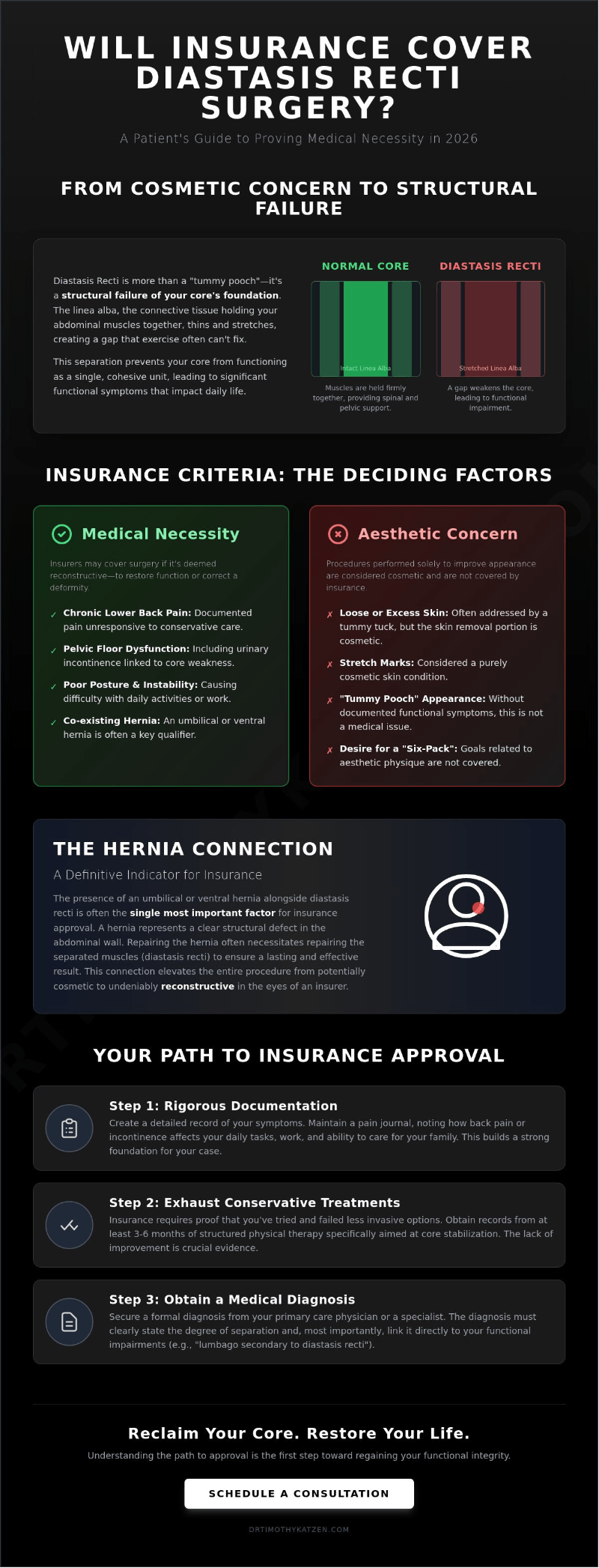
I often meet patients who feel betrayed by their own bodies. They have put in the work to heal and regain their health, yet their midsection remains stubbornly protruding. This isn't a matter of willpower or a lack of discipline. It's a medical reality. To begin Understanding Diastasis Recti, we must look at the thinning and stretching of the linea alba. This is the connective tissue that holds your rectus abdominis muscles together. When this tissue loses its integrity, it creates a gap that your muscles can't bridge on their own.
While some might view this as a minor aesthetic nuisance, for many, it represents a complete functional core failure. This leads many to ask, will insurance cover diastasis recti surgery? The answer depends on whether your condition has crossed the threshold from a cosmetic "pooch" to a medical impairment that affects your quality of life. It's not just about how you look; it's about how your body supports your every move.
The Anatomy of Abdominal Separation
Your rectus abdominis muscles do much more than create a "six-pack" look. They are the primary stabilizers for your pelvis and spine. When they separate, your internal organs press against the weakened fascia, creating a characteristic "doming" or "pooch" effect. This is an internal pressure issue, not a fat issue. Diastasis Recti is a structural deformity of the connective tissue that prevents your core from functioning as a single, cohesive unit. Traditional exercises like crunches often fail because they increase intra-abdominal pressure. Instead of closing the gap, these movements force the organs against the thin tissue, often widening the separation further. This creates a sense of hopelessness for those trying to exercise their way back to health.
Functional Symptoms vs. Aesthetic Complaints
Distinguishing between what you see in the mirror and what you feel during your daily movements is essential. Insurance providers focus strictly on functional symptoms that impact your health. These typically include:
- Chronic lower back pain caused by a lack of spinal support.
- Pelvic floor dysfunction or urinary incontinence.
- Poor posture and a persistent "heavy" feeling in the abdomen.
- The presence of a hernia alongside the muscle separation.
Contrast these with aesthetic complaints like loose skin or stretch marks. Insurance will never cover those. However, when the separation leads to a vicious cycle of core weakness and injury, the conversation shifts. You might wonder, will insurance cover diastasis recti surgery if you can't lift your children or perform your job without pain? This is where documentation becomes your most powerful tool. Living with a compromised abdominal wall is physically and emotionally taxing. It's a constant reminder of a transformation that feels incomplete, but there is a path toward renewal and strength.
The Criteria for Insurance Coverage: Medical Necessity vs. Aesthetic Enhancement
I often see the disappointment on a patient's face when they realize their insurance provider views their physical struggle as a lifestyle choice. In the eyes of major US insurers, the line between "cosmetic" and "reconstructive" is drawn at the point of functional failure. A procedure is considered cosmetic when it's performed to improve your appearance. It becomes reconstructive when it's designed to restore a bodily function or correct a deformity. When asking, will insurance cover diastasis recti surgery, you must understand that the 2026 insurance landscape is more rigorous than ever regarding this distinction.
It's a common misconception that chronic pain alone guarantees coverage. While your back pain is very real, insurers look for specific, quantifiable impairments that haven't responded to conservative care. According to the MedlinePlus Medical Encyclopedia, diastasis recti is essentially a gap between the muscles, but insurers typically only care if that gap causes a secondary medical crisis. Many of my patients seek a Tummy Tuck to address both the muscle separation and the excess skin. While I often perform these as a single, transformative procedure, insurers usually "unbundle" them. They might consider the muscle repair if necessity is proven, but they'll almost never cover the skin removal aspect of the Tummy Tuck.
Typical Insurance Exclusions for Diastasis Recti
Many plans still classify DR repair as "experimental" or "purely cosmetic." This is because the medical community often views physical therapy as the first line of defense. The standard of care in 2026 usually requires you to complete three to six months of physician-supervised physical therapy before surgery is even considered. If PT fails to stabilize the core, your case for surgery becomes much stronger. It's also vital to note that a panniculectomy, which is the medical removal of hanging skin, has entirely different coverage rules than muscle plication. One focuses on skin health, while the other focuses on internal structure.
The Role of CPT Codes in Your Surgical Quote
Your surgical quote will feature specific CPT codes that tell the insurer exactly what is being done. Common codes include 15830 for a panniculectomy and 49505 for certain types of hernia repair. If we are performing an abdominoplasty with fascial plication, we often use the add-on code 15847. I recommend that you consult with a specialist to review which specific codes apply to your anatomical needs before you submit your claim. Understanding how will insurance cover diastasis recti surgery often starts with knowing exactly which codes your surgeon plans to use for your reconstruction.
The Hernia Connection: When Muscle Repair Becomes Reconstructive
I frequently observe that diastasis recti rarely exists in isolation. Because the linea alba has thinned to the point of structural failure, the internal pressure of your abdomen often finds the weakest point, usually the umbilicus, and pushes through. This creates a hernia. While insurance companies may hesitate to cover a simple muscle separation, a hernia represents a physical hole in your fascia. This is a clear medical necessity. When I identify a hernia during a detailed physical exam, it fundamentally changes the conversation regarding will insurance cover diastasis recti surgery. The presence of a hernia often serves as the clinical "key" that unlocks coverage for a broader reconstruction.
Repairing a hernia without addressing the underlying diastasis is like patching a hole in a sail without fixing the frayed fabric around it. The tension of the repair often causes the sutures to pull through the weakened tissue, leading to a high recurrence rate. By performing a comprehensive reconstruction, I can secure the hernia while simultaneously plicating the abdominal muscles. This approach restores the geometric integrity of your core and ensures the repair is built to last. It's a methodical process that prioritizes your long-term well-being over a quick, temporary fix.
Umbilical Hernias and Core Stability
The weakened state of the linea alba in patients with significant separation is the primary driver for hernia development. If we only fix the hole, we ignore the structural instability that caused the problem in the first place. A truly functional repair aims to restore the containment of your abdominal organs, preventing them from protruding through the weakened wall. This restoration is the final, celebratory step in a long personal odyssey toward physical wholeness. It's about more than just closing a gap; it's about rebuilding a foundation of trust between you and your body.
Documenting the "Functional Deficit"
To secure approval, we must prove that your muscle separation causes a genuine physical disability. This means documenting an inability to lift objects, persistent pelvic instability, or a failure to maintain an upright posture. Imaging, such as a CT scan or ultrasound, is vital. It provides objective proof of the width of the gap. In the medical community, a separation of 3cm or more is often the clinical benchmark for severe diastasis. This measurement, combined with a diagnosed hernia, provides the most compelling evidence for insurers. I've seen many "hidden" hernias only discovered during these detailed scans or during a professional consultation. Identifying these issues early is the key to understanding how will insurance cover diastasis recti surgery in your specific case.
Step-by-Step: How to Document Your Case for Insurance Approval
I view the documentation process as the most critical phase of your journey toward core restoration. It is the bridge between your lived experience of physical struggle and the clinical data an insurance adjuster requires to authorize a claim. To answer the question, will insurance cover diastasis recti surgery, we must speak the language of the insurer with precision and persistence. This begins with a dedicated pain journal. For three to six months, you should record how your abdominal separation limits your daily functions. Perhaps you can't lift your child without a sharp twinge in your lower back, or you experience stress incontinence during a light jog. These entries provide a human narrative to back up the clinical findings.
Your next step involves gathering a team of medical allies. You should obtain a formal evaluation from your primary care physician or OBGYN to specifically address your back pain or pelvic floor dysfunction. I also recommend requesting a diagnostic ultrasound or CT scan. These imaging tools provide an objective measurement of your inter-recti distance (IRD). Having a verified measurement in your file removes the guesswork for the insurance company. Finally, you must consult with a board-certified plastic surgeon who understands the nuances of reconstructive coding. This specialist acts as your partner in translating your physical deformity into a documented medical necessity.
The Importance of Conservative Treatment
Insurance companies almost always require you to "check the box" for conservative treatment before they will consider a surgical intervention. This usually means completing a full course of physician-supervised physical therapy. Even if PT doesn't close the gap, it serves a vital purpose in your case. By documenting that specialized exercises failed to resolve your abdominal bulging or pain, you prove that surgery is the only remaining solution. In the eyes of an insurance adjuster, a "failed" treatment plan is actually a powerful piece of evidence that supports the need for reconstruction.
What Your Surgeon’s Letter of Necessity Should Include
The letter I write for my patients is a comprehensive clinical roadmap. It includes your specific IRD measurement, the presence of any hernias, and documentation of secondary issues like skin-to-skin irritation or chronic rashes. We also include high-resolution photos that clearly show the functional deformity, such as the "doming" effect when you engage your core. It is vital to understand the "Aesthetic Split." I may submit the muscle repair portion of your case to insurance while the skin excision, which is part of a standard Tummy Tuck, remains your financial responsibility. This transparent approach ensures you know exactly what to expect. If you are ready to begin this process, I invite you to schedule a detailed evaluation to review your documentation needs.
The Katzen Approach: Combining Functional Repair with Aesthetic Excellence
I believe that true healing requires more than just a functional patch. My philosophy centers on a 360-degree transformation that honors the hard work you've already put into your body. When patients ask, will insurance cover diastasis recti surgery, they are often hoping for a complete restoration of their silhouette. However, a "medical-only" repair, while solving the internal gap, often ignores the external skin envelope. This can leave you with a strong core but a remaining "pooch" of redundant skin that prevents you from feeling truly renewed. My approach bridges this gap by combining the structural integrity of a muscle repair with the refined artistry of a Tummy Tuck.
I see this procedure as the final, celebratory step of a long personal odyssey. Whether you've undergone significant weight loss or the transformative experience of childbirth, your body deserves a result that reflects your inner strength. By addressing both the internal muscle wall and the external contours, I ensure that your physical form matches your functional capability. I am also deeply committed to assisting my out-of-state patients in navigating the labyrinth of insurance documentation, ensuring that every clinical detail is presented with the precision required for a successful reimbursement claim.
Functional Restoration Meets Body Contouring
In my practice, I don't just "fix a problem." I focus on a comprehensive reconstruction of your midsection. Using precise geometric descriptors, I map out a 360-degree lower body lift that re-tensions the abdominal wall while simultaneously refining the external skin. This dual-layered strategy is what separates a standard medical intervention from a high-definition transformation. We move beyond simple repair to achieve an all-encompassing physical change. This methodical approach prevents the frustration of a "medical-only" result, where the core is stable but the aesthetic outcome feels incomplete. This is your moment to reclaim the symmetry and confidence you've been working toward for years.
Navigating Your Consultation and Financing
Your journey begins with a specialized consultation where I personally evaluate your core health and the extent of your muscle separation. We will discuss the clinical benchmarks for will insurance cover diastasis recti surgery and how my team can support your documentation efforts. We provide detailed reports that translate your functional impairments into the specific language insurers look for. While we focus on medical necessity, we also offer clear guidance on the aesthetic components of the procedure that may fall outside of coverage. This transparency allows you to plan your transformation with total peace of mind. Schedule your personal consultation with Dr. Katzen to evaluate your core health and take the first step toward your structural and aesthetic renewal.
Reclaiming Your Core Strength and Confidence
Managing the complexities of medical coverage is often the final hurdle in a long personal odyssey toward physical wholeness. You now understand that securing approval requires more than just a diagnosis; it demands a meticulous record of functional impairment and a clear distinction between reconstructive necessity and aesthetic enhancement. Whether your journey involves the repair of a co-existing hernia or the documentation of failed conservative treatments, the goal remains the same: restoring the structural integrity of your core. This is about more than just a procedure; it's about reclaiming a foundation of trust between you and your body.
While determining will insurance cover diastasis recti surgery can feel overwhelming, you don't have to walk this path alone. I am here to serve as your dedicated partner in this transformative process, ensuring your case is presented with clinical precision. As a surgeon Board-Certified by the American Board of Plastic Surgery with an international reputation for complex reconstructive cases, I specialize in the intricate needs of post-massive weight loss body contouring. It's time to move beyond the physical and emotional distress of a compromised midsection. Request a Consultation with Dr. Katzen today to begin your journey toward renewal and strength. You deserve a body that supports your lifestyle and reflects your inner resilience.
Frequently Asked Questions
Is Diastasis Recti surgery considered "major surgery"?
Yes, this procedure is a major surgical intervention that requires general anesthesia and a meticulous internal reconstruction. During the operation, I carefully bring the separated rectus muscles back to their original geometric alignment. Because this involves the deep fascia of your core, you'll need several weeks of restricted activity to ensure the internal sutures remain secure as your body heals and stabilizes.
Can I get insurance to cover a Tummy Tuck if I have a hernia?
Insurers often cover the specific hernia repair and the associated muscle tightening if it's deemed medically necessary. However, they almost never pay for the cosmetic components of a Tummy Tuck, such as the removal of excess skin or liposuction. I often perform these procedures together to achieve a comprehensive 360-degree transformation, but you'll likely be responsible for the aesthetic portions of the surgery.
What is the "medical necessity" code for Diastasis Recti repair?
There is no single CPT code that guarantees coverage for this condition alone. Most surgeons use code 15847, which is an add-on for fascial plication, in conjunction with a primary procedure like a hernia repair or a panniculectomy. Understanding how will insurance cover diastasis recti surgery often requires a detailed review of these specific codes during your professional consultation to ensure your claim is accurately represented to the insurer.
How long is the recovery for Diastasis Recti surgery compared to a Tummy Tuck?
The recovery timelines are nearly identical because the muscle repair is the most physically demanding part of both procedures. You can generally expect to return to light daily tasks within two weeks, but I advise waiting at least six weeks before resuming heavy lifting or core-intensive exercise. This methodical pace allows your internal foundation to stabilize and ensures the longevity of your physical and functional transformation.
Will insurance cover physical therapy for Diastasis Recti?
Yes, most insurance plans cover physical therapy as a primary, conservative treatment for abdominal separation. In fact, many insurers require you to complete a supervised course of therapy before they'll even consider an application for surgical intervention. Documenting your progress during these sessions is a vital step in proving that your condition requires a more permanent, surgical solution to restore your quality of life.
Does a Diastasis Recti repair always result in a large scar?
A functional repair typically requires a horizontal incision placed low on the abdomen, similar to the scar from a Tummy Tuck. While the incision is long, I place it carefully so it remains hidden beneath most swimwear and undergarments. This approach provides the necessary access to repair the entire length of the linea alba, ensuring a complete and all-encompassing restoration of your core's internal structure and stability.
Can men get Diastasis Recti surgery covered by insurance?
Men are absolutely eligible for coverage if they meet the same clinical criteria for functional impairment. While often associated with pregnancy, men frequently develop this condition due to significant weight fluctuations or heavy lifting. If the separation causes chronic back pain or is accompanied by a ventral hernia, I can help you document these issues to determine if will insurance cover diastasis recti surgery for your specific case.
What happens if my insurance denies my claim for muscle repair?
If your claim is denied, you have the right to file a formal appeal supported by additional medical evidence. I often assist my patients by providing more detailed clinical notes, higher-resolution imaging, or letters from their primary care physicians. If the appeal is unsuccessful, we can discuss self-pay options or financing to ensure you still have access to the restorative care you need for your long-term well-being.