360° Circumferential Lower Body Lift After Massive Weight Loss
1/15/2026
Massive weight loss changes a person’s life. Often, weight loss improves health, energy, and mobility. But many people feel blindsided by what comes next: loose skin that does not shrink back. Instead of feeling “finished,” they feel stuck managing heavy folds around the lower stomach, hips, sides, lower back, buttocks, and upper thighs.
Skin stretches like an elastic band, but elastic that stays stretched for a long time gets weak and tired. Over time, the elastic fibers that help skin recoil or bounce back can weaken and stay loose after major weight changes.
The 360° circumferential lower body lift was created to address all these weight loss related “tissue issues.” The lower body lift is designed to remove the “extra fabric” and lift the tissue all the way around the lower body. Do you want to know everything about the 360° circumferential lower body lift? Read ahead. This article explains what truly matters for results, safety, and long-term success.

Figure 1: Infographic regarding keys to safety, Results and Long-Term success after a 360° circumferential lower body lift.
Why Loose Skin Happens After Massive Weight Loss
Skin is meant to stretch a little and rebound. But when the body carries significant weight for years, the skin stretches far beyond what the skin was designed to handle. Think of a rubber band stretched around a box for a long time. The rubber band might still be rubber, but it is not the same—it has been stretched and permanent damage has been done to the internal fibers.
After weight loss, the body shrinks, but the skin often stays stretched. Stretched skin can create a “melted” look around the waistline and thighs. Sagging skin can also create practical problems that are not discussed enough: chafing, rashes, fungal infections, trapped moisture, difficulty wiping after using the bathroom, trouble finding clothing that fits, and discomfort during exercise.
A key point is worth stating clearly: building muscle improves the underlying shape, but increasing muscle mass does not remove excess skin. The “tissue issue” is the wrapper, not the contents. When there is excessive wrapper (think skin), plastic surgery is the only option to remove it.
What a 360° Circumferential Lower Body Lift Does
A circumferential lower body lift removes excess skin and tissue in a continuous band around the lower torso. From the front, the lower body lift tightens the lower abdomen and reduces overhang. Also, the pubic region is lifted and reduced. From the sides, the lower body lift improves the flanks and hips, where skin often droops or folds. From the back, the body lift procedures pulls and smooths the lower back and lifts buttock area; this maneuver is especially helpful for people whose buttocks look flattened after weight loss.
The lower body lift surgery is not meant to turn someone into a different person. The body lift is meant to restore body proportions and reduce the daily burden of loose skin and fat. Also, the lower body lift does not replace weight loss, healthy eating, or exercise. Usually, the scale does not drop dramatically after a lower body lift surgery, and the body lift should not be treated like a weight-loss method. However, after a body lift, the proportions and new body shape will be a dramatic change. Think of the lower body lift as a shape surgery, not a weight surgery.
Some patients ask if liposuction is part of a lower body lift. Liposuction may be added in certain cases, but the body lift’s core purpose is skin and fat removal and lifting. Removing too much fat can sometimes worsen laxity or compromise blood flow, so the safest plan varies from person to person.
Let’s have a look at the changes after a successful circumferential lower body lift by Dr. J. Timothy Katzen.
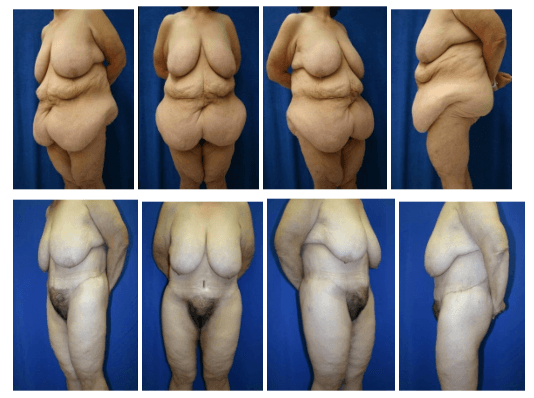
Figure 2: This is a 58-year-old female patient who weighed a maximum of 352 lbs. She underwent RNY and lost 160 lbs. She did not like the excess skin and fat of her central abdomen and saddlebags. She underwent a 360 body lift. Please note the significant improvement of her abdomen with the removal of excess skin/fat. Her abdomen is now flat, her pubic region exposed, and her saddlebags are eliminated. This procedure took 4 hours long and was performed under general anesthesia. Dr. Katzen removed 12 lbs. of skin and fat. This patient was able to return to her sitting job three weeks after surgery. She’s happy with her body and the lack of excess skin over her abdomen, hips, and buttocks
Who is a Good Candidate and Who Should Wait
Usually, a good candidate is someone with significantly lower body skin laxity after massive weight loss, who is healthy enough for surgery and emotionally prepared for the recovery. A properly prepared patient also should have realistic expectations of the limits of a lower body lift. The most important practical requirement is stable weight.
Stable weight does not mean “pretty close.” A stable weight means weight has stayed consistent for months. Many plastic surgeons require a stable weight for at least six months, sometimes longer, especially after bariatric surgery. If your weight is still fluctuating, you should consider rescheduling your lower body lift.
Usually, if you are actively losing weight, planning another big weight drop, using nicotine, or dealing with uncontrolled health issues, you should consider postponing your body lift surgery. The 360° circumferential lower body lift recovery is demanding, and pushing your body when it is not ready can lead to wound problems, infections, poor scars, and revision surgery.
Also, mindset matters. The 360° circumferential lower body lift procedure comes with a long scar. There is swelling. There is a phase when the body may look worse than before the lower body lift surgery. Patients who expect perfection quickly may struggle, even when healing is normal.
Why Preparation Matters More Than Most People Expect
Results depend mostly on the plastic surgeon. The skills of your chosen plastic surgeon matters but preparation and recovery behavior matter just as much.
Preparation includes stable weight, good nutrition, stopping nicotine completely, and getting medical issues under control. Preparation for the body lift includes planning for recovery and support at home. A lower body lift is not the kind of surgery where you can “go it alone.” You will need someone to help you walk, get to the bathroom, go the pharmacy, help you get to your post-operative appointments.
To be better prepared for your lower body lift surgery, please read The Complete Checklist of Supplies for a Successful Lower Body Lift Recovery.
Also, this is the time to clarify goals. Some people want a flatter lower abdomen. Others care most about the waist and flanks. Some are focused on the buttocks and outer thighs. Communicate these issues with your plastic surgeon. The body lift can be literally tailored to your needs. The surgical plan can be shaped around priorities, but priorities need to be realistic.
Choosing the Right Plastic Surgeon: What Actually Matters
Probably, the most important criteria of choosing a lower body lift is experience. Your chosen plastic surgeon should have performed hundreds of lower body lift patients. The more lower body lift procedures the better. Your plastic surgeon should have an extensive portfolio of lower body lift before-and after pictures. Before-and after pictures are the best proof a plastic surgeon has to confirm their experience. Do not be disillusioned by an inexperienced plastic surgeon who does not have hundreds of lower body lift pictures offering to perform your body lift surgery at a discount.
A circumferential lower body lift is complex because the surgery involves an incision around the entire lower torso. Often, massive weight loss patient’s skin can have thin skin, poor elasticity, history of chronic infections, and multiple folds that can pull in different directions.
A competent plastic surgeon communicates clearly, sets honest expectations, and prioritizes safety. Your consultation should include a discussion of scar placement, expected swelling, possible complications, and recovery limitations. You should leave the consult understanding the trade-offs, not just feeling excited.
Also, your plastic surgeon should have deep experience with related contouring issues, because many massive weight loss patients later consider targeted areas like thighs or mons; for additional reading, those topics are covered here: Thigh Lift Reduction Options Explained: From Surgery to Reduction and Understanding FUPA or Monsplasty Surgery: What to Expect Before, During, and After.
Scars: The Trade-Off That Must Be Understood Before Surgery
The 360° circumferential lower body lift procedure creates a scar that extends completely around the body. Usually, the scar is placed where underwear or swimwear can cover it, but it is still a real scar.
Early scars are not subtle. They are often red, raised, and firm. This is normal. Scar maturation can take many months. Over time, scars usually soften and fade, but they do not vanish. Prepared lower body lift patients must realize they are trading “skin for a scar.”
What Surgery Day Looks Like
Before surgery, markings are made while standing. This matters because loose skin shifts when lying down. During surgery, your plastic surgeon removes excess skin and repositions tissue so the skin sits higher and smoother. Because of the lower body lifts complexity, the surgery usually takes 6 to 8 hours to complete under general anesthesia.
After surgery, patients wake up tight and swollen. Drains are used to remove excess fluid and assist in healing. Compression garments are applied. Pain management and careful monitoring are standard.
A safe team encourages early, gentle walking as soon as it is appropriate. Early ambulation helps circulation and lowers the risk of blood clots.
The First Two Weeks of Recovery: The Part That Feels Most Real
The early phase is when most people think, “Wow, this is harder than expected.” You will have some degree of pain. Swelling is heavy. Energy is low. The body can feel stiff and fragile. Standing fully upright may be difficult for a short time because everything feels tight. Drains can feel annoying and awkward. Sleeping can be uncomfortable. Appetite can be weird. Constipation is common due to anesthesia and pain medication. This is why recovery planning matters.
Help at home is not optional for most patients. Simple tasks like getting out of bed, preparing food, and managing drain care can feel like a big job. Planning for support protects safety and reduces stress.
Risks: What to Expect Without Panicking
Every surgery has risks. A lower body lift has more risks because it is more lengthy in terms of time under anesthesia, longer incision line, and more extensive compared to a smaller procedure.
Common issues include swelling, bruising, fluid collections, delayed healing, and uneven scarring. More serious risks include infection, bleeding, blood clots, and wound separation. The best protection is proper screening, nicotine-free living, good nutrition, early walking, and following instructions.
Red flags should never be ignored. Sudden shortness of breath, chest pain, calf swelling, high fever, worsening redness, foul drainage, or rapidly increasing pain should trigger immediate contact with the surgical team or emergency care.
When Results Start to Show and When They Do Not
The body does not “settle” overnight. Swelling will hide your new shape for at least 6 to 8 weeks. Some patients may be swollen for months. Some areas may look uneven during healing. This is common and usually improves as tissues relax and swelling subsides.
Most patients begin to see clearer contour improvement within the first couple of months, but final results often can take 6 to 12 months. Also, scar maturation takes time. Early judgment often leads to unnecessary worry.
Here is another example of remarkable results of circumferential lower body lift.
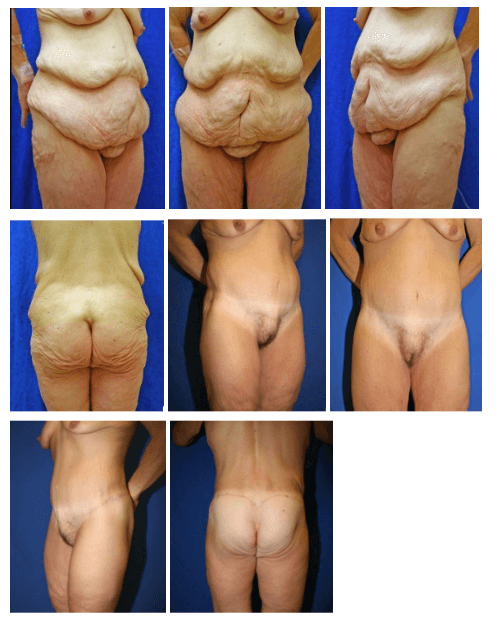
Before & After 360° Circumferential Lower Body Lift
Figure 3: This is a white 38-year-old female who weighed 340 pounds, underwent RNY gastric bypass, and lost 210 pounds. She did not like the excess skin/fat of her abdomen, nor the shape of her pubic region. She underwent a 360 body lift. Please note her new flat abdomen, her “new” belly button, and the removal of saddlebags. In addition, Dr. Katzen raised, reduced, and flattened pubic region. This surgery was performed under general anesthesia and took 4 hours to complete. This patient was able to return to her sitting job two and a half weeks after surgery. The patient is extremely happy with her results and confident in her decision to choose Dr. Katzen to complete her transformation and restore body harmony.
Long-Term Success: How to Protect Your Lower Body Lift Results for Years
Long-term success is less about perfection and more about consistency. Maintaining a stable weight protects results. Staying active helps shape and maintain overall health. Eating enough protein supports tissue quality. Attending follow-ups helps catch small issues early.
Skin will continue to age. Gravity still exists. But the burden of massive, hanging skin can be permanently reduced.
Some patients later consider additional shaping procedures depending on their anatomy and goals, especially around the buttocks. Some patients may consider a BBL. If you are considering these options please read his related resource: The Rise of the BBL.
Common Regrets and How to Avoid Them
Most regrets are predictable.
-
Rushing surgery before weight stabilizes is a big one.
-
Underestimating recovery needs is another.
-
Choosing a plastic surgeon based only on price or social media marketing can backfire.
The safest approach is slower and more deliberate. Stable weight, strong nutrition, nicotine-free living, thoughtful plastic surgeon selection based on body lift experience, and realistic expectations protect both safety and satisfaction.
Final Thoughts
A 360° circumferential lower body lift is a powerful procedure for people who have already done the hard work of massive weight loss. A lower body lift is not a shortcut and not a small tweak. This surgery is a full lower body reshaping surgery that can improve comfort, mobility, hygiene, and confidence when performed at the right time and supported by proper preparation.
The surgery itself matters, but what truly determines long-term success is what happens before and after: stable weight, solid nutrition, zero nicotine, safe planning, and disciplined recovery. When those pieces come together, the result is not just a new silhouette; it’s a brand new body. Your lower body lift result should be a body that finally feels like it belongs to the person who earned it.

Figure 4: Picture of Dr. J. Timothy Katzen’s office in Beverly Hills. The address is 9735 Wilshire Boulevard, Suite #407, Beverly Hills, CA 90212. Dr. Katzen’s phone is (310) 859-7770.
If you or someone you know are considering a 360° circumferential lower body lift, please get in touch with Dr. Katzen. Dr. Katzen and his team will be able to evaluate your abdomen and provide the most appropriate treatment. Please arrange for a consultation with Dr. Katzen by calling