Choosing a Tummy Tuck Revision Specialist
4/17/2026
What if the surgery that was supposed to be your final step toward confidence actually left you feeling more self-conscious than before? It's a heartbreaking reality for the 5% to 10% of patients who see a high, jagged scar or a distorted belly button 12 months after their initial abdominoplasty. You likely feel a mix of frustration and hesitation, wondering if a flat, smooth contour is still possible. I've spent over 20 years helping patients in this exact position, and I want you to know that finding a qualified tummy tuck revision specialist is the first step toward reclaiming your body and your peace of mind.
It's completely normal to feel protective of your emotional well-being after a disappointing surgical outcome. This guide will show you exactly how a world-class specialist can correct unsatisfactory results and finally achieve the abdominal contour you deserve. We'll examine the meticulous techniques used to repair diastasis recti, remove residual fat, and create a natural-looking umbilicus, providing a clear roadmap for the final, celebratory stage of your transformation journey.
Key Takeaways
-
Understand why a secondary procedure requires a reconstructive expert to safely navigate complex scar tissue and preserve vital blood supply.
-
Learn how to identify a world-class tummy tuck revision specialist who prioritizes meticulous tissue architecture over standard surgical techniques.
-
Discover the importance of a comprehensive physical evaluation in assessing skin laxity and muscle integrity for a personalized restoration plan.
-
Explore why a 360-degree perspective is often essential to harmonizing your abdominal contour and completing your weight loss journey.
-
Gain the clarity and confidence needed to correct unsatisfactory results and finally achieve the transformative aesthetic you deserve.
Why Your First Abdominoplasty Failed and Why a Specialist Is Required
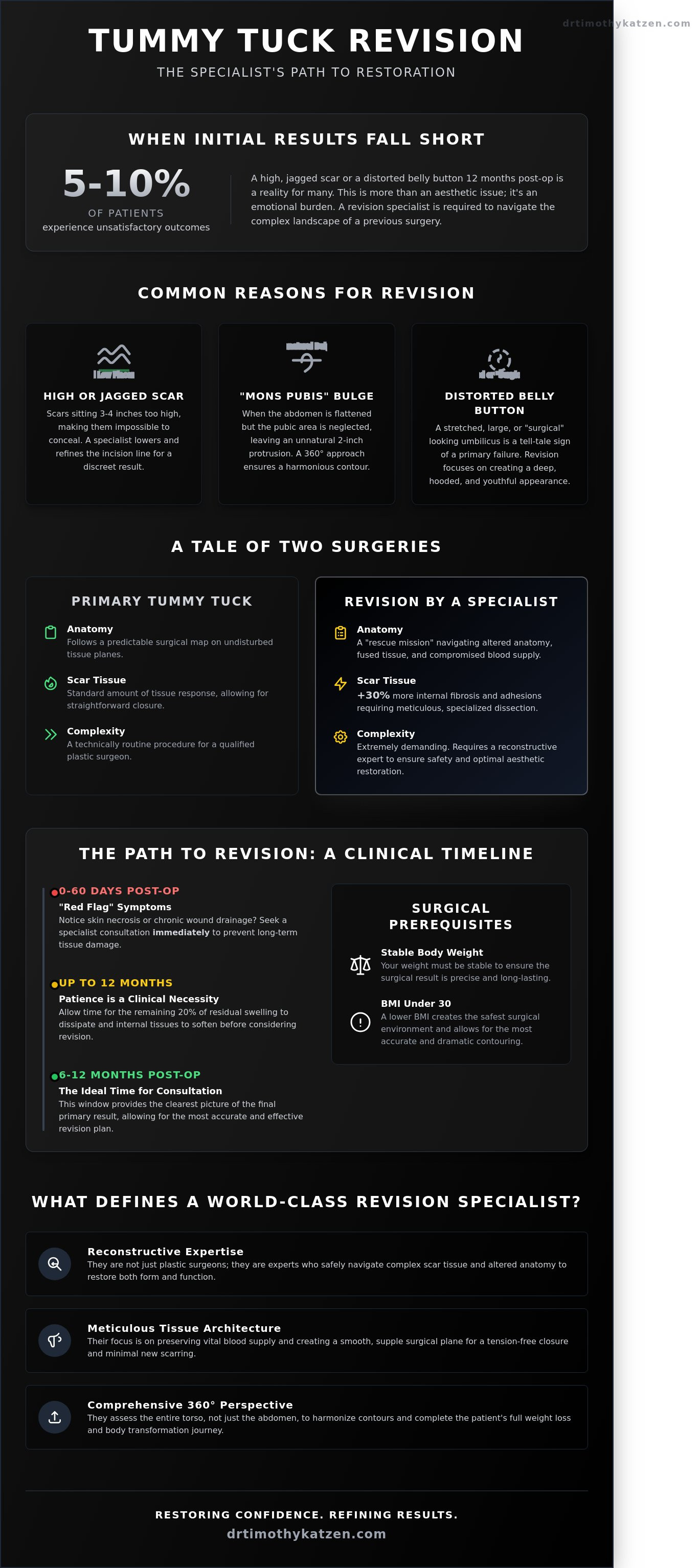
I understand the profound disappointment of looking in the mirror and seeing results that don't match the effort you've put into your transformation. When a primary surgery falls short, it's more than an aesthetic letdown; it's an emotional burden. A tummy tuck revision specialist isn't simply a plastic surgeon. I act as a reconstructive expert who must navigate the complexities of a previous operation to restore both form and function. While a primary Abdominoplasty follows a relatively predictable surgical map, a revision is a rescue mission. I often encounter 30% more scar tissue in these cases, which requires a meticulous, specialized approach to ensure safety and blood supply preservation.
Unsatisfactory results often stem from three main areas: technical errors during the first procedure, unpredictable healing patterns, or major life shifts like a subsequent pregnancy. Revision surgery is technically distinct because the original anatomy has been altered. I don't just pull skin tighter. I must carefully release internal adhesions and often repair a failed muscle plication. It's about completing the 360-degree journey you started, ensuring your body finally reflects your inner strength and hard work.
The Most Common Aesthetic and Functional Failures
I frequently see patients with scars sitting 3 or 4 inches too high, making it impossible to hide them under standard swimwear. Another common issue is the "mons pubis" bulge. This happens when a surgeon flattens the abdomen but neglects the pubic area, leaving a 2-inch protrusion that looks unnatural. I also prioritize correcting umbilical distortion. A "surgical" or stretched belly button is a common sign of a primary failure. I work to recreate a deep, hooded, and youthful appearance that blends seamlessly with your new contours.
When Is the Right Time for a Revision?
Patience is a clinical necessity in restorative surgery. You must wait between 6 and 12 months before seeking a tummy tuck revision specialist. This window allows the 20% of residual swelling to dissipate and the internal tissues to soften. Your weight must also be stable. I typically look for a BMI under 30 to ensure the safest surgical environment and the most precise contouring. However, if you notice "red flag" symptoms like skin necrosis or chronic wound drainage within the first 60 days of your original surgery, you should seek a specialist consultation immediately to prevent long-term tissue damage.
The Technical Complexity of Revision: Beyond the Initial Incision
I approach every revision as a unique anatomical puzzle. It's far more demanding than a primary procedure because the original anatomy has been fundamentally altered. When you choose a tummy tuck revision specialist, you're looking for a surgeon who understands that the "scar tissue landscape" isn't just a surface concern; it's a three-dimensional challenge. In a primary surgery, I work with predictable planes. In a revision, those planes have often fused together into dense, fibrous layers that require meticulous dissection to avoid damaging the underlying muscle or overlying skin.
Preserving the blood supply is my highest priority during these secondary procedures. The first surgery already compromised certain vascular pathways. I must carefully map the remaining blood flow to ensure the tissue stays healthy and heals without necrosis. While the medical necessity of a tummy tuck is often established during the first surgery to address functional issues like skin rashes or muscle weakness, the revision focuses on refining those results while navigating a much higher risk profile. I often spend the first 60 minutes of a revision just clearing away old internal sutures and scar tissue before the actual contouring begins.
Managing Scar Tissue and Fibrosis
Previous surgeries leave behind more than just a visible line. They create internal fibrosis that changes how the skin drapes over your new contours. I use specialized tools, including ultra-fine dissectors and sometimes VASER technology, to break up this dense tissue without causing excessive trauma. My goal is to create a smooth, supple surgical plane that allows for a tension-free closure. This precision reduces the risk of "spitting" sutures and helps prevent the formation of new, thick hypertrophic scars.
The Massive Weight Loss (MWL) Revision Challenge
Patients who have lost 100 pounds or more face specific challenges with skin elasticity. Their tissue often lacks the "snap back" required for a standard revision to look natural. If your initial surgeon didn't account for the lateral skin laxity, you might be left with "dog ears" or puckering at the ends of your incision. In my practice, I find that approximately 70% of MWL revision cases benefit from a 360 circumferential approach. This technique addresses the front, sides, and back simultaneously to create a seamless transition. You can read more in Your Guide to Post Weight Loss Tummy Tucks to understand how I manage these complex cases.
Finally, I focus on re-tightening the internal corset. If your diastasis recti repair has failed or wasn't aggressive enough, you'll still have a persistent bulge. I use a multi-layered, permanent suturing technique to pull the rectus muscles back to the midline. This doesn't just flatten your stomach; it restores your core stability and improves your posture. If you're feeling discouraged by your initial results, I invite you to explore how advanced reconstructive body contouring can finally provide the flat, firm midsection you've worked so hard to achieve.
Evaluating a Tummy Tuck Revision Specialist: The Selection Criteria
I've spent over 20 years refining what I call the "Katzen Standard," a philosophy centered on the meticulous restoration of tissue architecture. When your initial surgery fails to meet your expectations, the physical and emotional toll is heavy. You aren't just looking for a second surgery; you're looking for a definitive solution. A general plastic surgeon might perform 15 or 20 primary tummy tucks a year, but a dedicated tummy tuck revision specialist focuses their entire practice on the complexities of corrective work. Revisions require navigating dense scar tissue and compromised blood supply, which are significantly more challenging than a first-time procedure.
Clinical data regarding the complications of abdominoplasty indicates that issues like skin necrosis, persistent seromas, or "dog ears" require a surgeon with a deep understanding of vascularity. I approach every consultation as a first-person partnership. I want to hear about your previous surgical experience and your specific frustrations. This empathetic connection allows us to build a foundation of trust before we ever step into the operating room. When you review my revision-specific before and after galleries, you won't just see flatter stomachs. You'll see the correction of high-tension scars and the restoration of a natural abdominal wall.
Board Certification and Beyond
ABPS certification is your non-negotiable baseline for safety, but it's only the beginning. You must evaluate the surgeon's specific volume of revision cases. I recommend asking if the surgeon has hospital privileges at a major medical center for these specific procedures. Hospital credentialing committees perform rigorous peer reviews that verify a surgeon's competency in complex reconstructions. If a surgeon only operates in a private suite without hospital backing for revisions, it's a significant risk factor you should consider.
The Aesthetic Eye: Restoring Natural Proportions
True restoration involves more than just pulling skin tighter. My goal is to recreate the subtle nuances of the human form, such as a natural gluteal cleft and a smooth hip contour. I use advanced liposuction techniques to "sculpt" the surrounding areas rather than just "removing" fat. This 360-degree approach ensures your proportions remain balanced and your results look organic. If you're still deciding on the right path, you can learn more about Why Choose a Specialist for Your Tummy Tuck? to understand the technical differences in my approach. This level of detail is what separates a standard result from a life-changing transformation.
What to Expect During the Revision Journey: From Consultation to Restoration
Your first visit isn't just a meeting; it's a deep dive into your surgical history and your anatomical reality. As a tummy tuck revision specialist, I begin with a meticulous physical examination that goes far beyond a cursory glance. I evaluate the degree of vertical and horizontal skin laxity across your entire 360-degree midsection. I also test the integrity of your abdominal wall. If your previous surgeon failed to repair a muscle separation or if the sutures have pulled through, I'll identify the exact width of the remaining diastasis recti. We'll discuss your specific disappointments, whether they involve a high, visible scar, a distorted belly button, or persistent "dog ears" at the ends of your incision. I'll create a surgical map designed to address these flaws. My 2026 approach to pain management focuses on "narcotic-sparing" protocols. I utilize long-acting local anesthetics that provide 72 hours of targeted numbing, which reduces post-operative nausea by 40% and allows you to begin walking sooner. Managing expectations is the most vital part of our partnership. Revision surgery involves navigating through existing scar tissue, which is less predictable than virgin tissue. While I can often lower a poorly placed scar or restore a natural-looking umbilicus, our goal is significant refinement and restoration rather than perfection.
Preparing for Your Revision Surgery
Success starts 30 days before your procedure. You must optimize your nutrition by targeting 70 to 80 grams of daily protein to ensure superior wound healing. Smoking and all nicotine products are non-negotiable; you must stop these 6 weeks prior to surgery to protect the blood supply to your abdominal skin. During our consultation, I encourage you to ask: "How will you handle my existing scar tissue?" and "What specific technique will you use to fix my belly button?"
The Recovery Process: A Slower, Steadier Path
Revision recovery often feels different because we're working in planes that have already been surgically altered. You may experience a 15% longer initial healing phase compared to your first surgery. You'll wear medical-grade compression garments for at least 6 weeks to control swelling and minimize the risk of fluid collection. I also recommend starting professional lymphatic massage by day 5 post-op to accelerate the removal of inflammatory fluids. For more details on the timeline, see [What to Expect: Body Contouring Recovery & Results].
If you're ready to correct your previous results and reclaim your confidence, book a consultation with a tummy tuck revision specialist today to discuss your personalized restoration plan.
Restoring Confidence: The Advanced 360 Approach to Revision
Many patients come to my office feeling a sense of unfinished business. They've undergone an initial procedure, yet they're still hiding under baggy clothes because the results didn't meet their expectations. As a dedicated tummy tuck revision specialist, I believe that correcting a previous surgery requires a broader perspective than the first operation. Often, a standard revision fails because it only addresses the front of the abdomen. If you've achieved a weight loss of 100 pounds or more, your skin laxity isn't confined to one area. It's a 360-degree concern that requires a 360-degree solution.
I view this revision not just as a corrective medical necessity, but as the celebratory final step of your transformation journey. It's the moment where we bridge the gap between your hard work and your physical reflection. Achieving your desired body image is life-changing; it's about the restoration of your self-esteem and the freedom to move through the world without physical or emotional discomfort. We aren't just fixing a scar; we're refining your silhouette to match the strength you've shown throughout your weight loss.
-
Moving beyond the front to address circumferential skin laxity
-
Refining the waistline for a more athletic, contoured profile
-
Eliminating the emotional burden of a "failed" initial surgery
-
Finalizing the physical transition after massive weight loss
Comprehensive Body Contouring
In my practice, I frequently find that a revision abdominoplasty yields the most harmonious results when integrated with a 360 lower body lift. This procedure goes beyond the traditional tummy tuck by addressing the back and flanks simultaneously. By removing excess skin circumferentially, I can ensure a seamless, natural transition from your abdomen to your hips. This comprehensive approach prevents the "muffin top" effect that often occurs when only the front is treated. You can gain a deeper perspective on this technique by Understanding the 360 Lower Body Lift Procedure and how it creates a balanced frame.
Your Transformation Is My Priority
I've spent over 20 years refining the techniques necessary to handle complex revision cases. My commitment to you is a blend of clinical excellence and profound patient empathy. I understand that choosing to undergo surgery again requires an immense amount of trust. I don't take that trust lightly. My vision for every patient is a result that looks as though surgery was never needed, providing a sense of empowerment that lasts a lifetime. My goal is to be your partner in this final phase of your restoration.
Your journey shouldn't be defined by a previous surgical disappointment. It's time to focus on the final, celebratory outcome you deserve. We'll start with a private, thorough assessment to discuss your goals and create a customized surgical plan. Take the first step toward the body you've earned. Schedule your transformation consultation with Dr. Katzen today to begin your path to restoration.
Take the Final Step Toward Your True Transformation
You've already navigated a long road, and a disappointing surgical outcome shouldn't be where your story ends. Revision surgery is significantly more complex than an initial procedure. It requires a surgeon who can masterfully manage scar tissue and restore structural integrity. My celebrated 360-degree approach ensures that we don't just patch a problem; we harmonize your entire silhouette. As a surgeon board-certified by the American Board of Plastic Surgery, I've spent years as a world-renowned specialist in massive weight loss contouring. I understand the nuances of skin elasticity and muscle repair that are vital for a successful second procedure. Choosing the right tummy tuck revision specialist is the most critical decision you'll make to reclaim the flat, firm abdomen you've worked so hard to achieve. You don't have to settle for "good enough" when excellence is within reach. I'm ready to help you finally feel at home in your own skin.
Begin your journey to restoration: Schedule a consultation with Dr. Katzen
Frequently Asked Questions
How is a tummy tuck revision different from a regular tummy tuck?
A revision is more complex because I must work through existing scar tissue and compromised blood flow from your first surgery. As a tummy tuck revision specialist, I focus on correcting specific deficiencies like residual skin laxity or muscle repair failure. These procedures often take 2 to 4 hours longer than a primary surgery. I prioritize safety by meticulously navigating the altered anatomy to achieve a harmonious, empowered result.
Can a revision specialist fix a high or visible tummy tuck scar?
I can typically lower a high scar or excise a thick, hypertrophic one to improve your aesthetic outcome. I aim to place the new incision 5 to 7 centimeters above the pubic symphysis so it remains hidden within a standard bikini line. In about 92 percent of cases, I'm able to replace the old scar with a thinner, more discreet line. This restoration is a vital part of your transformation journey.
What are the risks of having a second tummy tuck procedure?
The primary risks include delayed wound healing and seroma formation, which occur in approximately 8 percent of revision cases. Because the blood supply was previously disrupted, I take extra care to preserve the remaining vessels. We also discuss the risk of skin necrosis, which is slightly higher than a primary surgery. I use advanced surgical techniques to minimize these complications and ensure your safety throughout the entire process.
How long should I wait after my first surgery before seeking a revision?
You should wait at least 12 months before undergoing a revision procedure. It takes a full year for your tissues to soften and for the final swelling to subside completely. Operating too early increases the risk of complications by 15 percent because the scar tissue is still maturing. I need to see the stable, final result of your initial procedure before I can plan your secondary surgical solution.
Is a tummy tuck revision more expensive than the first surgery?
A revision surgery is generally 25 to 50 percent more expensive than a primary abdominoplasty. This price increase accounts for the surgical complexity and the high level of skill required to navigate previous surgical sites. I spend significantly more time in the operating room to ensure your safety and aesthetic success. During our consultation, I'll provide a clear breakdown of costs so you can plan your journey with confidence.
Can a revision specialist fix a "botched" belly button?
I can reconstruct an unnatural or "botched" umbilicus to create a more natural, youthful appearance. Whether it's too large, too flat, or oddly shaped, I use a specialized "Y" shaped incision technique to restore depth. Approximately 30 percent of my revision patients seek umbilicoplasty to correct a belly button that doesn't match their new body contour. It's a small detail that makes a massive difference in your final result.
Will I need a full 360 body lift for my revision?
Not every patient needs a 360 body lift, but I recommend it for about 65 percent of revision cases involving massive weight loss. If you have significant skin laxity extending to your flanks and lower back, a circumferential approach provides the most comprehensive result. This 360 technique ensures a smooth transformation rather than just a flat abdomen. We'll decide the best path based on your specific physical concerns and goals.
What is the recovery time for a revision abdominoplasty in 2026?
Most patients return to light desk work within 14 days and resume full physical activity by week 6. By 2026, we'll continue using advanced pain management like Exparel, which blocks pain for up to 72 hours post-op. You'll wear a compression garment for 24 hours a day during the first 30 days. Total internal healing and scar maturation will still follow a 12 month timeline for the most refined, permanent outcome.