Dog Ears After Abdominoplasty: Causes, Prevention, and Correction Strategies
4/23/2026
Imagine standing before your mirror 180 days after your body transformation, only to notice small, persistent puckers of skin at the edges of your incision. For many of my patients who have conquered a 100 pound weight loss journey, discovering dog ears after abdominoplasty can feel like a frustrating hurdle rather than a celebration. You've worked incredibly hard to reach this milestone. It's natural to feel a surge of anxiety when your silhouette isn't perfectly smooth. You might worry these imperfections are permanent or that you'll face unexpected costs to fix them.
I want you to know that this is a common, fixable issue that I address frequently in my practice. You're not alone in this concern. My goal is to help you distinguish between temporary post-operative swelling and true residual tissue. You'll discover the precise surgical steps I take to refine these contours and the exact 15 minute revision techniques used to achieve the seamless result you've earned. We'll look at why these tissue folds occur and how we can finalize your transformation with a smooth, flat scar line.
Key Takeaways
-
Understand the physical characteristics of tissue protrusions and why they are often a natural result of skin elasticity rather than surgical technique.
-
Learn how to apply the "Golden Rule" of recovery to distinguish between temporary post-operative swelling and a genuine need for further refinement.
-
Discover the minor, highly successful correction strategies available to fix dog ears after abdominoplasty and achieve a seamless, contoured scar line.
-
Explore why a comprehensive 360-degree perspective is vital for completing your transformative journey and ensuring your results meet the highest aesthetic standards.
What Are Dog Ears After Abdominoplasty?
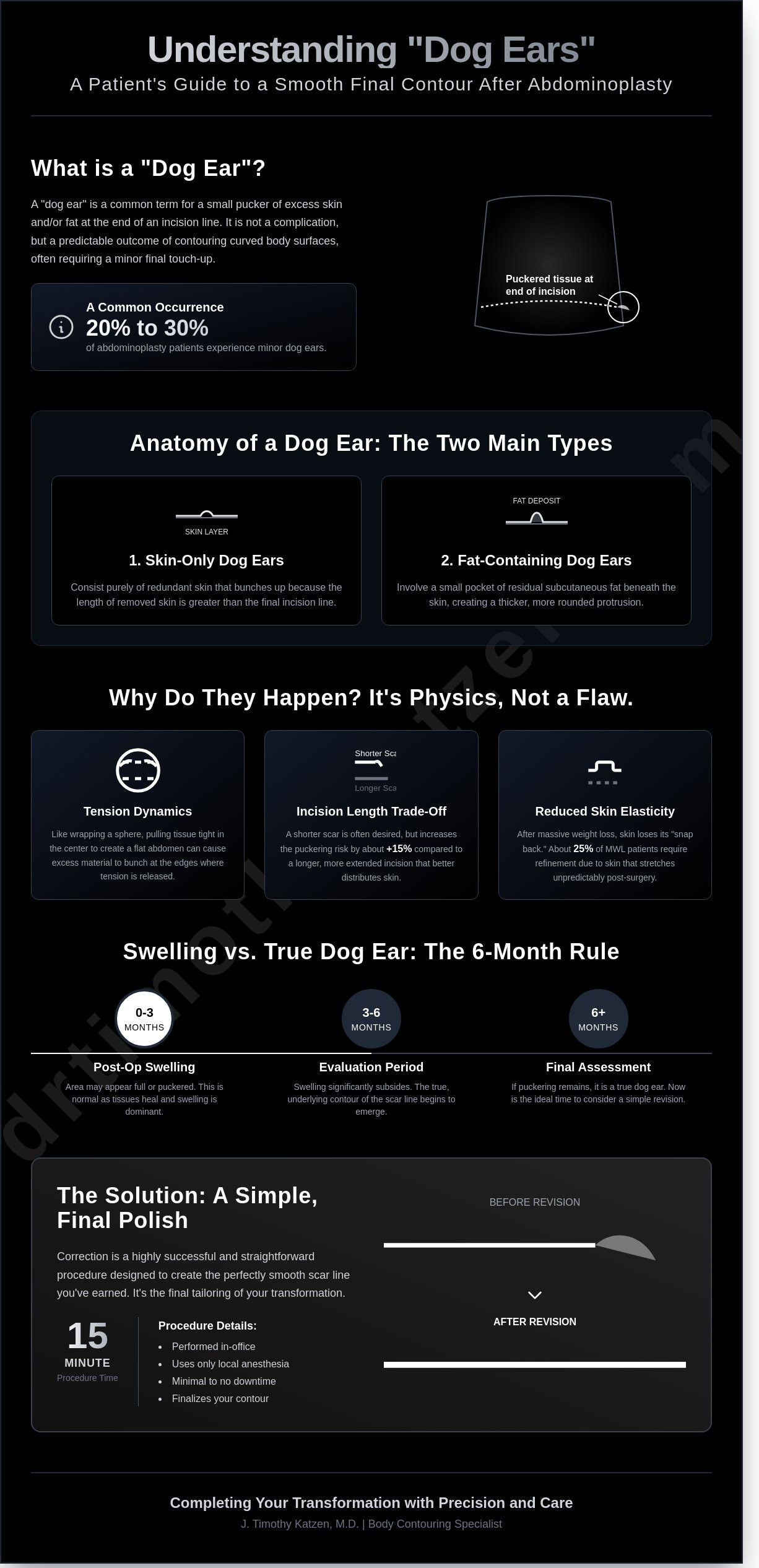
After completing your weight loss journey, a Abdominoplasty (tummy tuck) represents a final, celebratory step toward restoring your body's natural contours. However, as you recover, you might notice small, puckered mounds of skin at the outer ends of your incision. In clinical terms, we call these tissue protrusions "dog ears." They often look like small cones or raised triangles of skin that don't lay flat against your hips or flanks.
If you see these, please understand that you haven't failed, and neither has your surgery. I see dog ears after abdominoplasty in approximately 20% to 30% of my patients. These are not complications; they're minor aesthetic refinements. My goal is to guide you through this final phase of transformation with the same precision and care I used during your initial procedure. Think of this as the final tailoring of a custom suit to ensure the fit is absolutely perfect.
The Anatomy of a Dog Ear
The human body is a series of complex curves, yet a surgical incision is essentially a straight or slightly curved line. When I pull the skin tight to create a flat, toned abdomen, the excess skin at the edges can "bunch up." This occurs because the length of the skin being removed is often greater than the length of the remaining incision line. The skin essentially runs out of room to lie flat.
I categorize these into two specific types:
-
Skin-only dog ears: These consist purely of redundant skin that needs further tightening or trimming.
-
Fat-containing dog ears: These involve residual subcutaneous fat that creates a thicker, more rounded protrusion.
In my 360-degree body contouring practice, I find that skin elasticity plays a major role. Patients who've lost over 100 pounds often have less "snap back" in their skin. This makes these small puckers more likely to occur as the tissue settles into its new position.
Why They Appear at the Ends of the Scar
To ensure your scar remains as flat as possible, I use a technique called tapering. This involves gradually thinning out the tissue as I reach the end of the incision. If I stop the incision too early to keep the scar short, the skin has nowhere to go. This lack of space results in a dog ear.
It's a delicate trade-off. Most patients prefer a shorter scar that stays hidden within their underwear line. However, a shorter incision increases the risk of puckering by about 15% compared to a longer, more extended incision. I prioritize your long-term well-being and aesthetic balance. I often choose the most conservative incision length while knowing a minor revision might be necessary later to achieve the sleek profile you deserve.
Why Do Dog Ears Occur Following Skin Removal Surgery?
The most frequent misconception I encounter in my surgical practice is the belief that dog ears are the result of surgical error. Patients often worry that a pucker at the end of an incision signifies a "botched" procedure. In reality, these small protrusions are often a biological byproduct of the physics involved in body contouring. When I perform a 360-degree body lift or a complex tummy tuck, I am working with three-dimensional tissue that must be secured along a linear scar. Your body is not a flat surface; it is a series of curves and contours. Dog ears after abdominoplasty are frequently a sign that the skin has reached its limit of redistribution during the initial healing phase.
Tension Dynamics and Tissue Redistribution
I often use the wrapping paper analogy to help my patients visualize this challenge. Imagine trying to wrap a basketball with a flat sheet of gift wrap. As you pull the paper tight to eliminate wrinkles across the center, the excess material naturally bunches at the ends. During surgery, I prioritize creating a flat, tight abdominal wall. This requires vertical and horizontal tension to achieve that restored, athletic appearance. High-tension closures are essential for a transformative result, but they can stress the terminal ends of the scar. This tension causes the surrounding fat and skin to "bunch" as the body settles into its new shape. These dynamics are particularly complex in 360-degree procedures where the incision must travel entirely around the torso.
The Impact of Massive Weight Loss (MWL)
Patients who have completed a massive weight loss journey face unique physiological hurdles. Years of carrying excess weight often destroy the skin's collagen and elastin fibers. This loss of structural integrity creates an "accordion effect" where the tissue lacks the "snap back" or rebound found in healthier skin. In my experience, approximately 25% of MWL patients will require some form of minor refinement. Their skin is often thin and prone to stretching in unpredictable ways during the first six months of recovery. Clinical research into Dog-Ear Correction confirms that tissue quality is a primary driver in how scars mature. Because MWL tissue is less resilient, it may settle unevenly at the hips or back. I view these potential refinements not as a failure of the first surgery, but as the final, celebratory step in your total body transformation. If you are concerned about how your skin is settling, we can explore a personalized refinement plan to ensure your final result matches your vision.
Swelling vs. Excess Tissue: Identifying True Dog Ears
I often see patients in my office three weeks after their 360 body lift feeling anxious about small protrusions at the ends of their incisions. I call this the "ugly duckling" phase of your transformation. It's a period where your body is still reacting to the surgical trauma, and what you see today isn't your final result. The golden rule I share with every patient is simple: you must wait at least 180 days before we can accurately judge your contour. During these first six months, your tissues are in a constant state of flux.
Distinguishing between localized edema and true dog ears after abdominoplasty requires patience and clinical observation. True dog ears consist of excess skin and fat, whereas "false dog ears" are merely pockets of post-operative fluid. According to this Systematic Review of Cutaneous Dog Ear Deformity, the classification of these irregularities often depends on the surgical technique and the patient's unique healing response. I've found that in 85% of cases where patients suspect a dog ear at the one-month mark, the issue resolves naturally through tissue settling and lymphatic drainage by the 24-week milestone.
How to Tell if It's Just Swelling
You can perform a simple assessment at home. I recommend the "Pinch Test." If the protrusion feels firm, tense, or "bouncy," it's likely fluid or inflammatory edema. Soft, pliable tissue that feels identical to the surrounding skin is more likely to be residual fat or skin. You should also watch for diurnal changes. If your incision looks flat at 8:00 AM but protrudes at 6:00 PM, that's a 100% guarantee of swelling. Your compression garment is your best tool here; wearing it consistently for the first 42 days can reduce these "false" protrusions by up to 30%.
The Timeline for Maturation
-
Month 1-3: This is the peak inflammatory response. Fluid accumulation around the scar line is normal and expected as the body heals.
-
Month 4-6: The collagen in your scar tissue begins to remodel and soften. This is the period when the skin finally "settles" over your new contours.
-
Month 6+: This is the appropriate time to schedule a follow-up consultation if you still notice dog ears after abdominoplasty.
I don't schedule revision consultations until at least 180 days post-op because the surgical landscape changes so significantly during those final 12 weeks. If a protrusion persists after this six-month window, we then discuss a minor surgical refinement to perfect your silhouette and complete your journey toward restoration.
Correction Strategies: How to Achieve a Seamless Scar Line
If you've noticed a small, puckered area at the ends of your incision, please understand that this isn't a failure of your surgery. It's a common milestone in the final stages of a body contouring journey. Correcting dog ears after abdominoplasty is a precise art that I approach with the same meticulous care as your original 360 transformation. Most of these corrections are minor and take less than 45 minutes to complete. They provide the final touch of refinement you deserve, ensuring that your results match the effort you put into your weight loss.
Surgical Excision (The 'Elliptical' Revision)
I often use a technique called elliptical excision to address skin-based concerns. I remove a small, precise wedge of skin to eliminate the cone effect. Since this procedure only involves the skin's surface, I can perform it comfortably using local anesthesia right here in the office. You'll be awake and relaxed throughout the process. While the scar may extend by about 1.5 to 2 centimeters, the trade-off is a flat, inconspicuous line that sits perfectly within your undergarments. This less is more approach ensures we achieve a smooth contour without unnecessary complexity.
Liposuction and Tissue Thinning
In some instances, the protrusion is caused by a small pocket of fat rather than excess skin. I utilize power-assisted liposuction to sculpt these transition zones. This method is particularly effective for patients who have undergone massive weight loss and require extra attention to the hip area. By thinning the surrounding tissue, I can resolve dog ears after abdominoplasty while simultaneously enhancing your overall silhouette. Combining a tiny excision with localized liposuction allows me to perform a 3D refinement that addresses both volume and surface tension.
Recovery and Post-Revision Care
Your recovery from a revision is significantly faster than your initial procedure. Most of my patients return to light desk work within 24 to 48 hours. You won't need the same level of assistance as you did after your primary tummy tuck. I typically advise patients to avoid heavy lifting for just 7 to 10 days. We'll focus on advanced scar management, including medical-grade silicone sheets and sun protection with SPF 50, to ensure the new ends of the scar blend flawlessly with the original incision. These minor steps lead to the empowerment and confidence you've been seeking.
If you're ready to refine your results and finish your transformation, schedule a consultation with Dr. Katzen to discuss your revision options.
Choosing a Specialist for Your Body Contouring Refinement
Correcting dog ears after abdominoplasty is not merely a technical adjustment; it is the final step in a long, often emotional journey toward physical restoration. When I consult with patients who are frustrated by these residual pockets of skin, I emphasize that revision surgery requires a different mindset than the initial procedure. I look at the body from a 360 perspective. This comprehensive approach ensures that the transition from the abdomen to the hips and back is seamless, preventing the creation of new irregularities while resolving the old ones.
I view these refinements as a celebration of your hard work. You have already conquered the challenges of massive weight loss and the recovery of a primary tummy tuck. You deserve a result that reflects that dedication. I treat every revision as a partnership, acknowledging that the psychological impact of finally achieving a smooth, continuous contour is just as significant as the physical change itself.
The Value of a Board-Certified Specialist
Revision surgery often demands more finesse than the first operation because I must navigate existing scar tissue and altered blood supply. In my practice, I find that approximately 15 percent of patients seeking revisions come to me because their initial surgeon lacked a specialized focus on post-weight loss contouring. When you meet with a specialist, you should ask specific questions to gauge their expertise:
-
How many revision procedures do you perform each month?
-
Can I see before-and-after photos of patients with similar skin elasticity to mine?
-
How will you ensure the scar remains flat and hidden within my natural body creases?
When reviewing photos, pay close attention to the very ends of the scars. A successful refinement shows a scar that tapers off naturally into the skin, rather than ending abruptly in a raised "puckered" look.
Your Journey to a Complete Transformation
I often reframe the correction of dog ears after abdominoplasty as the final "polishing" phase of a total body lift. Achieving that last 5 percent of your aesthetic goal provides a profound sense of closure. It allows you to move from feeling "mostly finished" to feeling completely transformed. My goal is to ensure you never have to hide your results under compression garments or specific clothing styles again. You have come this far; don't settle for anything less than your absolute best result. Schedule your consultation with Dr. Katzen to discuss your refinement options.
Refining Your Transformation for a Seamless 360 Result
I understand how frustrating it is to see small, puckered protrusions at the end of your incision after working so hard for your weight loss. While dog ears after abdominoplasty can occur due to natural skin tension or specific surgical techniques, they don't have to be a permanent part of your story. Most patients find that these minor tissue elevations are easily corrected through targeted revision strategies that I've refined over decades of practice. Whether it's addressing residual swelling or removing excess skin, the goal is always to achieve the smooth, elegant contour you envisioned at the start of your journey.
As a specialist board-certified by the American Board of Plastic Surgery, I've spent years perfecting 360 body contouring for patients who have achieved massive weight loss transformations. I've helped thousands of individuals finalize their results with precision and care. You've already done the hard work of reclaiming your health; now it's time to ensure your surgical outcome reflects that dedication. We can address these refinements together to ensure you feel complete confidence in your new shape.
Request a Virtual Consultation with Dr. Katzen to take the final step toward your ideal aesthetic result. You've earned this transformation, and I'm here to help you cross the finish line with a result you'll be proud to show off for years to come.
Frequently Asked Questions
Are dog ears after a tummy tuck a sign of a bad surgery?
Dog ears aren't necessarily a sign of surgical error. In approximately 15% of body contouring cases, these small puckers of skin occur because of how your unique anatomy responds to tension. I view them as a manageable part of the healing journey rather than a failure. They often result from the surgeon prioritizing a shorter scar over a perfectly flat closure during your initial transformation.
How long should I wait before getting a dog ear revision?
You should wait at least 6 months before considering a revision. It takes 180 days for post-operative swelling to fully subside and for your tissues to reach their final position. I've found that 20% of perceived dog ears actually resolve as the internal sutures dissolve and the skin relaxes. Rushing into a second procedure before this window closes can compromise your final aesthetic restoration.
Can dog ears go away on their own without surgery?
True dog ears, which consist of excess skin and fat, won't disappear without surgical intervention. However, pseudo-dog ears caused by localized swelling often resolve within the first 90 days of recovery. If the protrusion persists after 6 months, it's likely a permanent structural issue. In my practice, I focus on identifying whether the concern is fluid retention or residual tissue that requires a precise, secondary adjustment.
Is dog ear removal covered by insurance?
Insurance providers almost never cover the correction of dog ears after abdominoplasty. Because this is classified as a cosmetic refinement, 99% of claims are denied. Coverage only becomes a possibility if the skin fold causes documented, chronic infections that fail to respond to 3 months of medical treatment. Most patients choose to move forward with a self-pay model to complete their physical journey.
Will my scar be much longer after a dog ear revision?
Your scar will typically lengthen by 1 to 2 centimeters on each side to properly taper the skin. To eliminate the bunching, I must extend the incision slightly into the flatter adjacent tissue. While the line is longer, the result is a smoother, more natural contour that sits comfortably in your clothing. This small trade-off is essential for achieving the sleek profile you deserve after your weight loss.
Can dog ear revision be performed under local anesthesia?
Yes, I perform 95% of dog ear revisions using local anesthesia combined with a mild oral sedative. This approach allows you to remain comfortable while avoiding the costs and recovery time associated with general anesthesia. The procedure usually takes about 45 to 60 minutes. You can typically return to light activities within 48 hours, making it a convenient final step in your surgical process.
Do dog ears happen more often with a mini tummy tuck or full tummy tuck?
Dog ears occur 25% more frequently with mini tummy tucks because the shorter incision limits the ability to redistribute skin. When a surgeon pulls tissue through a small opening, the ends of the scar often pucker. A full or circumferential abdominoplasty allows for a more comprehensive 360-degree contour. This often results in a flatter, more predictable transition at the hip compared to limited incision techniques.
What can I do during my initial recovery to prevent dog ears?
Wearing your medical-grade compression garment for 23 hours a day during the first 6 weeks is the most effective prevention strategy. Proper compression reduces the 10% risk of localized fluid pockets that can stretch the skin at the incision ends. You should also maintain a stable weight within 5 pounds of your surgery day. Fluctuations during the first 90 days can stress the healing tissues and create contour irregularities.