Gynecomastia in Men: Causes, Symptoms, and the Path to Restoration
4/24/2026
Research from the Cleveland Clinic indicates that as many as 50% of men will experience enlarged breast tissue at some point in their lives. If you've spent your mornings layering shirts to hide your chest or avoiding the pool because of "gym-shame", you know this isn't just about aesthetics. Dealing with gyno in men often brings a mix of physical tenderness and deep social embarrassment that diet alone cannot fix. You might feel a firm knot behind the nipple or a general puffiness that refuses to budge despite a rigorous fitness routine. It's a frustrating experience that can make you feel disconnected from your own masculinity.
I believe every man deserves to feel powerful and confident in his own skin. It's important to understand whether you're dealing with "true" gynecomastia or simple fatty deposits before you can find a permanent solution. This guide will provide you with the medical clarity you need to identify your specific condition and the roadmap to a flatter, more masculine chest contour. We'll examine the hormonal triggers, the symptoms of glandular growth, and the surgical techniques I use to help patients reclaim their bodies and their lives.
Key Takeaways
-
Learn to distinguish between benign glandular enlargement and excess fatty tissue to understand the specific physiological needs of your chest.
-
Discover how hormonal imbalances during various life stages trigger gyno in men and why these changes are often a medical rather than a lifestyle issue.
-
Explore the "pinch test" as a helpful self-assessment tool to differentiate between true gynecomastia and pseudogynecomastia before seeking a professional diagnosis.
-
Understand the various paths to resolution, from the "watchful waiting" approach for adolescents to targeted non-surgical management of underlying conditions.
-
Delve into the "360" surgical approach that combines liposuction and glandular excision to restore a naturally masculine profile and reclaim your confidence.
Understanding Gynecomastia: More Than Just "Male Breasts"
I often meet men who feel their bodies have betrayed them. They describe a persistent, uncomfortable growth in the chest area that doesn't respond to any amount of bench pressing or clean eating. This condition, medically known as gynecomastia, is the benign enlargement of male breast glandular tissue. It's a remarkably common condition, affecting roughly 35 percent of men at some point in their lives, yet it remains shrouded in silence and misinformation.
True gyno in men isn't simply excess fat, which we call pseudogynecomastia. Instead, it's a proliferation of the actual milk-producing glands that every male possesses in a vestigial state. While physiological changes during puberty or older age are common, persistent glandular growth often indicates a hormonal imbalance between estrogen and testosterone. You might notice specific physical markers that signal this isn't just weight gain:
-
Visible swelling or puffiness centered directly behind the nipple area.
-
Localized tenderness or a "bruised" sensation when the chest is touched or compressed.
-
Increased nipple sensitivity that makes wearing certain fabrics or tight shirts uncomfortable.
-
A firm, rubbery mass that you can feel beneath the skin, distinct from the softer texture of surrounding fat.
When to Seek Professional Guidance
Distinguishing between fatty tissue and glandular growth requires a clinical eye and a physical exam. During a consultation, I palpate the chest to identify the presence of a firm, disk-like mass located beneath the areola. If you feel a hard lump, notice skin dimpling, or experience any nipple discharge, you shouldn't wait to seek an evaluation. Early diagnosis is vital for your safety. Identifying the root cause, whether it's a reaction to specific medications or an underlying endocrine issue, allows us to create a precise, medically sound roadmap for your restoration.
The Emotional Journey of Chest Restoration
The physical symptoms of gyno in men are often only half the story. I've seen how this condition dictates daily choices and erodes self-esteem. Patients frequently adopt "coping postures," such as hunching their shoulders forward to hide their chest, or they wear multiple layers of clothing even in the heat of a California summer. This constant self-monitoring leads to a significant drop in social confidence and body image. My practice focuses on moving beyond this "hidden" struggle. We work together to transition from a state of self-consciousness to one of empowerment. Restoration isn't just about removing tissue; it's about reclaiming the freedom to live without the heavy burden of concealment.
The Root Causes: Why Gyno Develops in Men
Understanding the development of gyno in men requires us to look at the delicate biological see-saw of hormones. While we often think of testosterone as the primary male hormone and estrogen as female, every man's body requires a precise balance of both. When your testosterone levels drop or your estrogen levels rise, the glandular tissue in the chest can proliferate. This isn't a simple matter of weight gain; it's a physiological response to a chemical shift. I've found that identifying the specific trigger is the first step toward a successful restoration of the male chest contour.
Lifestyle factors and environmental exposures also contribute to this imbalance. Modern diets often include processed foods that may contain phytoestrogens or endocrine disruptors. Environmental estrogens, such as phthalates found in certain plastics and personal care products, can mimic estrogen in the body. These external factors quietly nudge the hormonal balance out of alignment, leading to the growth of firm, glandular tissue that diet and exercise alone cannot eliminate.
Natural Hormonal Shifts Across the Lifespan
Hormonal fluctuations occur at three distinct stages of life. Clinical data shows that 50% of male newborns experience transient breast buds due to the influence of maternal estrogen in the womb. These usually disappear within two to three weeks after birth. The second peak happens during puberty, affecting nearly 60% of adolescent boys. While this can be a source of significant distress, the tissue typically resolves on its own within six months to two years. Finally, as men reach their 50s and 60s, testosterone production naturally wanes. This decline, combined with an increase in body fat that converts androgens into estrogen, often leads to late-onset tissue growth.
External Triggers: Medications and Substances
Your medicine cabinet may hold the answer to physical changes in your chest. Research indicates that medications are responsible for approximately 20% to 25% of cases of gyno in men. I often advise patients to audit their prescriptions and supplements before considering surgical intervention. Several common substances are known triggers:
-
Hair Loss Treatments: Finasteride can alter the testosterone-to-estrogen ratio.
-
Mental Health Meds: Certain anti-anxiety medications, like Diazepam, and tricyclic antidepressants are linked to tissue growth.
-
Anabolic Steroids: These substances often aromatize, meaning the body converts the excess synthetic testosterone into estrogen.
-
Alcohol and Liver Health: Chronic alcohol consumption can lead to liver cirrhosis, which prevents the liver from properly clearing estrogen from the blood.
If you've noticed persistent changes that don't resolve with lifestyle adjustments, consulting with a specialist can help determine if your medications are the underlying cause. Often, the first step in your journey is simply understanding that these changes are a medical condition with a clear, treatable path forward.
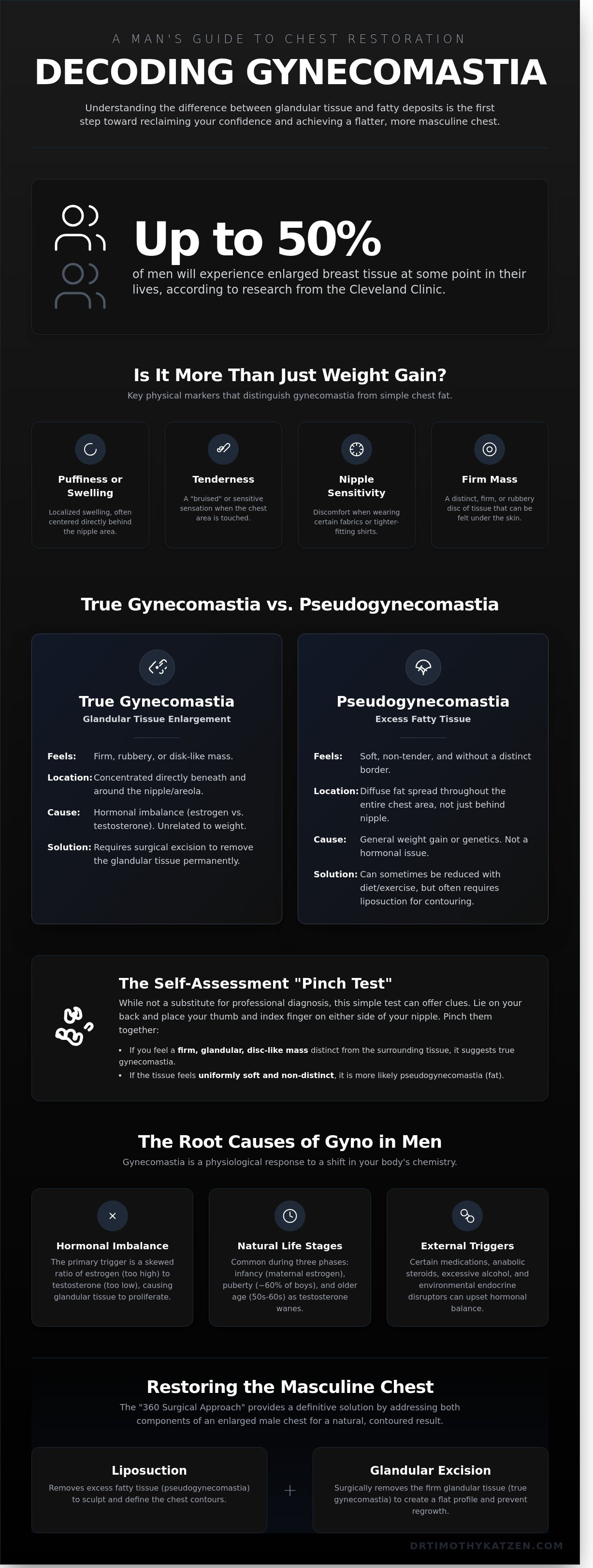
True Gynecomastia vs. Pseudogynecomastia: Knowing the Difference
Distinguishing between true gynecomastia and pseudogynecomastia is the first step in your journey toward a restored chest. While both conditions result in an enlarged male breast, their underlying structures are entirely different. Pseudogynecomastia is simply an accumulation of adipose tissue, or fat, often associated with weight gain. True gyno in men, however, involves the actual growth of glandular breast tissue. This distinction is vital because your body treats these tissues differently; fat can be burned through metabolic processes, but glandular tissue is permanent without surgical intervention.
I often recommend the "pinch test" as a preliminary self-assessment. To do this, you gently grasp the tissue behind the nipple and areola. If you feel a firm, rubbery, or even slightly tender disk of tissue, it's likely a glandular growth. If the area feels soft and consistent with the fat on other parts of your body, it's likely pseudogynecomastia. While this test provides a helpful baseline, it isn't a definitive diagnosis. I use my clinical expertise and diagnostic imaging to ensure we understand exactly what we're treating before moving forward.
The Anatomy of the Male Chest
Understanding your anatomy helps demystify the physical changes you're experiencing. Glandular tissue is dense and fibrous, typically centered directly under the nipple. This gives the chest a pointed or "puffy" appearance that remains visible even through clothing. Adipose tissue is more diffuse and spreads across the pectoral muscle. In complex cases, I may utilize a high-resolution ultrasound or a mammogram to confirm the presence of a gland. These tools allow me to visualize the internal structure, ensuring your surgical plan is precise and effective.
Why Weight Loss Isn’t Always the Answer
Many of my patients have already completed an incredible weight loss transformation, sometimes losing 100 pounds or more. They're often frustrated to find that their chest hasn't flattened despite their dedication to the gym. This happens because glandular gyno in men is resistant to diet and exercise. You can't "sweat away" a gland. In fact, losing weight can sometimes make the glandular tissue more prominent as the surrounding fat disappears.
-
The Glandular Barrier: Dense breast tissue doesn't shrink with a caloric deficit.
-
The Deflated Look: Massive weight loss often leaves behind loose, inelastic skin that hangs over the remaining tissue.
-
Surgical Contouring: Achieving a flat, masculine chest often requires a combination of gland excision and skin tightening.
I view the removal of this tissue as the final, celebratory step of your weight loss journey. My goal is to provide a comprehensive 360 restoration that addresses both the internal tissue and the external skin envelope. This approach moves beyond simple fat removal to create a contoured, athletic appearance that reflects the hard work you've put into your health and well-being.
The Path to Resolution: From Observation to Intervention
Understanding that you have options is the first step toward reclaiming your chest contour and your confidence. In my practice, I often encounter men who feel they've exhausted every resource. However, the journey to restoration begins with a precise diagnosis to determine if your condition requires immediate action or a period of clinical observation. For many of my younger patients, we start with a "watchful waiting" approach. Clinical data indicates that pubertal gyno in men resolves spontaneously in approximately 90% of cases within a 24-month period as hormones naturally balance out.
I monitor these cases closely to ensure that the physical changes don't cause lasting psychological distress. If the condition persists beyond two years, or if it's triggered by specific external factors, we shift our focus toward active medical management or lifestyle modifications. My goal is to find the least invasive path that provides the most significant physical and emotional relief.
Medical Management and Lifestyle Adjustments
If your condition is secondary to a medication or an underlying health issue, I'll partner with your medical team to address the root cause. Discontinuing trigger medications, such as certain anti-androgens or calcium channel blockers, can lead to visible tissue regression within 90 to 180 days. We also look at systemic health; treating hyperthyroidism or liver dysfunction can often stabilize hormone levels. While the FDA hasn't approved specific drugs for this condition, off-label hormonal therapies like Tamoxifen may be used. Studies suggest these can reduce breast tissue volume by up to 50% when administered during the early, proliferative phase of the condition.
Determining If You Are a Candidate for Surgery
When medical management reaches its limit, or when tissue has become fibrotic after 12 months of persistence, surgery becomes the definitive solution. To ensure a safe and successful transformation, I look for specific criteria in my patients:
-
Weight Stability: You should maintain a stable weight for at least 180 days before the procedure to ensure predictable results.
-
Health Optimization: Managing chronic conditions like diabetes or hypertension is essential for proper healing.
-
Hormonal Equilibrium: We must confirm that the underlying cause of the gyno in men is resolved so the tissue doesn't return.
-
Psychological Readiness: You should be prepared for the positive emotional shift that follows a body contouring procedure.
Surgery isn't just about removing tissue; it's about restoring the masculine frame you've worked hard to achieve. If you're ready to move past the frustration of persistent breast tissue, I invite you to schedule a consultation at my office to discuss your surgical options.
Restoring the Masculine Chest: The Role of Expert Contouring
Surgery isn't just a clinical fix. It's the final, celebratory milestone of a personal journey. When treating gyno in men, I utilize a "360" contouring philosophy. This means I don't look at the chest in isolation. I analyze how the pectorals transition into the shoulders, the armpits, and the midsection. By combining power-assisted liposuction with direct glandular excision, I can sculpt a chest that looks natural and athletic from every angle. My goal is to demystify this process and build a foundation of trust before you even step into my Beverly Hills office.
The Surgical Art of Chest Sculpting
In my practice, I've found that over 95% of successful outcomes depend on the meticulous removal of the entire breast gland. If any firm tissue remains, the condition can return. I prioritize hidden incisions, often placing them along the lower border of the areola where they blend into the natural pigment. For the 40% of my patients who come to me after massive weight loss, the primary challenge is often skin laxity rather than just fat. In these specific cases, I perform a specialized chest lift to remove redundant skin. This ensures the final result is firm and masculine. I don't want you to just have a smaller chest; I want you to have a chest you're proud to show at the pool.
Life After Gyno Surgery: Confidence Restored
The transformation extends far beyond the operating room. Within 48 hours, most patients notice a profound shift in their physical profile. You'll need to wear a medical-grade compression garment for 24 hours a day during the initial 3 weeks of recovery. This is a vital investment that helps the skin adhere to the new muscle contours. I typically clear patients for light walks immediately, while heavy lifting and bench pressing resume after 42 days of healing. We monitor your progress closely during follow-up appointments at the 1-week and 3-week marks to ensure symmetry is developing perfectly.
The emotional weight of gyno in men often exceeds the physical weight. Many of my patients report that for the first time in 15 years, they feel comfortable wearing a fitted t-shirt. This procedure doesn't just change your silhouette. It restores your ability to engage with the world without hesitation. It's the beginning of a new chapter where your body finally matches your inner strength and the hard work you've put into your health.
Take the Final Step Toward Your New Profile
Dealing with gyno in men often means managing more than just physical symptoms. It's about addressing the emotional weight that comes with a chest profile that doesn't reflect your hard work or identity. You've explored how hormonal shifts and weight changes create glandular tissue that diet alone can't fix. Identifying whether you face true gynecomastia or pseudogynecomastia is essential for choosing the right surgical path. This clarity allows for a targeted approach to restoration that prioritizes your long-term well-being and physical comfort.
Dr. Katzen provides board-certified expertise in advanced body contouring to ensure your results are both natural and masculine. As a world-renowned specialist in post-weight loss restoration, he understands the intricacies of skin elasticity and muscle definition. You'll receive empathetic, personalized care that's specifically tailored to your unique anatomy and male aesthetic goals. This isn't just a medical procedure; it's an opportunity to reclaim your confidence and celebrate your body's transformation with a partner who values your journey.
Begin your transformation journey with a consultation with Dr. Katzen
You've worked hard to reach this point. Now, it's time to let a dedicated specialist help you cross the finish line with safety and precision.
Frequently Asked Questions about Gynecomastia
Is gynecomastia permanent or will it go away on its own?
Whether your condition is permanent depends largely on your age and the underlying cause. In roughly 90% of adolescent cases, pubertal gyno in men resolves spontaneously within 6 to 24 months as hormone levels stabilize. However, if the enlarged tissue persists for more than 2 years, it often becomes fibrotic and permanent. At this stage, surgical restoration is typically the only way to achieve a flat, masculine chest contour.
Can exercise and chest workouts get rid of gynecomastia?
Exercise cannot eliminate true glandular gynecomastia because breast tissue is not fat. While a 2021 study in the Journal of Clinical Medicine notes that weight loss reduces pseudogynecomastia, it often makes firm glandular tissue more prominent. I find that many of my patients who have undergone massive weight loss still struggle with this stubborn tissue. Surgery remains the definitive solution for removing the physical gland itself.
Does having gynecomastia mean I have a higher risk of breast cancer?
Having gynecomastia does not directly cause breast cancer, though the two conditions share similar hormonal triggers. The American Cancer Society reports that male breast cancer accounts for less than 1% of all breast cancer cases annually. While the risk remains low, I always perform a thorough evaluation during your consultation. If I detect any suspicious masses, we'll prioritize diagnostic imaging to ensure your long term health and safety.
What is the "pinch test" for gynecomastia and how accurate is it?
The pinch test involves feeling for a firm, rubbery mass directly behind the nipple area. If you feel a distinct, disk like growth rather than soft, pliable fat, it's a strong indicator of glandular tissue. While this self exam provides a helpful starting point, it isn't a substitute for a clinical diagnosis. I use precise physical examinations to differentiate between true gyno in men and simple adipose tissue.
How much does gynecomastia surgery typically cost?
The total cost of male breast reduction varies based on the complexity of your procedure and the surgical techniques required. According to 2020 data from the American Society of Plastic Surgeons, the average surgeon's fee for this procedure was $4,239. It's important to remember that this figure doesn't include anesthesia, operating room facilities, or other related expenses. We'll provide a detailed, transparent quote during your personalized consultation.
What is the recovery time after a male breast reduction procedure?
Most patients return to light desk work within 3 to 5 days after their procedure. You'll need to wear a compression garment for 4 to 6 weeks to minimize swelling and support your new chest contours. While you can resume walking immediately, I advise waiting at least 4 weeks before engaging in heavy lifting or strenuous chest exercises. This methodical approach ensures your safety and optimizes your final aesthetic results.
Will insurance cover the removal of enlarged male breast tissue?
Most insurance providers classify male breast reduction as a cosmetic procedure and do not provide coverage. However, some policies may offer reimbursement if the condition causes documented physical pain or is linked to specific medical pathologies. I recommend checking your specific policy requirements regarding Grade IV gynecomastia. My team can help you navigate the documentation process to determine if you qualify for any medical necessity benefits.
Can certain foods or supplements cause gynecomastia in men?
Yes, specific substances can trigger hormonal imbalances that lead to breast tissue growth. Research published in the Journal of Clinical Endocrinology and Metabolism indicates that alcohol consumption and certain herbal supplements like tea tree oil can interfere with testosterone production. Additionally, roughly 50% of men who use anabolic steroids for bodybuilding develop some degree of tissue enlargement. Identifying these triggers is a vital step in your journey toward restoration.