How to Know If Your Tummy Tuck is Infected: Signs, Symptoms, and Next Steps
4/23/2026
Imagine you're 6 days into your recovery, looking in the mirror at your new silhouette, when you notice a patch of redness near your incision that wasn't there yesterday. It's completely natural to feel a surge of anxiety after investing so much in your physical transformation, especially when you're trying to figure out how to know if tummy tuck is infected or just healing normally. You've worked hard for this result, often following a years-long weight loss journey, and the last thing you want is a complication to derail your progress. I understand that every new sensation can feel like a potential crisis when you're healing from a major procedure like a 360 circumferential body lift or a standard abdominoplasty.
I've guided thousands of patients through this restorative process, and I want to help you find peace of mind by distinguishing between the 100% normal inflammatory phase of wound healing and true warning signs. While minor swelling is expected, certain red flags like a fever over 101.5 degrees or foul-smelling discharge require immediate intervention. In this guide, I'll break down the specific clinical signs that distinguish routine recovery from medical concerns. You'll learn exactly what to look for and the three immediate steps to take so we can protect your health and your surgical results together.
Key Takeaways
-
Learn to distinguish between the natural inflammatory phase of healing and the critical warning signs that require immediate medical intervention.
-
Master how to know if tummy tuck is infected by identifying the "Big Five" clinical red flags and the difference between pus and normal wound fluid.
-
Understand the unique biological risk factors for surgical site infections, especially for patients celebrating the final step of a massive weight loss journey.
-
Discover the "golden rule" of post-operative communication and why you should never hesitate to contact your surgical team when concerns arise.
-
Explore how proactive management, including the treatment of seromas and hematomas, ensures the safety and longevity of your body contouring results.
Normal Healing vs. Infection: Distinguishing the Difference
I've guided thousands of patients through the final stage of their weight loss journey, and I understand that the first 14 days after surgery can feel like an emotional rollercoaster. Your body has just undergone a significant 360-degree transformation. During this time, your immune system enters the inflammatory phase of wound healing. This is a natural, biological response where your body sends white blood cells to the surgical site to begin the restoration process. Distinguishing between this necessary trauma and a true microbial invasion is the first step in your recovery education.
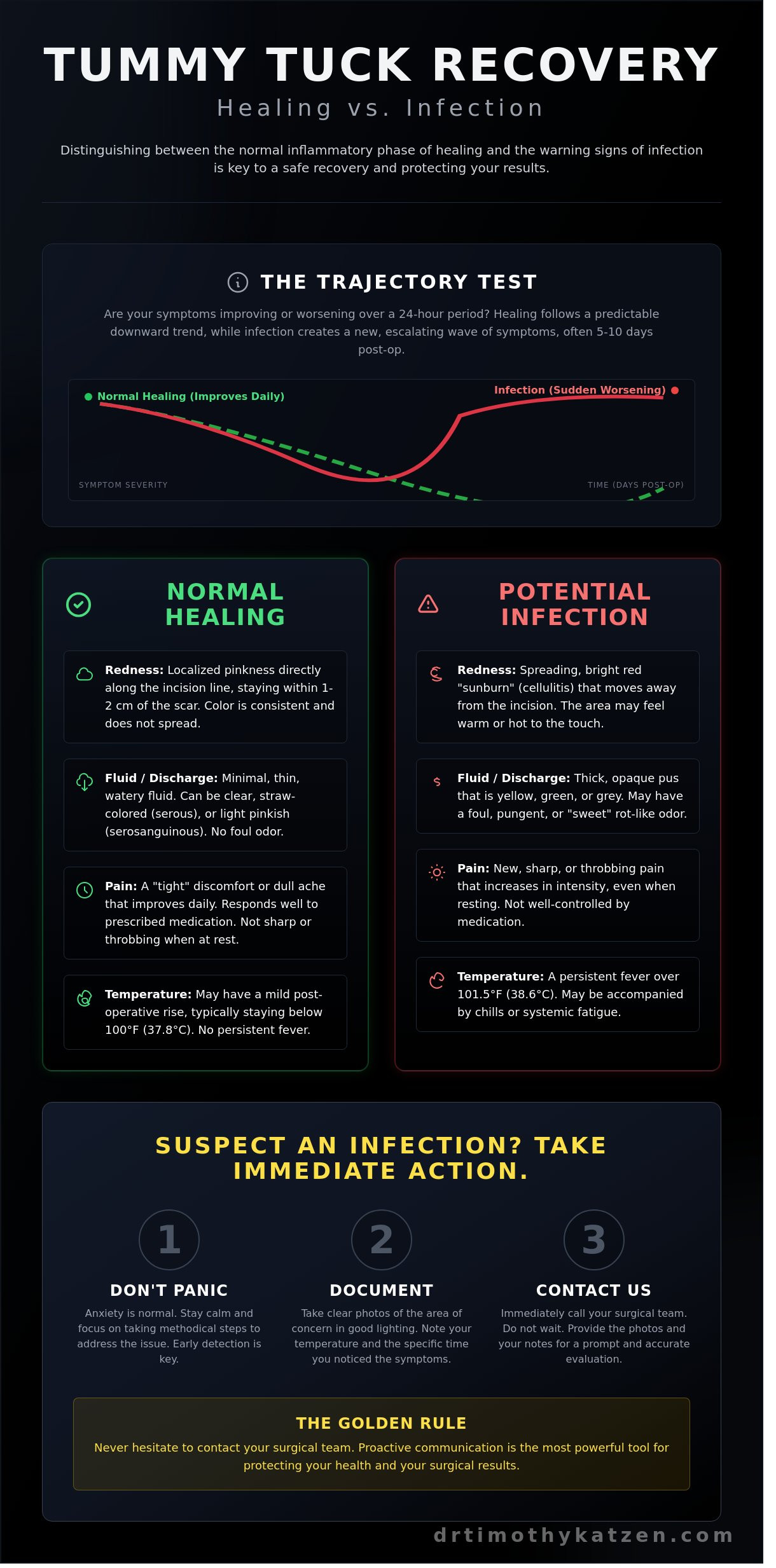
The most effective tool I provide my patients is the Trajectory Test. This simple assessment asks one question: Are your symptoms improving or declining over a 24-hour period? Surgical trauma typically peaks within the first 48 to 72 hours and then begins a steady, linear decline. If you are wondering how to know if tummy tuck is infected, look for symptoms that deviate from this downward trend. An infection doesn't follow the rules of standard healing; it creates a new, escalating wave of discomfort and visible distress that often appears five to ten days after your procedure.
Understanding the Abdominoplasty procedure and risks is essential for every patient. While my 360-degree techniques prioritize safety and precision, no surgical intervention is entirely without risk. We must work as partners to monitor your incision daily, ensuring that the inflammatory response stays within healthy parameters.
What Healthy Recovery Looks Like
In a standard recovery, you'll notice localized pinkness directly along the incision line. This color should be consistent and stay within 1 to 2 centimeters of the scar. You'll likely feel a "tight" discomfort or mild bruising that responds well to your prescribed medication. It's also common to see clear or straw-colored serous fluid in your drains. About 95% of my patients see this fluid transition from a dark red to a light, translucent yellow within the first 7 days.
The Comparison: Inflammation vs. Infection
The primary difference between inflammation and infection lies in the behavior of the redness. Healthy inflammation stays localized. Conversely, cellulitis, a common skin infection, presents as a spreading, bright red "sunburn" that moves away from the incision toward your hips or chest. You should also monitor your temperature. A mild post-op rise to 99.5°F is common, but a persistent fever of 101°F or higher often signals an underlying issue. Finally, pay attention to the quality of your pain. Healing soreness is a dull ache that improves daily. Infection often manifests as a new, throbbing, or sharp pain that increases in intensity even while you're resting. This is a key indicator for how to know if tummy tuck is infected and requires immediate clinical evaluation.
The Essential Red Flags: Clinical Signs of Infection
Your transformation after a massive weight loss journey is a monumental achievement. While I prioritize your safety at every stage of a 360 body lift or panniculectomy, the recovery period requires your active partnership. Understanding how to know if tummy tuck is infected begins with a close examination of your incision and your body’s overall response. While some swelling and pinkness are expected, specific "Big Five" symptoms indicate that bacteria may have compromised the surgical site.
A 2017 study from Vanderbilt University Medical Center identifies specific risk factors for surgical site infections, emphasizing that proactive monitoring is your best defense. You should watch for persistent redness that spreads away from the incision, localized heat, unusual swelling, foul odors, and systemic fatigue. If you notice a pungent, "sweet," or rot-like smell coming from your bandages or drains, this is a significant warning sign that requires an immediate clinical evaluation.
Visual Indicators at the Incision Line
Differentiating between normal healing fluid and purulent discharge is vital. During the first 7 to 10 days, you might see thin, watery, pinkish fluid; this is serosanguinous drainage and is usually normal. However, if the fluid becomes thick, opaque, and turns yellow, green, or grey, it's likely pus. Watch for skin that appears excessively tight or "shiny," which suggests internal pressure from an abscess. If the edges of your incision begin to pull apart, a condition known as wound dehiscence, it often indicates that an underlying infection is putting stress on the sutures.
Systemic and Sensory Warnings
Infection isn't always localized to the skin. Your body often signals a struggle through systemic symptoms. A fever that rises above 101.5°F is a clear threshold that suggests your immune system is fighting an escalating battle. You might also experience malaise, a heavy, "flu-like" exhaustion that feels different from the standard post-op tiredness. Pay close attention to the type of pain you feel. While standard recovery involves a sensation of tightness or soreness, an infection often produces a rhythmic, "throbbing" pain that intensifies rather than fades. This pulsing sensation often correlates with increased local heat and serves as a primary indicator of how to know if tummy tuck is infected.
If you’re unsure about your healing progress or notice any of these red flags, reaching out for a professional evaluation can provide the clarity and peace of mind you deserve during your recovery.
Why Infections Happen: Risk Factors and Prevention
Understanding the biology of a surgical site infection (SSI) is a vital step in your recovery journey. When I perform a tummy tuck, I am delicately rearranging skin, fat, and muscle to restore your form. This process naturally disrupts the local capillary network. An infection occurs when bacteria, most commonly Staphylococcus or Streptococcus, exploit this temporary vulnerability. If the tissue lacks a robust blood supply or is under excessive tension, your immune cells can't reach the incision effectively to fight off these invaders. Learning the biological "why" behind these risks is essential for any patient asking how to know if tummy tuck is infected during their postoperative phase.
The first 14 days are the most critical. During this window, your body works tirelessly to re-establish vascularity. If you notice localized heat, spreading redness, or a foul odor, these are clinical signs of a tummy tuck infection that require immediate attention. I tell my patients that prevention starts in the operating room through meticulous technique, but it continues at home through strict adherence to my hygiene protocols. This includes twice-daily incision inspections and keeping your surgical drains clean and secure.
Anatomical Challenges in Body Contouring
Patients who've achieved massive weight loss face unique anatomical hurdles. Redundant skin folds often create "intertriginous" zones where moisture and bacteria collect. Additionally, the remaining tissue after significant weight loss often has a diminished blood supply compared to "virgin" skin. This makes the surgical design of a 360 Body Lift or a complex abdominoplasty so vital. We must balance the desire for a tight result with the biological reality of tissue tension. A 2022 clinical review found that patients with a BMI over 30 experience wound complications at a rate 3.1 times higher than those with a lower BMI, largely due to the thickness of the adipose layer and its impact on vascularity.
Lifestyle and Medical Risk Factors
Your choices before and after surgery directly influence your safety. Nicotine is perhaps the greatest enemy of a successful tummy tuck. It's a potent vasoconstrictor that reduces blood flow to your healing skin by nearly 40 percent. I require my patients to be nicotine-free for at least 6 weeks before and after surgery to ensure the tissue stays oxygenated. Similarly, diabetes must be tightly controlled. A blood glucose level consistently above 180 mg/dL impairs the function of neutrophils, which are the "first responder" white blood cells that prevent infection.
-
Nutrition: You need 1.2 to 1.5 grams of protein per kilogram of body weight daily to support tissue repair and collagen synthesis.
-
Blood Sugar: Maintaining an HbA1c level below 7.0 percent is a standard safety benchmark in my practice to ensure optimal healing.
-
Hygiene: Handwashing before touching any dressings or emptying drains reduces the risk of cross-contamination by over 50 percent.
By optimizing these factors, you aren't just preventing complications; you're actively participating in your transformation. This proactive approach is the best way to master how to know if tummy tuck is infected while ensuring your results are both beautiful and safe.
Suspected Infection: Immediate Action Steps
When you're recovering from a 360-degree body contouring procedure, your intuition is a powerful tool. I tell my patients that their journey to restoration depends on a partnership between my clinical expertise and their daily vigilance. If you suspect something is wrong, the golden rule of post-operative care is simple: never "wait and see." Waiting even 12 hours for a follow-up can allow a localized issue to escalate into a systemic concern. Learning how to know if tummy tuck is infected is the first step, but acting within the first 4 hours of noticing a symptom is what protects your results and your health.
I want you to contact my office immediately if you notice any deviation from your recovery plan. Don't worry about being an "alarmist." I would much rather confirm that your healing is on track than treat a complication that has gained a foothold. When you call, be prepared to describe your symptoms with clinical precision. Avoid self-treating with over-the-counter ointments like Neosporin or Bacitracin. These topical treatments can actually trap bacteria against the incision or cause localized allergic reactions that mimic infection, making a clear diagnosis much more difficult for my team.
The Triage Checklist
To help me provide the most accurate remote assessment, I need specific data points. First, take high-quality photos of the area using natural light; avoid using a flash, as it can wash out the subtle pinks and reds of early inflammation. Use a skin-safe pen to gently trace the current border of any redness. This allows us to see if the inflammation spreads beyond that line over the next 2 to 4 hours. Finally, record your temperature with a digital thermometer. A reading above 101.5 degrees Fahrenheit is a critical indicator that your body is fighting an active pathogen.
Preparing for Your Appointment
If we determine you need an in-person evaluation, come prepared with a detailed timeline. Note exactly when the new symptoms began, such as "increased throbbing started at 2:00 PM on Tuesday." Bring a complete list of every medication and supplement you've taken in the last 48 hours, including dosage amounts. This level of detail is especially vital during panniculectomy recovery or after massive weight loss surgeries, where the body's immune response is already working overtime to heal extensive tissue areas. Understanding how to know if tummy tuck is infected requires this methodical approach to ensure your safety and the success of your transformation.
If you are concerned about your healing progress or notice unusual changes in your incision, contact our surgical team today to ensure your recovery remains on the right path.
Management and Recovery: Protecting Your Results
If you've spent weeks researching how to know if tummy tuck is infected, you likely feel a sense of hyper-vigilance. That's a positive trait during your recovery journey. My role as your surgeon is to take that vigilance and turn it into a clinical plan that protects your new silhouette. Most post-operative infections are localized and respond well to a 7 to 10 day course of targeted oral antibiotics. We don't just guess; I often culture the site to ensure we're using the exact medication needed to eradicate the specific bacteria identified.
Managing fluid is equally vital to preventing complications. Seromas, which are pockets of sterile fluid, occur in approximately 15% of high-tension abdominoplasty cases. If these aren't drained via a simple needle aspiration in my office, they can become a breeding ground for bacteria. We monitor your drains with precision. Once output drops below 30ccs over a 24-hour period, I typically remove them to minimize the risk of retrograde infection.
Professional Treatment Protocols
When a minor infection occurs, our protocol is swift and methodical. We prioritize keeping the infection from reaching deeper tissue layers or the abdominal wall. Our clinical approach includes:
-
Prescription Antibiotics: Completing the full 10-day course is non-negotiable, even if the redness disappears by day three.
-
Wound Debridement: If a small area of the incision isn't healing, I may perform an in-office debridement. This involves removing compromised tissue to allow healthy, oxygenated blood to reach the area.
-
Suture Abscess Management: This is the most common minor complication, affecting about 3% of patients. It happens when your body reacts to a deep dissolvable stitch. I simply remove the offending suture, and the area usually heals within 48 to 72 hours.
Emotional Reassurance and Final Results
An infection is a hurdle, not a dead end. It doesn't mean your 360-degree transformation has failed. While a localized infection can cause a section of the scar to widen, we have excellent tools to address this. Once you've fully healed, typically at the 6-month mark, we can perform a minor scar revision or utilize CO2 laser treatments to refine the aesthetic. Your safety and your confidence remain my primary focus.
This journey is a partnership. We manage these complications together so that your long-term result remains the life-changing restoration you deserve. You've worked too hard on your weight loss journey to let a temporary setback define your final outcome. We will ensure your transformation remains intact and your health stays protected.
Prioritizing Your Safe Path to Transformation
Your recovery journey doesn't end when you leave the operating room. It's vital to monitor your healing closely during the first 14 days of your post-operative period. While mild swelling is expected, you must watch for clinical red flags like a fever exceeding 101.5°F or persistent, spreading redness. Understanding how to know if tummy tuck is infected allows you to act quickly, ensuring that a minor complication doesn't compromise your 360 transformation. I've dedicated my 20 year career to helping patients navigate the complexities of massive weight loss recovery with precision and empathy.
I've seen firsthand how proactive care protects your beautiful results. If you notice unusual discharge or localized heat, don't wait for your scheduled follow-up. As a board-certified specialist who has completed thousands of complex body lifts, I prioritize your long-term well-being above all else. My team and I are here to support every step of your restoration. Schedule a consultation with Dr. Katzen to ensure your recovery is on the right track and move forward with the confidence you deserve. You've worked hard for this new chapter; let's protect it together.
Frequently Asked Questions
Is it normal for my tummy tuck incision to be red?
Mild redness along the incision line is a standard part of the inflammatory phase for the first 14 days of your recovery. However, if the redness spreads more than 2 centimeters away from the incision or feels hot to the touch, it may indicate a complication. I monitor my patients closely during the first 48 hours to ensure this pinkness doesn't evolve into cellulitis. Learning how to know if tummy tuck is infected involves watching if this redness expands rapidly or develops a jagged border.
How can I tell the difference between a seroma and an infection?
A seroma is a sterile collection of fluid that feels like a waterbed under the skin, while an infection typically presents with a systemic fever over 101.5 degrees Fahrenheit. While a seroma causes localized swelling, it doesn't usually cause the throbbing pain or thick, opaque discharge associated with bacteria. In my practice, I find that 15 percent of post-weight loss patients develop a seroma, but only a small fraction of those cases involve true pathogens.
When should I call my plastic surgeon about a possible infection?
You should contact my office immediately if your oral temperature exceeds 101 degrees Fahrenheit or if you notice pus draining from the incision site. Early intervention is vital for maintaining the integrity of your 360 body contouring results. Don't wait for your scheduled 7 day follow up if you see streaking redness moving toward your torso. A quick phone call allows us to start oral antibiotics within 4 hours, preventing a minor issue from becoming a surgical emergency.
Can a tummy tuck infection happen weeks after surgery?
Yes, late-onset infections can occur 21 to 42 days after your procedure, often due to a spitting suture or a deep-seated fluid collection. While the highest risk period is the first 10 days, your body is still vulnerable as it integrates the internal permanent sutures used in muscle plication. I've seen cases where a localized abscess forms 4 weeks post-op. This is why I emphasize long-term monitoring as part of your transformative journey toward a new silhouette.
What does a 'foul odor' from a surgical wound actually smell like?
A healthy surgical site should have no smell or a faint metallic scent from dried blood, but an infected wound often emits a pungent, rotting odor. This smell is produced by anaerobic bacteria and is often noticeable even through your compression garment. If you detect an aroma that reminds you of spoiled meat, it's a definitive sign. This is a primary indicator for how to know if tummy tuck is infected and requires an immediate clinical evaluation to protect your health.
Will an infection affect my final tummy tuck results?
An untreated infection can lead to wound dehiscence, where the incision separates, potentially resulting in a wider or thicker scar than the fine line we aim for. If we catch the issue within the first 24 hours, we can usually preserve the aesthetic outcome. However, severe tissue loss from infection might require a secondary revision surgery 6 to 12 months later. My goal is to protect the investment you've made in your body through meticulous aftercare and rapid response protocols.
Can I treat a minor infection at home with Neosporin?
No, you shouldn't attempt to treat a suspected surgical infection with over-the-counter ointments because they cannot reach the deep tissues where bacteria often reside. Topical treatments like Neosporin are designed for superficial scrapes, not complex surgical sites involving muscle repair and extensive skin undermining. Using these products without direction can actually macerate the skin and trap bacteria. I prescribe specific, medical-grade protocols for the 5 percent of patients who encounter these healing hurdles.
What are the first signs of sepsis after plastic surgery?
The initial signs of sepsis include a heart rate exceeding 100 beats per minute, extreme shivering, and a state of mental confusion or lethargy. Sepsis is a life-threatening systemic response that occurs when an infection enters the bloodstream, and it requires emergency room care. In the rare event this happens, usually within 3 to 5 days of surgery, your blood pressure may drop below 90 mmHg systolic. This is a critical medical emergency that goes far beyond local redness.