Mons Pubis Reduction: Classification, Liposuction, Pubic Lift, Surgical Options
9/22/2026
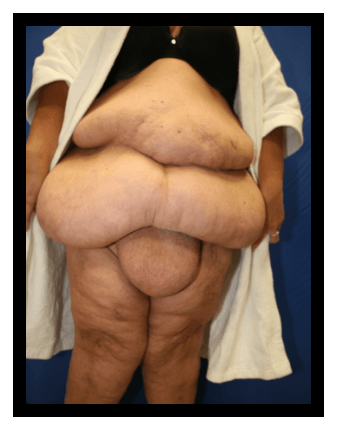
Figure 1: A 56-year-old massive weight loss female patient who lost 165 pounds displays a Type 5 mons with excess skin and fat in the horizontal and vertical dimension.
The Mons Reduction
The mons pubis or FUPA (fatty upper pubic area) is the rounded, hair-bearing area of skin and fatty tissue located over the pubic bone. Although it is a relatively small anatomical region, its size and position strongly influence the transition between the lower abdomen and the external genital area. When the mons becomes enlarged, elongated, or descended, it may create a visible bulge in clothing, interfere with exercise and hygiene, cause discomfort during sexual activity, and make the lower abdomen look incompletely contoured even after weight loss or abdominal surgery.
The mons may change following weight gain, pregnancy, aging, hormonal changes, or massive weight loss. In some women, the primary concern is excessive fatty volume. In others, the main problem is loose skin and downward displacement. Many patients have a combination of excess fat, stretched skin, loss of internal support, and distortion of the pubic hairline.
For this reason, there is no single operation appropriate for every patient. Mons reduction, also called monsplasty, pubic lift, or mons pubis reduction, may involve liposuction, direct removal of fat, removal of redundant skin, elevation and internal suspension of the mons, or a combination of these methods.
For women considering mons reduction surgery, the most important first step is identifying the specific anatomical problem. The procedure should then be designed to correct that problem while preserving a natural contour, avoiding excessive tension, and placing scars as discreetly as possible.
Why Does the Mons Pubis Become Enlarged or Sag?
The mons is composed of skin, subcutaneous fat, fibrous connective tissue, superficial fascial structures, lymphatic channels, sensory nerves, and small blood vessels overlying the pubic symphysis. Its contour is influenced not only by the amount of fat present but also by the elasticity of the skin and the integrity of the tissues that suspend it from the lower abdominal wall.
Several changes may occur independently or simultaneously:
- Localized fat can produce a prominent or projecting mons even in a woman who is otherwise thin.
- General weight gain can enlarge both the lower abdomen and mons.
- Weight loss can reduce volume while leaving stretched, deflated skin behind.
- Pregnancy and aging can stretch the skin and weaken connective-tissue support.
- Massive weight loss may produce substantial vertical descent and side-to-side redundancy.
- Prior abdominal operations may alter the relationship between the lower abdomen and pubic region.
- An abdominoplasty performed without directly evaluating the mons may flatten the abdomen while leaving the mons disproportionately prominent.
- Natural differences in fat distribution and skin quality can cause prominence without pregnancy or major weight change.
Monsplasty is therefore not simply a matter of removing fat. The plastic surgeon must evaluate volume, projection, skin quality, vertical descent, horizontal width, pubic hairline position, external genital relationships, and the transition into the lower abdomen and groins.
A Practical Classification of Mons Pubis Deformities
The mons is classified according to the predominant anatomical problem. This classification helps determine whether the patient is best treated with liposuction, a horizontal suprapubic lift, a vertical reduction, or a combined procedure.
Type I: Fat-Predominant Mons
The skin has reasonably good elasticity, but excessive fatty tissue causes anterior projection. The mons is full or bulky but does not hang substantially downward. The pubic hairline remains in a generally acceptable position.
Typical treatment: Carefully controlled liposuction.
Type II: Excess Fat With Mild Skin Laxity
There is excessive fatty volume combined with early skin looseness. The skin may contract after conservative liposuction, but its ability to do so is less predictable than in a Type I deformity.
Typical treatment: Conservative liposuction in carefully selected patients, sometimes combined with limited skin removal. If the skin is unlikely to retract, open lifting should be discussed before surgery.
Type III: Vertical Ptosis or a Descended Mons
The mons has migrated downward. The upper border of the hair-bearing region may sit substantially lower than desired, and the mons may partly cover the upper external genital tissues. This pattern is particularly common after massive weight loss, pregnancy, or significant abdominal skin stretching.
Typical treatment: Horizontal suprapubic skin excision, elevation of the mons, and internal suspension when indicated. Liposuction may be added if excessive thickness is also present.
Type IV: Horizontal Excess or Excessive Width
The mons is unusually broad, with excess tissue extending from side to side. Elevating the tissue through a horizontal incision may improve height but will not necessarily narrow it.
Typical treatment: A carefully planned vertical skin and soft-tissue excision, with liposuction when needed.
Type V: Combined Vertical and Horizontal Redundancy
After massive weight loss, the mons may be long, wide, thick, and descended. Skin excess exists in more than one direction, and internal support may be markedly weakened.
Typical treatment: A tailored combination of liposuction, horizontal suprapubic lifting, vertical narrowing, direct fat reduction, and internal suspension.
This system is a framework rather than an inflexible label. The goal is to choose the shortest and least invasive operation that can reliably correct the actual deformity. A smaller scar is not an advantage if it leaves the dominant problem untreated.
Consultation and Preoperative Evaluation
A thorough consultation is important because women use the word “fullness” to describe several different anatomical problems. Fullness may mean excess fat, hanging skin, a low hairline, edema, asymmetry, or a prominent mons made more obvious by a flat lower abdomen. These problems require different solutions.
The examination is performed with the patient standing because gravity reveals the true direction and degree of descent. The plastic surgeon assesses the patient from the front, side, and oblique views. The mons is gently elevated by hand to determine how much improvement can be obtained with vertical lifting and whether upward movement causes undesirable traction on nearby tissues.
The evaluation should include:
- Thickness and distribution of subcutaneous fat
- Skin elasticity, stretch marks, and tissue quality
- Degree of vertical descent
- Amount of horizontal redundancy
- Position and shape of the pubic hairline
- Relationship of the mons to the labia and clitoral hood
- Lower abdominal skin and fat
- Groin contour and symmetry
- Previous abdominal or pelvic scars
- History of pregnancy, cesarean section, weight change, or body-contouring surgery
- Symtoms involving hygiene, moisture, rashes, exercise, clothing, or sexual activity
- Patient preference regarding scar length versus maximum correction
Weight stability is important. Significant weight loss after surgery can create recurrent laxity, while substantial weight gain can restore fullness. Medical conditions that increase operative risk or impair healing should be optimized. Nicotine exposure is particularly concerning because it constricts blood vessels and increases the risk of delayed healing, wound separation, infection, and unfavorable scarring.
Preoperative photographs document the starting anatomy and help with planning. Depending on the patient’s health and the extent of surgery, laboratory testing or medical clearance may be required. Medications and supplements that affect bleeding should be reviewed individually rather than stopped without guidance from the prescribing clinician.
Surgical Planning and Markings
Precise markings are essential. The markings are generally made while the patient is standing, with the mons and lower abdomen fully visible. The plastic surgeon identifies the midline, natural lower abdominal crease, lateral boundaries of the mons, existing scars, pubic hairline, and proposed incision.
For liposuction, the areas of greatest projection and the borders of the desired transition are marked. The goal is not to flatten the mons completely. A normal mons has a soft, gently convex contour and provides cushioning over the pubic bone. The treatment zone must blend into the lower abdomen and groins without abrupt depressions.
For a horizontal mons lift, the proposed lower incision is positioned low enough to be concealed by typical underwear when anatomy permits. The upper line of excision is estimated by elevating the mons without creating excessive pull on the external genital tissues. Removing too much skin can elevate the pubic hairline excessively, distort the labia or clitoral hood, or create a tight and uncomfortable closure.
For vertical mons reduction, the amount of side-to-side excess is estimated by gently pinching the central mons. The planned ellipse must be conservative enough to permit closure without excessive tension. Its inferior extent is designed with particular care so that the scar does not unnecessarily enter sensitive external genital tissues.
Markings may be adjusted after the patient lies down because tissue relationships change in the supine position. Final decisions are based on both standing anatomy and the appearance of the tissues during surgery.
Anesthesia and Preparation
Small-volume liposuction may be performed under local anesthesia with sedation in selected patients. Open skin excision, extensive lifting, or combination surgery is more commonly performed under general anesthesia. The choice depends on the extent of treatment, associated procedures, patient health, and facility protocols. Before the operation, measures may be taken to reduce the risk of blood clots and infection based on the patient’s risk profile. Sequential compression devices may be placed on the legs. Antibiotics are typically administered when an open incision is planned. The operative field is prepared widely enough to permit accurate assessment of the lower abdomen, groins, and mons. When liposuction is performed, a tumescent solution is infiltrated into the fatty layer. This solution commonly contains sterile fluid, a local anesthetic, and a medication that constricts small blood vessels. Infiltration helps control bleeding, improves postoperative comfort, and allows smoother cannula passage. Adequate time is allowed for the vasoconstrictive effect before suction begins.
Option 1: Mons Pubis Liposuction
When the primary problem is excess fat and the skin has good elasticity, liposuction may be sufficient. The best candidates have a bulky or projecting mons without substantial hanging skin, major descent, or a markedly low pubic hairline.
How Mons Liposuction Is Performed
Several very small access incisions are placed in discreet locations, often near existing creases. Through these openings, the plastic surgeon introduces a narrow liposuction cannula into the subcutaneous fat. The cannula is passed in controlled, overlapping tunnels. Treatment is performed from more than one direction so fat is reduced evenly rather than creating isolated channels or depressions. The plastic surgeon repeatedly checks thickness by palpation and visually compares the right and left sides. The cannula must remain in an appropriate fatty plane. Very superficial suction can injure the undersurface of the skin, create visible grooves, impair circulation, or cause prolonged firmness. Passing too deeply or aggressively can disrupt deeper structures and create an unnatural hollow over the pubic bone. Small cannulas and deliberate movements are useful because the area is compact and contour errors can be conspicuous. The central area of greatest prominence usually receives the most reduction, while the edges are feathered into adjacent untreated tissues. If the plastic surgeon removes fat only from the most prominent central region, the patient may be left with a saucer-like depression or sharp transition. The amount removed is determined by contour, not by a predetermined volume. Some fat should remain to preserve softness, vascularity, and natural cushioning. At the end of suction, the plastic surgeon evaluates symmetry, residual thickness, and the transition into the lower abdomen and groin. The access incisions may be closed with small sutures or left partly open for short-term drainage, depending on technique.
Traditional and Ultrasound-Assisted Liposuction
Conventional suction-assisted liposuction can provide excellent volume reduction. Ultrasound-assisted liposuction may also be considered, particularly when fat is fibrous, a broader adjacent area requires contouring, or a revision is needed. Ultrasound energy helps emulsify fat before suction, but it must be used carefully. Energy-based treatment introduces risks such as thermal injury, seroma, excessive tissue trauma, and irregularity if applied improperly. Regardless of the device, the objective is controlled contouring, not maximum fat removal. Technology does not compensate for poor patient selection. If loose skin or descent is dominant, liposuction cannot reliably lift the mons and may make deflation more obvious.
Limitations of Liposuction Alone
Liposuction removes volume but does not directly remove redundant skin, reposition a low hairline, or rebuild weakened internal support. Mild skin contraction may occur over time, especially in younger patients with good elasticity, but it is not equivalent to a surgical mons lift. In a patient with significant mons laxity, aggressive fat removal may leave a thinner but more wrinkled or hanging mons. If skin removal may eventually be required, the patient should understand the staged or combined options from the outset.
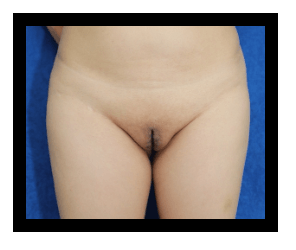
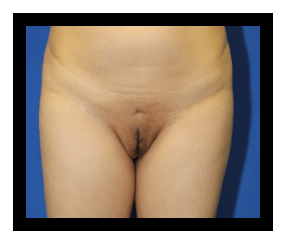
Figure 2: This is a before and after comparison of a 37-year-old female non-weight loss patient. She has a Type 1 mons. She underwent liposuction of the mons.
Option 2: Horizontal Suprapubic Mons Lift
For women with significant downward displacement and loose skin, a horizontal suprapubic lift directly addresses vertical excess. The operation removes a transverse segment of redundant tissue, elevates the remaining mons, and may secure deeper tissues to the strong fascia of the lower abdominal wall.
Incision and Exposure
The operation begins through the preoperatively marked horizontal incision. When possible, it is placed low enough to be covered by underwear or a bathing suit. Existing low abdominal scars may sometimes be incorporated, but scar location, blood supply, and the required direction of pull must be considered. The plastic surgeon incises the skin and proceeds through subcutaneous tissue while controlling small blood vessels. The planned segment is removed in a measured fashion. Conservative initial excision is prudent because additional tissue can be removed, whereas excessive removal may produce tension or distortion that is difficult to reverse. Dissection is limited to what is necessary to mobilize and elevate the mons. Excessive undermining creates dead space, disrupts lymphatic drainage, and may increase seroma and prolonged swelling. Inadequate release, however, may prevent the tissue from advancing smoothly. The required balance depends on the severity of descent and prior scars.
Reducing Thickness
If the mons is also bulky, volume may be reduced with liposuction, direct excision, or both. Liposuction is useful for diffuse fat and blending the margins. Direct fat excision may be appropriate when an open incision already provides access to a thick central pad or dense fibrofatty tissue.
Direct excision must be conservative. Removing too much tissue can create a step-off, adherence to deeper fascia, contour depressions, prolonged numbness, or inadequate padding. The plastic surgeon preserves a reasonably uniform layer beneath the skin and avoids unnecessary injury to blood supply and lymphatics.
Elevation and Internal Suspension
Once sufficient mobility and thickness have been achieved, the mons is advanced upward. The plastic surgeon checks the pubic hairline and the effect of elevation on external genital tissues. The lift should improve exposure and contour without producing an unnaturally high hairline or excessive traction. In selected patients, superficial fascial tissues of the mons are secured to stable lower abdominal fascia with strong sutures. These internal suspension sutures transfer part of the lifting force away from the skin closure. They can help maintain elevation and reduce the tendency of a heavy mons to descend while healing. Fixation points are placed symmetrically. Sutures should capture secure tissue without strangulating it, and their position should produce a broad lift rather than focal dimpling. The plastic surgeon reassesses contour after each fixation suture because overly tight or uneven suspension can create asymmetry, tethering, or an unnatural crease. Internal suspension is not mandatory in every patient. A woman with mild laxity and light tissues may obtain adequate support from limited excision and layered closure. A patient with massive-weight-loss skin, a heavier mons, or markedly weakened support may benefit more from fascial fixation.
Layered Closure
Meticulous hemostasis is obtained before closure. If a substantial space remains beneath the elevated tissue, progressive-tension or quilting sutures may secure superficial tissues to deeper fascia. These sutures can reduce shear, distribute tension, and decrease space where fluid could accumulate. The wound is closed in layers. Deeper sutures approximate fascial and subcutaneous tissues, followed by dermal and skin closure. Layered closure avoids relying on skin alone to withstand the full upward pull. Excessive skin tension increases the chance of a widened scar, delayed healing, and wound separation. Before completing closure, the plastic surgeon confirms that the mons is centered, both sides are at a similar height, and nearby tissues are not distorted. A drain may be placed if dissection or dead space is substantial.
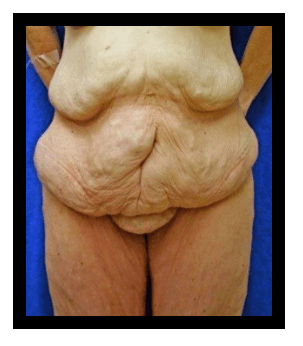
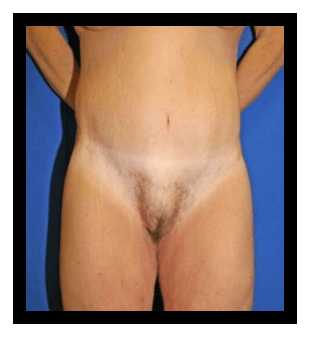
Figure 3: This is a before and after comparison of a 42-year-old female massive weight loss who lost 113 pounds. She has a Type 5 mons. She underwent horizontal mons reduction.
Option 3: Vertical Mons Reduction
A horizontal incision primarily corrects vertical descent. It does not reliably correct a horizontal excess or significantly wide mons. For selected women (particularly after massive weight loss) a vertical reduction can narrow the mons and remove side-to-side redundancy.
How Vertical Excision Works
A vertically oriented ellipse is designed through the central area of greatest excess. The skin is incised, and the planned wedge of skin and underlying soft tissue is removed. The plastic surgeon adjusts depth according to the patient’s thickness and avoids an unnecessarily deep defect. Temporary sutures or clamps may be used before final removal to estimate the effect of closure. This matters because the preoperative pinch test can overestimate how much tissue can be safely removed once swelling and tension develop during surgery. The remaining tissues are brought toward the midline in layers. Deep sutures reduce tension and help prevent the full force of closure from falling on the skin. The plastic surgeon checks that narrowing is symmetrical and that inferior tissues are not pulled upward or inward unnaturally.
The major tradeoff is a visible vertical scar through the mons. In a patient with severe horizontal redundancy, however, a well-planned vertical scar may be preferable to persistent width, bunching, or incomplete correction. Scar placement and anticipated visibility should be discussed explicitly.
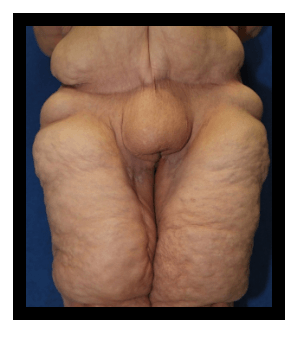
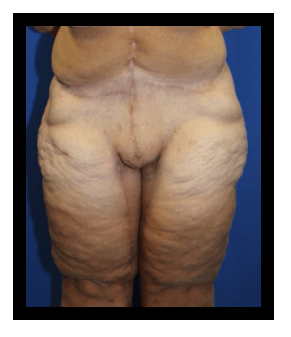
Figure 4: This is a before and after comparison of a 51-year-old female massive weight loss who lost 134 pounds. She has a Type 4 mons. She underwent vertical a mons reduction.
Combined Horizontal and Vertical Mons Reduction
Some women have substantial excess in both directions. A horizontal lift can elevate the mons but may leave it too broad. A vertical reduction can narrow it but may not correct downward descent. A combined approach may therefore be necessary. The horizontal component removes vertical redundancy and raises the mons. The vertical component reduces width. Liposuction or conservative direct fat excision reduces thickness. Internal fascial suspension supports the repositioned tissues. Because multiple vectors are being corrected, the operation requires careful sequencing. The plastic surgeon may first reduce volume, then temporarily tailor horizontal and vertical excisions before committing to final removal. This allows tissue removal in one direction to be adjusted based on correction achieved in the other. The point where incisions meet is exposed to greater tension and may have a higher risk of wound opening and delayed healing. Preserving blood supply, limiting undermining, avoiding excessive excision, and performing a secure layered closure are particularly important. The patient must accept both scar components in exchange for more complete three-dimensional correction.
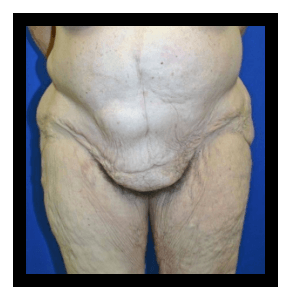
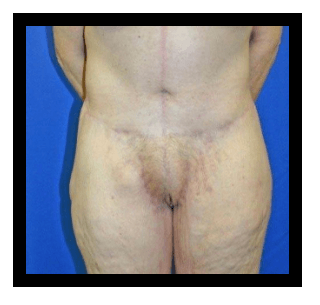
Figure 5: This is a before and after comparison of a 51-year-old female massive weight loss who lost 134 pounds. She has a Type 4 mons. She underwent vertical a mons reduction.
Mons Reduction With Abdominal Contouring
The mons should be evaluated whenever abdominal contouring is planned. Flattening the lower abdomen without addressing a bulky or descended mons may make pubic fullness more obvious. Conversely, access through a low abdominal incision may allow simultaneous elevation, volume reduction, and suspension. The two regions must be planned together. Excessive upward pull from the abdomen can raise the hairline or place tension on external genital tissues. Insufficient correction can leave a step between a flat abdomen and prominent mons. Balanced planning seeks a smooth transition while maintaining normal anatomy. Combination surgery is longer and generally produces more swelling, restricted mobility, and a longer recovery than isolated monsplasty. Safety depends on the patient’s health, total operative time, blood-loss risk, and extent of tissue dissection.
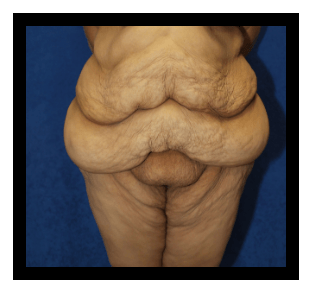
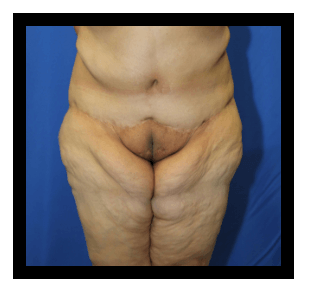
Figure 6: This is a before and after comparison of a 48 year old female massive weight loss who lost 138 pounds. She has a Type 5 mons. She underwent mons reduction combined abdominal wall contouring.
Drains and Fluid Management
Not every patient requires a drain. Liposuction-only procedures usually do not require traditional closed-suction drainage. Fluid may exit temporarily through small access sites, and absorbent dressings may be used. After open mons lift or a combined procedure, a drain may be placed when there is meaningful dead space or concern for fluid accumulation. The drain exits through a separate small opening and connects to a bulb that applies gentle suction. Patients are shown how to empty it, record output, and identify concerning changes. Drain removal is based primarily on output and surgeon protocol, not a fixed calendar date. Removing a drain too early may contribute to seroma; leaving it longer than necessary can increase discomfort and irritation. Even with a drain, a seroma can occur and may require aspiration or additional treatment.
Compression Garments After Mons Surgery
Postoperative compression is useful for many patients, particularly after liposuction. A properly fitted garment supports the area, limits tissue movement, reduces discomfort, and helps control swelling while tissues begin to adhere in their new position. The garment should provide even, moderate support. It should not fold sharply across the incision, dig into the groin, or place excessive pressure on the genital region. Excessive compression can impair circulation, irritate the incision, worsen numbness, cause wound openings, or create contour indentations. Duration depends on the procedure and healing. A patient undergoing limited liposuction may need compression for less time than one undergoing open excision and suspension. Many patients use support for six to eight weeks, but the exact garment and schedule should be prescribed by the operating plastic surgeon.
Recovery After Mons Reduction
Swelling, bruising, tightness, tenderness, and temporary numbness are expected. Because fluid moves downward with gravity, the mons and adjacent genital tissues can become more swollen than patients anticipate. This does not necessarily indicate a complication, but rapidly increasing one-sided swelling, severe pain, expanding bruising, fever, drainage, or shortness of breath requires prompt assessment. During the first several days, patients should rest but not remain completely immobile. Short, frequent walks support circulation. Patients generally avoid wide strides, deep squatting, heavy lifting, or movements that pull across the incision. Incisions should be kept clean and monitored as directed. Showering, dressing changes, and wound care vary according to the closure and associated procedures. Patients should not apply unapproved creams, powders, antiseptics, or scar products to a fresh incision. Most bruising and pronounced swelling improve during the first few weeks. Residual firmness and edema may persist for several months, particularly after extensive liposuction, open dissection, or combined abdominal surgery. The contour immediately after surgery is not the final result.
Return to Work
Return to work depends on the operation and occupational demands:
- After limited liposuction, some patients with sedentary work may return in several days to approximately one week.
- After an isolated open mons lift or vertical reduction, many patients require approximately one to two weeks before returning to desk-based work.
- More extensive excision, combined abdominal contouring, or complications can require a longer recovery.
- Jobs involving lifting, climbing, prolonged standing, repetitive bending, or strenuous activity require additional time.
These are estimates, not guarantees. Pain control, drain status, wound healing, energy level, commuting demands, and the ability to wear a garment at work all affect timing.
Exercise and Sexual Activity
Light walking begins early, but strenuous exercise is commonly restricted for about four to six weeks. Activities creating friction, pressure, or tension across the mons may need to be delayed longer if healing is incomplete. Sexual activity directly moves and compresses the operative region. It is therefore avoided during initial healing, commonly for approximately four weeks or longer after open surgery. Clearance should be individualized following examination.
Scars After Mons Reduction
Every operation that removes skin creates a permanent scar. The pattern depends on the anatomical problem:
- Liposuction: several small access scars
- Horizontal lift: a low transverse suprapubic scar
- Vertical reduction: a vertical scar through the mons
- Combined reduction: both horizontal and vertical scars
Scars commonly appear pink, red, firm, or raised early in healing. They generally soften and fade over many months, but no plastic surgeon can guarantee that a scar will become thin or inconspicuous. Genetics, skin type, tension, infection, delayed healing, nicotine exposure, and sun exposure influence scar quality. Once the incision is fully healed, silicone gel or sheeting may be recommended. Sun protection helps limit discoloration. Thickened or symptomatic scars may be treated with injections, laser therapy, or surgical revision in selected cases, but revision creates a new scar.
Risks and Potential Complications
Mons reduction is generally well tolerated in appropriately selected patients, but it is surgery and carries real risks. These include:
- Bleeding or hematoma
- Seroma or prolonged fluid drainage
- Infection
- Delayed wound healing or wound separation
- Skin or fat necrosis
- Persistent swelling or firmness
- Temporary or permanent numbness
- Painful or altered sensation
- Contour irregularity, depression, or waviness
- Asymmetry
- Residual fullness or loose skin
- Over-resection or an unnaturally thin appearance
- Excessive elevation or distortion of nearby tissues
- Unfavorable, widened, raised, or painful scars
- Recurrent descent after healing or future weight change
- Blood clots, pulmonary complications, and anesthesia-related complications
- Need for aspiration, wound care, scar treatment, or revision surgery
Lymphatic disruption deserves attention in this area. Swelling may be prolonged when extensive liposuction and undermining are combined. Limiting unnecessary dissection and using thoughtful compression can reduce risk but cannot eliminate it. No operation can produce perfect symmetry, remove every irregularity, or stop future aging. The aim is meaningful improvement with an acceptable balance of scars, contour, recovery, and risk.
Mons Reduction Surgery
Women considering mons reduction should seek a board-certified plastic surgeon with experience in both liposuction and post-weight-loss body contouring. A fat-predominant mons in a patient with elastic skin is fundamentally different from a wide, descended mons after massive weight loss. Treating both with the same method produces inconsistent results. During your consultation, discussion should cover anatomy, realistic goals, scar tolerance, expected garment use, anticipated time away from work, and whether an isolated or combined operation is safest. The plastic surgeon should explain why a specific incision is recommended and what that incision can and cannot correct.
The surgical facility, anesthesia plan, postoperative support, and emergency contact process should also be reviewed. Patients traveling need a clear plan for local accommodations, an adult caregiver, early postoperative visits, drain management if applicable, and safe timing for the return trip. Travel should not be scheduled so early that it interferes with follow-up or increases blood-clot risk.
Choosing the Appropriate Operation
A concise way to understand the decision process is:
- Excess fat with resilient skin: consider liposuction.
- Excess fat with questionable skin elasticity: consider conservative liposuction, limited excision, or a staged approach.
- Vertical descent and redundant skin: consider a horizontal suprapubic lift with possible internal suspension.
- Excessive width: consider vertical excision.
- Severe excess in multiple directions: consider combined horizontal and vertical correction with selective volume reduction.
The Simple Rules
- Fat? Liposuction
- Width? Vertical Reduction
- Length / Descent? Horizontal Reduction
- Width + Length? Combined Reduction
The mons operation should fit the anatomy rather than forcing every patient into the same technique. A technically successful procedure treats the dominant deformity, preserves normal relationships, and produces a proportionate transition between the lower abdomen and pubic region.
Frequently Asked Questions
- Can mons pubis fat be removed with liposuction alone? Yes, when excessive fat is the main problem and skin has adequate elasticity. Liposuction is less effective when substantial loose skin, a low hairline, or downward descent is present. Removing fat alone may leave the mons thinner but still hanging.
- How much fat should be removed? There is no ideal volume for every patient. The plastic surgeon removes enough to improve projection and balance while preserving a smooth, soft layer over the pubic bone. The endpoint is contour, not the largest possible aspirate.
- Does mons reduction leave a scar? Yes. Liposuction leaves small access scars. A horizontal lift leaves a longer low suprapubic scar, and narrowing an excessively wide mons may require a vertical scar. Scars fade but do not disappear.
- Can the scar be hidden under underwear? A horizontal incision is generally designed to lie beneath underwear when anatomy permits. Garment styles vary, and scar position cannot be guaranteed to remain hidden in every garment. A vertical scar is inherently more visible within the mons.
- Can mons reduction be performed with a tummy tuck? Yes. Addressing both areas during one operation can create a more balanced transition. However, the mons must be specifically evaluated and treated; abdominal skin removal alone does not guarantee adequate mons reduction or elevation.
- Will abdominal surgery automatically lift the mons? Not necessarily. Some elevation may occur, but a bulky or markedly descended mons may require direct fat reduction, skin excision, or internal suspension. Failure to plan it separately can leave disproportionate fullness.
- How long does surgery take? Limited liposuction may take less than an hour, while an isolated open reduction commonly takes approximately one to two hours. Combined or complex procedures take longer. Actual time depends on anatomy, technique, prior surgery, and additional procedures.
- Is a drain always required? No. Drains are uncommon after small liposuction-only procedures. A drain may be used after open lifting or extensive dissection when there is meaningful dead space.
- When can I return to work? Some patients return to sedentary work within several days after limited liposuction. After open reduction, approximately one to two weeks is a more realistic estimate for many desk-based workers. Physically demanding work and combined procedures require more time.
- How long must I wear compression? Many patients wear a supportive garment for several weeks, although duration varies. It should be snug and smooth, not painfully tight. The operating plastic surgeon should specify the garment and schedule.
- How long does swelling last? Visible swelling improves substantially during the first several weeks, but residual edema and firmness can persist for a few months. More extensive surgery generally produces longer-lasting swelling.
- Will sensation change? Temporary numbness, tingling, or altered sensation is common because small sensory nerves are stretched or divided during liposuction and skin excision. Sensation often improves, but permanent change is possible.
- Can mons reduction improve function? Yes. In selected women, reducing and elevating the mons can improve comfort in clothing, hygiene, exercise, access to the genital region, and sexual comfort. Improvement depends on the cause of symptoms.
- Is mons reduction the same as labiaplasty? No. Mons reduction treats the hair-bearing tissue over the pubic bone. Labiaplasty addresses the labia. They are anatomically distinct procedures, although concerns in both regions may be evaluated during the same consultation.
- Can the mons become prominent again? Yes. Future weight gain, pregnancy, aging, tissue relaxation, or major weight loss can change the result. Stable weight helps preserve contour, but no procedure permanently stops biological aging.
- When will I see the final results? Improvement in size or position is visible early, but swelling initially obscures detail. A more settled contour develops over several months, while scars continue to mature for a year or longer.
For more information, watch these YouTube mons reduction videos
https://www.youtube.com/watch?v=WoX3zn4QJfI
https://www.youtube.com/watch?v=uWANYmEvz9g
The Goal of Mons Reduction
Successful mons surgery is not simply about making the pubic region smaller. The objective is to create a mons that is appropriately sized, properly positioned, proportionate to the lower abdomen, and naturally contoured.
For one woman, the appropriate procedure may be conservative liposuction through several tiny access sites. For another, especially after massive weight loss, meaningful correction may require skin removal, direct fat reduction, elevation, internal fascial suspension, and correction in more than one direction.
Careful diagnosis determines the procedure. Careful technique protects blood supply, preserves an appropriate soft-tissue layer, distributes tension through deeper tissues, and avoids unnecessary distortion. Equally important, realistic counseling helps each patient understand the relationship between correction, scar length, recovery, and risk.
If you have questions about a mons reduction, please call (310) 859-7770 to schedule a private and confidential consultation with Dr. Katzen.