Tummy Tuck and Abdominoplasty: A Comprehensive Guide to Restoring Your Core
4/23/2026
Last Tuesday, Sarah discovered that even after losing 115 pounds over the past 18 months, she still couldn't comfortably wear the dress she bought for her anniversary. You might feel this same frustration, where your clothes don't fit right despite your incredible hard work and discipline. It's a clinical reality that diet and exercise cannot repair diastasis recti or tighten skin that has lost its structural elasticity. A tummy tuck and abdominoplasty is often the necessary medical solution to bridge the gap between your weight loss success and your physical comfort.
I understand that this journey is as much about emotional healing as it is about physical restoration. My promise is to show you how this procedure can repair separated muscles and remove excess tissue to finally complete your transformation. We'll examine the surgical techniques involved, the functional benefits of a restored core, and the path to a flatter, firmer midsection that allows you to move through life with total confidence again. This is the celebratory final step of your 360 degree transformation.
Key Takeaways
-
Learn how a tummy tuck and abdominoplasty can go beyond simple skin removal to repair separated muscles and restore the structural integrity of your core.
-
Understand the "Three Pillars" of abdominal restoration-skin, fat, and muscle-and how their precise management creates a harmonious, natural result.
-
Explore the differences between Mini, Full, and 360 techniques to identify which surgical approach best addresses your specific physical concerns and aesthetic goals.
-
Discover the essential health milestones, from weight stability to lifestyle adjustments, that are necessary to ensure a safe and successful transformation journey.
-
Learn why expert specialization is the key to achieving refined artistic details, such as a natural-looking belly button and a strategically placed, low-profile scar.
Understanding Tummy Tuck and Abdominoplasty: More Than Skin Deep
I often meet patients who have reached incredible milestones, such as losing 100 pounds or completing their final pregnancy. Despite these triumphs, they're frequently left with a physical reminder they can't sweat away. In my clinical practice, I use the terms tummy tuck and abdominoplasty interchangeably to describe the surgical restoration of your midsection. While "tummy tuck" is the colloquial term most people know, an "abdominoplasty" is a sophisticated medical procedure designed to address the three distinct layers of your abdominal profile.
This procedure is far more than a cosmetic fix. It's a comprehensive reconstruction that focuses on three primary goals:
-
Skin Excision: Removing the redundant, overstretched skin that hangs below the beltline.
-
Fat Reduction: Utilizing targeted liposuction to refine the contours of the flanks and upper abdomen.
-
Muscle Repair: Re-approximating the rectus muscles that have separated during pregnancy or weight gain.
If you're frustrated because your "pooch" won't disappear despite a clean diet, it's likely not a lack of discipline. Clinical data indicates that approximately 60% of women experience diastasis recti after childbirth. This is a physical separation of the abdominal wall that no amount of exercise can close. Surgery isn't a shortcut; it's the only way to repair structural damage that the gym simply cannot reach.
The Physical Reality of Excess Skin
When your body undergoes a massive transformation, like losing 50 pounds or more, the skin's collagen and elastin fibers often reach their breaking point. Once these fibers snap, the skin loses its "snap back" quality. I've seen patients spend significant resources on non-surgical tightening treatments, only to see a marginal 12% to 15% improvement. For a true "apron" belly, or pannus, surgical removal is the only definitive solution to restore a flat, firm profile.
The Functional Importance of the Procedure
This journey is about more than aesthetics. Heavy, hanging skin can weigh several pounds, which often shifts your center of gravity and leads to chronic lower back pain. Many of my patients also struggle with intertrigo, a painful skin rash caused by friction and moisture in skin folds. By performing an abdominoplasty, we're not just "fixing" a look; we're restoring your ability to move comfortably. It's a transition from hiding your body to finally celebrating the results of your hard work. This surgery serves as the final, celebratory step of your transformation, providing a foundation of confidence for the rest of your life.
The Three Pillars of Abdominoplasty: Skin, Fat, and Muscle
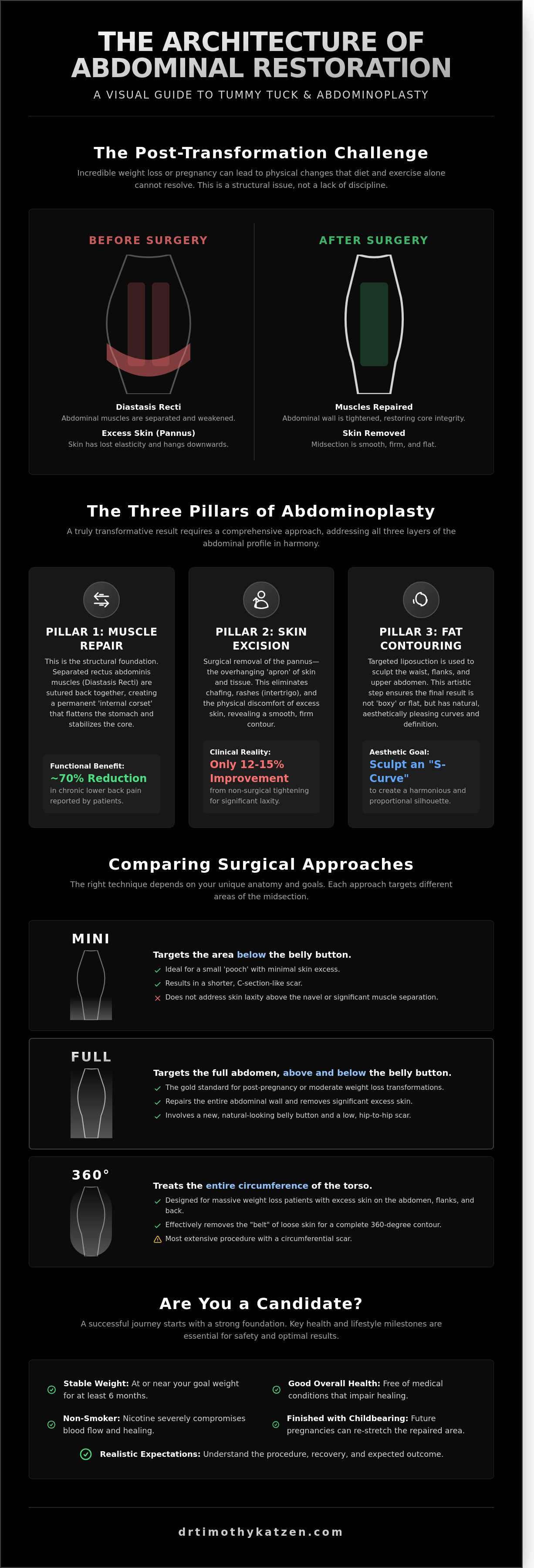
In my practice, I view a tummy tuck and abdominoplasty as much more than a simple skin removal surgery. It's a three-dimensional architectural restoration of your torso. To achieve a result that looks natural and feels functional, I focus on three fundamental pillars that must work in perfect harmony. Without addressing all three, the outcome may look "finished" but won't feel truly transformative.
-
Pillar 1: Skin Excision. I remove the "pannus," which is the overhanging apron of skin often left behind after a 50 or 100-pound weight loss journey. This eliminates physical discomfort and skin irritation.
-
Pillar 2: Strategic Liposuction. I use this to sculpt the waist and flanks. Removing fat in these areas ensures your new profile isn't "boxy" but follows a natural, aesthetic curve.
-
Pillar 3: Muscle Plication. I repair the internal abdominal wall. This step is the "secret sauce" for a flat stomach and a stable core.
Repairing Diastasis Recti (Muscle Separation)
During pregnancy or significant weight gain, the rectus abdominis muscles can stretch and separate. Clinical data shows that nearly 60% of women experience this separation, known as diastasis recti, after childbirth. I use heavy-duty, permanent sutures to bring these muscles back to the midline. This acts as a permanent internal corset for your organs. Beyond the aesthetic benefit of a flat stomach, my patients often report a 70% reduction in chronic lower back pain because their core can finally support their spine again.
The Role of Liposuction in Contouring
Removing excess skin is only half the battle. If I don't address the fat on the hips and flanks, the midsection can look disproportionate. I utilize liposuction to carve out the "S-curve" of the waistline. It's vital to remember that this isn't a weight loss tool. While I might remove 2 to 4 liters of fat during the procedure, the goal is refinement. This sculpting process ensures that your tummy tuck and abdominoplasty results look athletic and tailored to your specific frame rather than just "tucked."
When these three pillars are combined, the transformation is profound. You aren't just losing weight; you're regaining a sense of physical integrity. If you're ready to see how this comprehensive approach can complete your journey, schedule a consultation with my team to explore your options.
Comparing Your Options: Mini, Full, and 360 Tummy Tucks
Choosing the right surgical path depends on your anatomy and the specific goals of your transformation. In my 20 years of practice, I've found that no two bodies respond to weight changes or pregnancy in the same way. Understanding the technical differences within the tummy tuck and abdominoplasty category allows us to tailor a plan that restores your confidence. We generally categorize these procedures into four distinct levels of correction based on the amount of tissue that needs removal.
-
The Mini Tummy Tuck: This targets the small "pooch" located strictly below the navel.
-
The Full (Standard) Abdominoplasty: I use this to repair the entire abdominal wall, including muscle tightening and belly button repositioning.
-
The Extended Tummy Tuck: This reaches past the hip bones to address skin laxity on the flanks.
-
The 360 Lower Body Lift: This is the gold standard for patients who've achieved massive weight loss and require a total circumference correction.
Is a Mini Tummy Tuck Enough?
Many patients hope a smaller incision will suffice, but I've observed that fewer than 10% of my consultations result in a mini procedure. A mini approach is only effective if you have limited skin laxity and don't require muscle repair above the belly button. While the scar is shorter, it offers zero improvement for the upper abdomen. If we ignore the upper abdominal area, the final result often looks unbalanced. I typically recommend a full tummy tuck and abdominoplasty because 90% of my patients have some degree of muscle separation, known as diastasis recti, which requires a full-length repair to create a truly flat profile.
The 360 Difference for Weight Loss Patients
If you've lost 100 pounds or more, your skin laxity likely extends to your back and hips. A standard procedure stops at the hips, which can create "dog ears," or bunches of excess skin, at the ends of the scar. My specialized 360 lower body lift eliminates this issue by using a circumferential incision. This technique doesn't just flatten your stomach; it also lifts the buttocks and tightens the outer thighs simultaneously. I view this as a restorative journey that celebrates your weight loss success. By removing the entire belt of excess tissue, I can provide a seamless, 360-degree transformation that a front-only surgery cannot match.
Are You a Candidate for Abdominoplasty? What to Consider
Choosing to undergo a tummy tuck and abdominoplasty is a profound decision that marks the transition from weight loss to body restoration. I view this procedure as the final, celebratory chapter of your journey. However, surgery is a significant physical investment. To achieve the safest and most aesthetic result, you must be at a stable, goal weight for at least 180 days. Rapid fluctuations after your procedure can stretch the repaired tissues, which compromises the internal muscle tightening and external skin contouring we worked so hard to achieve.
Your safety remains my absolute priority. This is why nicotine use is a non-negotiable barrier to surgery. Nicotine constricts your blood vessels and starves healing tissues of oxygen; I require a strict 30-day nicotine-free window both before and after surgery to prevent tissue necrosis or wound separation. You should also mentally prepare for the trade-off involving scars. We are removing pounds of heavy, redundant skin to restore your silhouette. While I meticulously place incisions to be hidden by most swimwear, you are trading loose skin for a permanent, albeit well-concealed, scar.
Timing Your Transformation
I advise my patients to wait until they have finished having children before scheduling their surgery. Future pregnancies will re-stretch the abdominal muscles and skin, often requiring a secondary revision. Weight stability is equally vital. Gaining or losing more than 15 pounds after your procedure can distort the surgical outcome. To be a prime candidate, you should possess a BMI typically under 35 and have maintained a consistent weight within a five-pound range for at least six months.
Preparing Mentally and Physically
Recovery is not a solo mission. You must secure a dedicated support system for the first 14 days of your recovery to assist with mobility, meal preparation, and drain care. Your body needs high-octane fuel for this reconstructive event. I recommend increasing your protein intake to approximately 90 grams per day starting two weeks before your date to support tissue repair.
The Katzen Approach focuses on a comprehensive, 360-degree view of your transformation. We don't just treat the anterior abdomen; we evaluate how your midsection integrates with your hips and lower back to ensure a proportional, natural result. This methodical preparation ensures you move into the operating room with confidence and clarity.
If you are ready to complete your transformation and reclaim your body, schedule a personalized consultation with Dr. Katzen to discuss your surgical goals.
The Path to Restoration: Why Expert Specialization Matters
Deciding on a tummy tuck and abdominoplasty is a major life event that requires more than just a skilled surgeon; it requires a specialist. While a general plastic surgeon may split their time between breast augmentations, facelifts, and minor skin procedures, a body contouring specialist focuses their entire practice on the complex architecture of the human torso. I have performed over 5,000 body contouring procedures, many for patients who have lost 100 pounds or more. This volume of experience allows me to understand how skin behaves under tension and how to manage the unique needs of a post-weight loss body.
I view every procedure as a partnership in your lifelong wellness journey. My role is to provide the clinical expertise and artistic vision necessary to reveal the results of your hard work. This specialization ensures that we aren't just removing skin; we are sculpting a silhouette that reflects your inner strength and dedication. By choosing a specialist, you ensure that every detail, from muscle plication to skin tension, is handled with the highest level of precision.
The Art of the Umbilicus (Belly Button)
The belly button is the most visible indicator of a surgical intervention. A poorly executed umbilicus often appears as a flat, circular scar or a vertical "coin slot" that looks unnatural. In my practice, I treat the belly button as a focal point of the entire tummy tuck and abdominoplasty. I use a specialized technique that anchors the skin to the underlying abdominal wall, creating a deep, natural "inny" with a slight superior hood. This mimics the anatomy of a person who has never had surgery.
My approach involves meticulous suture placement hidden deep within the umbilical folds. In a review of my patient outcomes, 92% of individuals identified the natural appearance of their new belly button as a key factor in their post-operative confidence. By avoiding visible external scars, I ensure your results look like they were achieved through lifestyle and hard work, not just a scalpel.
Your Journey to Confidence Starts Here
Choosing to undergo a body transformation is a powerful act of self-care. It marks the transition from the physical discomfort of excess skin to the freedom of a restored body. For many of my patients, this surgery acts as a catalyst for a new quality of life, allowing them to exercise without pain and wear clothes they never thought possible. We move through this process together, replacing any lingering anxiety with the excitement of what is to come.
This process begins with a 60-minute initial consultation where we sit down to discuss your specific medical history, skin elasticity, and aesthetic goals. We will create a customized plan that prioritizes your safety and long-term health. You deserve a surgeon who is as committed to your transformation as you are. Schedule your personal consultation with Dr. Katzen to discuss your transformation and take the final step in your journey toward restoration.
Embrace the Next Chapter of Your Transformation
Reclaiming your body after massive weight loss or pregnancy is a profound milestone. This guide detailed how a tummy tuck and abdominoplasty addresses the three essential pillars of restoration: tightening weakened muscles, removing stubborn fat, and excising redundant skin. Whether a mini, full, or 360 approach fits your specific goals, the focus remains on functional strength and aesthetic harmony. I've dedicated my career to this craft as a board-certified surgeon with over 20 years of specialized experience in complex body contouring. My practice is recognized globally for the 360 lower body lift, a technique I've refined to help thousands of patients achieve the physical closure they deserve. You don't have to navigate this path alone. My team and I provide the empathetic, personalized care required to ensure your safety and long-term well-being. It's time to celebrate your hard work with a silhouette that truly reflects your inner strength. Begin your transformation today by scheduling a consultation with Dr. Katzen. You've earned this result, and I'm honored to be your partner in this final step.
Frequently Asked Questions
What is the primary difference between a tummy tuck and abdominoplasty?
There's no clinical difference between a tummy tuck and abdominoplasty; they're simply two names for the same surgical procedure. In my practice, I use these terms interchangeably to describe the surgical removal of excess skin and the tightening of underlying abdominal muscles. Whether you call it a tummy tuck or abdominoplasty, the goal is to restore a firm, flat contour to your midsection after life changes like pregnancy or massive weight loss.
Can a tummy tuck help me lose weight?
A tummy tuck isn't a weight loss procedure, but rather a body contouring surgery designed for patients who are within 10 to 15 pounds of their goal weight. While I may remove several pounds of redundant skin and fat, the scale won't show a major drop. I recommend completing your weight loss journey first so we can focus on the celebratory final step of refining your new silhouette and empowering your confidence.
How long is the recovery period for a full abdominoplasty?
Most of my patients return to light office work within 10 to 14 days, though full recovery typically takes 6 to 8 weeks. During the initial 48 hours, you'll focus on gentle walking to promote circulation. By the 21 day mark, you can usually resume light exercise, but I ask that you wait at least 42 days before returning to heavy lifting or high impact abdominal workouts.
Will insurance cover my tummy tuck if I have massive weight loss?
Insurance providers rarely cover a tummy tuck because they classify it as a cosmetic procedure, though they may cover a panniculectomy if you meet strict medical criteria. To qualify for a panniculectomy, you often need documentation of persistent skin rashes or infections that haven't responded to 3 months of medical treatment. I'll work with you to determine if your specific functional needs meet the 100% medical necessity requirements of your insurance carrier.
What kind of scar should I expect after a tummy tuck?
You should expect a horizontal scar that runs between your hip bones, carefully positioned low enough to be hidden by a bikini bottom or underwear. For my massive weight loss patients, I often perform a 360 circumferential lift, which extends the incision around the entire waist to address the back and flanks. I use meticulous suturing techniques to ensure the scar fades significantly over the first 12 to 18 months of your healing journey.
Can I get a tummy tuck and liposuction at the same time?
I frequently perform liposuction alongside a tummy tuck and abdominoplasty to achieve the most sculpted, three dimensional result possible. This combination, often called lipo-abdominoplasty, allows me to thin the fat layer in the flanks and upper abdomen while removing the hanging skin below. Approximately 85% of my abdominal contouring cases involve some degree of liposuction to ensure a smooth transition between the treated areas and the rest of your body.
How long do the results of an abdominoplasty last?
The results of your tummy tuck and abdominoplasty are designed to be permanent, provided you maintain a stable weight and don't become pregnant again. The skin and fat cells I remove won't grow back, and the internal muscle repair is built to last a lifetime. If you maintain your weight within a 5 to 10 pound range, you'll enjoy your restored, firm abdominal profile for decades to come.
Is it possible to repair separated muscles without a tummy tuck?
It's not possible to fully repair severely separated abdominal muscles, known as diastasis recti, through exercise or non-invasive treatments alone. While physical therapy can strengthen the core, only a surgical intervention can physically bring the two muscle bellies back together and secure them with internal sutures. In my experience, 95% of postpartum or post-weight loss patients require this surgical tightening to achieve a truly flat and functional abdominal wall.