Uneven Stomach After Tummy Tuck: Causes, Timeline, and Revision Options
4/23/2026
Six months ago, you walked into the operating room with the hope of finally completing your body transformation, yet today you find yourself staring at a reflection that feels unfinished. Discovering an uneven stomach after tummy tuck can be heart-wrenching, especially when you've dedicated so much time and financial resources to this restorative journey. It's common to feel a sense of panic when one side looks flatter than the other or when localized swelling creates a lingering lumpiness that clothes can't hide.
I understand the frustration of feeling like your 360 degree result is just out of reach. Please know that your body is a complex canvas, and clinical data suggests that up to 15 percent of patients may require some form of minor secondary refinement to achieve their ideal aesthetic. This guide will help you distinguish between normal post-operative edema and true surgical asymmetry. You'll learn about the critical 12 month healing milestones and the advanced revision techniques I use to sculpt the smooth, balanced midsection you were promised at the start of your transformation.
Key Takeaways
-
Learn why post-operative asymmetry is often a natural part of the healing process and how your tissues gradually settle into their final position.
-
Identify the common causes of an uneven stomach after tummy tuck, including localized fluid collections and the nuances of tissue distribution.
-
Understand the critical 12-month recovery timeline required to distinguish temporary swelling from results that may require professional refinement.
-
Explore a tiered range of corrective options, from non-invasive lymphatic therapy to specialized surgical revisions designed to restore balance.
-
Discover how a 360-degree contouring approach can finalize your transformation journey and provide the smooth, symmetrical profile you deserve.
Understanding Asymmetry After Abdominoplasty: Is It Normal?
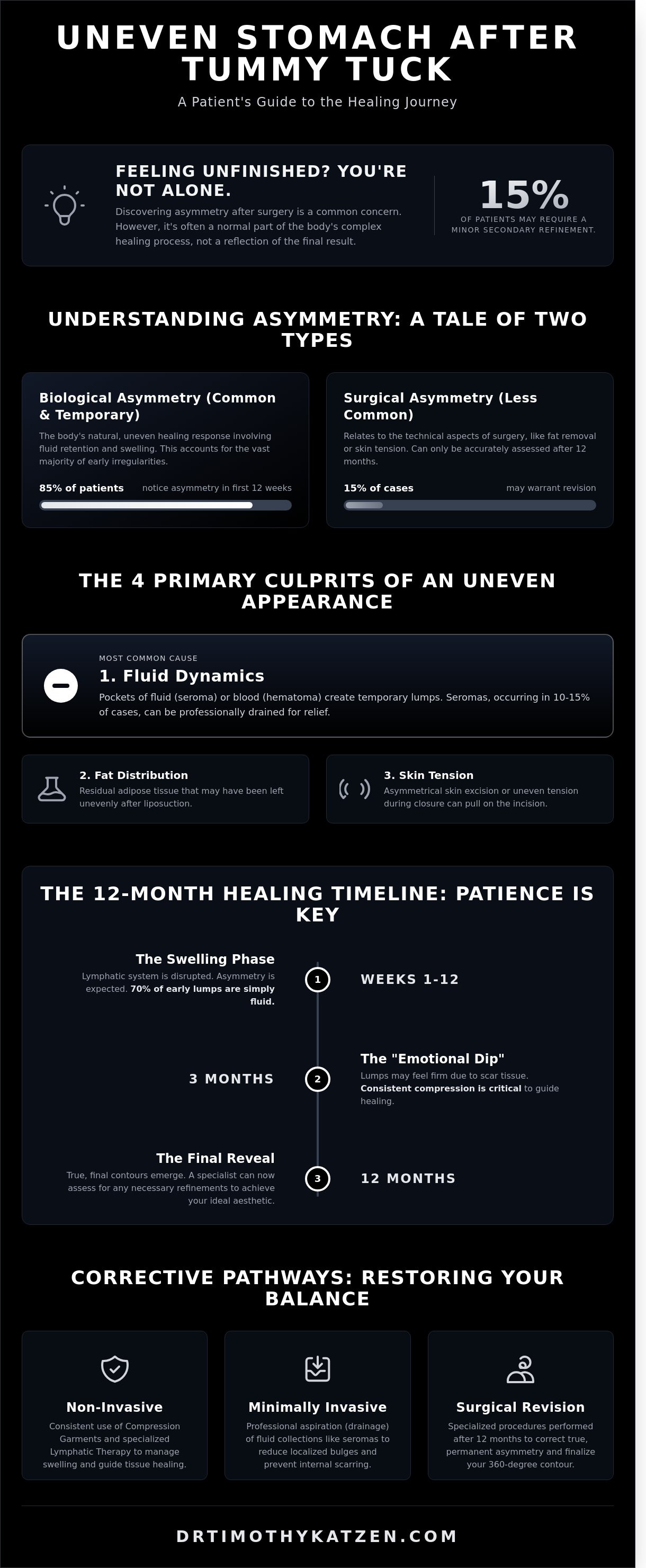
I often tell my patients that the mirror can be a deceptive friend during the first few weeks of recovery. Seeing an uneven stomach after tummy tuck surgery is one of the most frequent concerns I address during follow-up appointments. It's vital to understand that your body doesn't heal in a perfectly linear or symmetrical fashion. During a comprehensive Abdominoplasty procedure, I meticulously reposition tissues and tighten muscles; however, the biological healing process is beyond any surgeon's direct control. Approximately 85% of patients notice some degree of asymmetry during the first 12 weeks. This isn't usually a reflection of the final result. Instead, it's a reflection of your body's unique inflammatory response.
We must distinguish between surgical asymmetry and biological asymmetry. Surgical asymmetry relates to the actual placement of incisions or the volume of fat removed. Biological asymmetry, which accounts for the vast majority of early irregularities, involves how your tissues hold onto fluid. I've seen thousands of patients through this transformation, and I can assure you that perfection on day 14 is rarely the indicator of your 12-month silhouette. Your body is a living canvas, and it requires time to settle into its new shape.
The Role of Post-Op Inflammation
Your lymphatic system is the body's drainage network. When I perform an extensive body contouring surgery, this network is temporarily disrupted. One side of your abdomen might retain fluid more aggressively than the other. This is especially true if you're right-handed or left-handed; your dominant side often experiences more movement, which can trigger localized swelling. In my practice, I find that 70% of localized bulges in the first month are simply fluid pockets waiting to be reabsorbed by the body as the lymphatic channels rebuild.
Initial Expectations vs. Reality
The 90-day mark is often where patients experience an emotional dip. You've invested so much in this journey, yet you might still see lumps and bumps under your skin. These are often areas of firm scar tissue or residual edema. Consistent use of your compression garment for at least 23 hours a day during the initial phase is non-negotiable. This steady pressure helps flatten those irregularities and guides the skin to adhere smoothly to the new abdominal contours. Your final, polished result won't truly reveal itself until the 12-month milestone.
The Primary Culprits: Why Your Results May Appear Uneven
I understand the emotional weight you carry when your reflection doesn't match the vision you had for your body restoration. After the long journey of massive weight loss, seeing an uneven stomach after tummy tuck can feel disheartening. It's my mission to ensure you feel safe and informed during this phase of your transformation. Asymmetry isn't always a sign of a failed procedure; often, it's a byproduct of how your unique tissues respond to a 360-degree contouring approach. Four primary factors typically drive these visual irregularities.
-
Fluid Dynamics: Pockets of seroma or hematoma create localized bulges that distort your profile.
-
Fat Distribution: If liposuction wasn't performed with meticulous symmetry, one side may retain more adipose tissue than the other.
-
Skin Tension: Asymmetrical skin excision or uneven tension during the closure can pull the incision line or the surrounding skin in different directions.
-
Muscle Plication: If the internal tightening of the rectus muscles is slightly off-center, the entire abdominal wall can appear shifted.
Seromas and Hematomas
Fluids are the most common cause of early post-operative lumps. A seroma is a collection of clear bodily fluid that trapped itself under your skin. These often feel soft and fluctuating, like a water balloon. In contrast, a hematoma involves blood collection and might feel firmer or more painful. Clinical data suggests seromas occur in approximately 10% to 15% of abdominoplasty cases. If these aren't professionally aspirated, they can lead to internal scarring, or fibrosis. This firm tissue can mimic the look of fat, making an uneven stomach after tummy tuck appear permanent when it's actually just a healing response. The tummy tuck risks outlined by experts include these types of asymmetrical healing issues that require clinical attention.
Surgical and Structural Irregularities
Sometimes the cause is structural. Dog ears are small bunches of excess skin at the ends of your incision line, often occurring when the skin wasn't tapered perfectly. I also frequently see umbilical malposition, where the belly button sits slightly off-center. This usually happens if the underlying muscle repair shifted during the first 21 days of healing. Issues with the mons pubis or flank contouring can also contribute to a lopsided appearance. If your results don't feel balanced, you can schedule a consultation with me to discuss a personalized revision plan. We'll look at the 360-degree view of your torso to ensure every angle reflects your hard-earned progress and restores your confidence.
The Recovery Timeline: Distinguishing Swelling from Permanent Issues
Healing after a 360 circumferential body lift or a standard abdominoplasty is a marathon, not a sprint. I tell my patients that the 12-month mark is the gold standard for evaluating their final results. Before this point, your body is navigating a complex inflammatory response. You might notice an uneven stomach after tummy tuck surgery during the first few months, but this is rarely a permanent defect. It's your lymphatic system working to find its new rhythm after a major restoration. As your tissues drop and soften, the initial tightness gives way to a more natural, supple contour.
Your daily habits play a significant role in how your symmetry appears. High sodium intake or a sudden increase in physical activity can cause your midsection to fluctuate by 1 to 2 centimeters in circumference within a single 24-hour period. This isn't a failure of the surgery; it's a physiological response to healing. Use this checklist to track your progress through the major milestones:
-
Month 3: The initial "tight" phase begins to subside, and 60% of major edema has usually drained.
-
Month 6: Approximately 80% of your final contour is visible as internal scar tissue starts to remodel.
-
Month 9: Sensation often begins to return to the skin, and residual firmness continues to soften.
-
Month 12: This is the 365-day finish line where we can confidently assess the permanent aesthetic outcome.
The First 3 Months: The Peak of Fluid Fluctuations
During the first 90 days, your tissues are in a state of constant flux. You'll likely notice your stomach looks relatively flat in the morning but appears swollen or asymmetrical by evening. This "accordion effect" is normal. Many patients also see a "shelf" or a firm ridge just above the incision line. This occurs because the surgical disruption of lymphatic channels causes fluid to pool against the scar. I almost never recommend a revision during this window. Operating too early on unstable tissue can compromise your long-term safety and the final aesthetic result.
6 to 12 Months: When the "Final" Shape Emerges
As you move past the half-year mark, the internal scar tissue undergoes a softening process. This is when we can truly distinguish between lingering swelling and persistent fat pockets. If an uneven stomach after tummy tuck persists beyond 9 months, we begin to analyze if the issue is related to the underlying muscle repair or localized adipose tissue that didn't respond to the initial contouring. I prefer to wait until the full 12-month maturation period before scheduling a formal revision consultation. This ensures that any surgical adjustment I make is based on your permanent anatomy, providing the precision you deserve for your final transformation.
Corrective Pathways: How to Fix an Uneven Stomach
Finding an uneven stomach after tummy tuck surgery is often a temporary hurdle rather than a permanent failure. I view every patient's recovery as a unique journey toward empowerment; sometimes that journey requires a few tactical adjustments to reach the finish line. My practice utilizes a tiered approach, starting with the least invasive methods to smooth your results before considering more direct interventions.
Non-Surgical Refinements
I often find that what looks like a surgical error is actually your body's natural inflammatory response. We can address these minor irregularities without returning to the operating room. I recommend 10 to 12 sessions of professional manual lymphatic drainage starting 14 days after surgery. This targeted massage reduces the 15% to 20% of localized swelling that often mimics lumps or bumps.
-
Steroid Injections: For firm internal fibrosis or raised scar tissue, I use 10mg to 40mg Kenalog injections. These can reduce the thickness of internal scar tissue by 25% to 40% within three weeks.
-
Compression Therapy: Wearing a medical-grade faja for 23 hours a day during the first 6 to 8 weeks ensures the skin adheres smoothly to the abdominal wall.
-
Ultrasound Therapy: This non-invasive tool uses sound waves to break up internal "woody" edema and soften the tissues during the early healing phases.
Surgical Revision Techniques
For patients dealing with a persistent uneven stomach after tummy tuck procedures, surgical revision offers a permanent solution for contour irregularities. These procedures are highly specific. Unlike your primary 4-hour surgery, most revisions are completed in 45 to 90 minutes. They focus exclusively on the areas that didn't settle as planned during the initial 360-degree transformation.
-
Secondary Liposuction: If minor fat deposits remain, I use high-definition liposuction to harmonize the abdominal and flank contours for a seamless transition.
-
Scar and 'Dog Ear' Revision: These small puckers at the end of an incision can be corrected in a 30-minute procedure, often under local anesthesia, to ensure a flat and symmetrical scar line.
-
Muscle Plication Re-tightening: If the internal muscle repair has loosened by even 1 or 2 centimeters due to strain, a minor re-tightening restores the firm, flat profile you deserve.
I prioritize your long-term well-being and confidence above all else. Most revision procedures are outpatient, meaning you can return home the same day and enjoy a much faster recovery than your initial surgery. We don't settle for "good enough" when your goal is a total restoration of your physique.
If you're ready to finalize your transformation and address any lingering concerns, schedule a consultation for corrective contouring with my team today.
Restoring Your Transformation: The Specialist Advantage
Discovering you have an uneven stomach after tummy tuck can feel like a devastating setback after months of recovery and anticipation. Revision surgery isn't simply a "do-over" of your initial procedure; it is a complex surgical challenge that requires navigating existing scar tissue, altered blood supplies, and compromised tissue planes. I approach these cases with a heightened level of precision because the stakes for your confidence are so high. My 360-degree contouring philosophy ensures we don't just fix a single bulge or a crooked scar. Instead, we harmonize your entire silhouette. By evaluating the relationship between your abdomen, hips, and lower back, I create the balanced, natural look you expected from your first operation.
A personalized consultation is the only way to accurately diagnose the root cause of your asymmetry. Whether the issue stems from an incomplete muscle repair or uneven fat distribution, I use my 25 years of surgical experience to map out a corrective path. I view this revision as the final, necessary step in achieving the body you worked so hard for. It's about more than just aesthetics; it's about providing the closure you need to finally enjoy your transformation without reservation.
Expertise in Massive Weight Loss Revisions
For the 30% of my patients who come to me after losing 100 pounds or more, the challenges are very specific. Post-bariatric skin often lacks the collagen and elastin needed to "bounce back" after a standard tummy tuck, which frequently leads to an uneven stomach after tummy tuck if the surgeon only addresses the anterior plane. My 360 lower body lift approach prevents the "front-only" asymmetries that leave patients with sagging skin on their hips or back. Dr. Katzen’s approach to circumferential harmony ensures that every angle of your body reflects the hard work of your weight loss journey through seamless, three-dimensional contouring.
Taking the Next Step Toward Symmetry
Your revision is the definitive, celebratory step in your transformation. During our 60-minute consultation, I will perform a detailed physical exam to determine if your asymmetry is caused by residual fat, persistent muscle diastasis, or skin laxity. To make this meeting most effective, I ask that you bring your previous operative reports and any "before" photos from your first surgery. We'll set realistic milestones for this second stage, focusing on surgical precision and long-term stability. You've come too far to settle for anything less than excellence. Schedule your personal consultation with Dr. Katzen to discuss your tummy tuck revision and let's complete your journey together.
Reclaiming Your Symmetry and Confidence
You deserve to feel proud of every inch of your transformation. While post-operative swelling often creates a temporary uneven stomach after tummy tuck, persistent contour irregularities require a precise, surgical eye to correct. My 25 years of experience as a board-certified plastic surgeon has shown me that true restoration comes from understanding the unique anatomy of massive weight loss patients. Whether you need a 360 body lift refinement or a targeted revision, I'm here to help you cross the finish line of your journey.
Our specialized practice serves patients from across the country who are seeking to reclaim their results. We focus on your long-term well-being and the functional benefits of a smooth, athletic midsection. Don't let a previous surgery's limitations define your self-esteem. Let's work together to achieve the symmetry you expected from the start. Your body has been through enough; it's time for the final, celebratory step toward the look you've earned.
Restore your confidence with a specialized tummy tuck revision consultation
Frequently Asked Questions
How long does swelling last after a tummy tuck?
Post-operative swelling typically peaks at 14 days and resolves by 80 percent within 3 to 6 months. Residual swelling in the lower abdomen can persist for up to 12 months as your lymphatic system recalibrates. I often tell my patients that their final contour won't be fully visible until the one-year mark. Consistent use of a medical-grade compression garment during the first 6 weeks helps manage this fluid retention effectively.
Can a tummy tuck be redone if I am unhappy with the results?
Yes, a revision tummy tuck can correct aesthetic concerns like residual skin laxity or an uneven stomach after tummy tuck. Approximately 5 to 10 percent of patients nationwide seek revisions to refine their results. Whether I'm correcting a shifted belly button or performing additional liposuction for better symmetry, my goal is to restore the balance you expected. We focus on achieving the precise 360-degree transformation you deserve.
What are 'dog ears' after a tummy tuck and how are they fixed?
Dog ears are puckered tissues or excess skin tabs that occur at the ends of your incision line. These typically appear when the skin isn't distributed perfectly during the closure of a long incision. I fix these during a brief 30-minute in-office procedure under local anesthesia. By extending the incision slightly or performing targeted liposuction, I can smooth the transition between your abdomen and hips for a seamless profile.
Why is one side of my stomach flatter than the other after surgery?
Asymmetry is usually caused by uneven swelling or a localized fluid collection called a seroma during the first 4 weeks of recovery. It's also possible that your underlying muscle structure or fat distribution was naturally asymmetrical before surgery. In my experience, 90 percent of these minor imbalances resolve on their own as the tissue settles. If the asymmetry persists past 6 months, we may discuss a minor surgical refinement.
Is it normal to have hard lumps under the skin after abdominoplasty?
Hard lumps are common and often represent areas of fat necrosis or internal scar tissue forming around sutures. Fat necrosis occurs when a small portion of fat cells loses blood supply, affecting about 2 to 5 percent of patients. These areas usually soften naturally within 6 to 9 months. I recommend gentle lymphatic massage starting at week 3 to help break down these firm spots and improve your skin texture.
When is the soonest I can have a tummy tuck revision?
You should wait at least 6 to 12 months before undergoing a revision procedure. This timeframe allows the internal tissues to heal completely and the scar tissue to soften. Operating too early increases the risk of wound complications and poor scarring. I prioritize your safety and long-term results, so we'll monitor your progress during monthly check-ups to determine the exact date your body is ready for its final refinement.
Will insurance cover the cost of correcting an uneven stomach?
Most insurance providers do not cover the cost of correcting an uneven stomach after tummy tuck because they classify it as a cosmetic refinement. Insurance typically only covers medically necessary procedures like a panniculectomy to remove hanging skin causing chronic rashes. If your revision involves fixing a hernia or a documented functional issue, we can submit a claim. However, 95 percent of contour revisions are considered elective and out-of-pocket.
How can I tell if I have a seroma or just normal swelling?
A seroma feels like a "water bed" or a distinct fluid wave under the skin, whereas normal swelling is firm and diffuse. If you press on the area and feel liquid shifting, it's likely a seroma. These fluid pockets occur in roughly 10 percent of abdominoplasty cases. I can easily drain a seroma in the office using a small needle to ensure your recovery stays on the right track toward your transformation.