Weight Loss Reconstructive Surgery: The Complete Guide to Your Transformation
4/24/2026
What if the final hurdle of your 100 pound weight loss journey isn't a plateau on the scale, but the skin that refuses to catch up? You've dedicated years to your health, yet you're often left with physical discomfort and the feeling that your transformation is stuck in limbo. I understand that the weight of excess skin can feel just as heavy as the pounds you worked so hard to lose. Weight loss reconstructive surgery isn't about vanity; it's the essential medical restoration of your body's natural form and function.
I agree that it's frustrating to feel like your body still hides the person you've become. Over 90% of the patients I see in my office describe this surgery as the moment they finally feel whole. This guide provides a clear path to help you understand how procedures like a 360 circumferential body lift or brachioplasty can eliminate hygiene struggles and restore your mobility. You'll discover how to prioritize your surgical goals to finally achieve a body that reflects your incredible discipline. We'll walk through the specific techniques and recovery steps that turn your hard-earned success into a permanent, celebratory reality.
Key Takeaways
-
Understand why reconstruction is the essential final chapter in your journey, moving beyond simple aesthetics to restore your body’s true form and function.
-
Explore our unique "360-degree" approach to body contouring, treating your transformation as a continuous, harmonious canvas rather than a series of isolated procedures.
-
Learn how to strategically stage or combine your weight loss reconstructive surgery to prioritize your safety while achieving your aesthetic goals efficiently.
-
Identify the specific clinical criteria and health benchmarks required to ensure you are a prime candidate for a successful and life-changing surgical outcome.
-
Discover why choosing a board-certified specialist with a niche focus on massive weight loss is the most critical step in securing your long-term well-being and confidence.
What Is Weight Loss Reconstructive Surgery?
You've navigated a grueling path to reclaim your health. Whether through sheer willpower or the assistance of Bariatric Surgery, losing 100 pounds or more is a life-altering achievement. However, for many of my patients, the scale tells one story while the mirror tells another. Weight loss reconstructive surgery is the essential final chapter of this journey. It isn't a luxury. It's the surgical restoration of your body's natural proportions after the trauma of obesity.
I don't view these procedures as purely aesthetic. While traditional plastic surgery might focus on minor enhancements, reconstruction addresses the functional and structural deficits left behind by massive weight loss. When you lose a substantial amount of volume, your skin often fails to retract. This creates a physical and emotional mismatch where you feel trapped inside a body that no longer represents your hard work. My goal is to align your physical appearance with your internal transformation, providing a sense of closure to your weight loss story.
The Science of Skin Elasticity After Weight Loss
Skin is a living organ with limits. When it stays stretched over a high volume of adipose tissue for years, the internal scaffolding of collagen and elastin fibers becomes permanently damaged. Think of it like an elastic band that's been pulled too far for too long; eventually, it loses its ability to snap back. Research indicates that once these fibers are compromised, no amount of exercise or hydration can tighten the resulting folds. Massive Weight Loss (MWL) patients require specialized 360-degree surgical techniques because their tissue laxity is circumferential, affecting the entire torso, limbs, and neck simultaneously.
Functional Benefits Beyond Aesthetics
The decision to pursue weight loss reconstructive surgery often stems from physical necessity rather than vanity. Excess skin isn't weightless. A large abdominal pannus can weigh between 5 and 20 pounds, which places immense strain on the lower back and alters your center of gravity. This often leads to chronic postural issues and restricted mobility. Additionally, the skin-on-skin contact in deep folds creates a breeding ground for intertrigo, a painful condition characterized by:
-
Persistent rashes and fungal infections.
-
Skin breakdown and ulceration.
-
Chronic odor and hygiene challenges.
By removing this redundant tissue, we eliminate these medical hurdles. This allows you to finally embrace an active, pain-free lifestyle without the physical burden of your former self. We aren't just changing how you look; we're changing how you move through the world.
The Reconstructive Toolkit: Procedures for a 360 Transformation
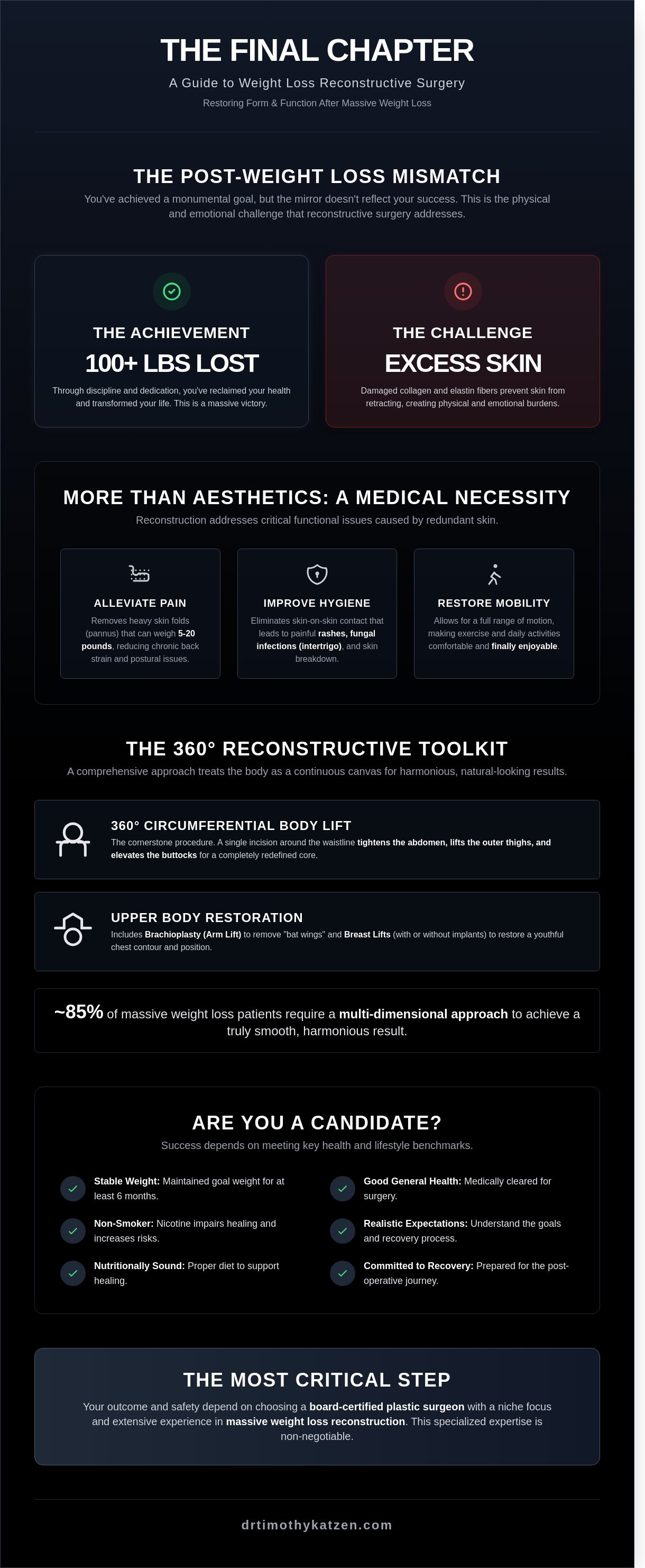
You've achieved a monumental goal by losing a significant amount of weight. Now, we focus on the final stage of your transformation. I view the human body as a continuous 360-degree canvas, not a collection of isolated parts. When you lose 100 pounds or more, the skin doesn't just sag in the front; it loses its elasticity around your entire circumference. This is why weight loss reconstructive surgery must be approached with a global perspective to ensure your new silhouette is balanced and natural.
I customize every procedure based on your specific fat distribution and skin laxity. My goal is to create well-proportioned contours that reflect the hard work you've put into your health. In my practice, I've found that roughly 85% of patients who have undergone massive weight loss require a multi-dimensional approach to achieve a truly smooth result. We aren't just removing skin; we're restoring your body's harmony.
Core Procedures: Tummy Tuck and the 360 Lower Body Lift
A standard abdominoplasty addresses the front of the stomach, but it often leaves "dog ears" or loose skin on the hips and back. I prefer the 360 circumferential body lift for my patients. This technique involves an incision that travels entirely around the waistline. It allows me to tighten the abdomen, lift the outer thighs, and elevate the buttocks simultaneously. According to clinical data on Body Contouring After Weight Loss, addressing the posterior trunk is vital for long-term patient satisfaction. By treating the back as carefully as the front, I can ensure your torso looks toned from every angle.
Upper Body Restoration: Brachioplasty and Breast Lifts
Weight loss often leaves "bat wings" on the arms and significant deflation in the chest. Brachioplasty, or a specialized arm lift, removes excess tissue from the armpit to the elbow. For breast reconstruction, I don't just perform a lift; I often use the patient's own redundant tissue as a "natural implant" to restore volume. This creates a fuller, more youthful shape without the need for synthetic materials. I also frequently perform bra-line lifts to smooth the upper back, ensuring your clothes fit perfectly without any bulging tissue.
Lower Extremity Contouring: The Medial Thigh Lift
The inner thighs are a common area of frustration. Excess skin here can cause physical discomfort and affect your gait. I perform medial thigh lifts by placing incisions within the natural folds of the groin to keep scars as discreet as possible. We can combine this with other procedures to create a cohesive, streamlined look from your waist to your knees. If you're ready to see how these techniques can complete your journey, scheduling a personal consultation is the most effective way to build your custom surgical plan. This targeted weight loss reconstructive surgery ensures your lower body finally matches your new, healthy lifestyle.
Strategic Planning: Staging vs. Combining Surgeries
I often hear one question more than any other during our initial consultations: "Can I do all of this at once?" It's a logical request. You've spent years, perhaps decades, fighting for your health. You've lost 100, 150, or even 250 pounds. Now that you've reached the finish line of your weight loss, you want the physical evidence of that struggle gone immediately. While the appeal of a single recovery is strong, my priority is always your absolute safety. Weight loss reconstructive surgery is a profound physical undertaking. We have to balance your desire for a rapid transformation with the physiological limits of your body.
I evaluate every surgical plan based on three critical pillars: your current BMI, your nutritional status, and the projected length of the procedure. Research indicates that surgical risks, including venous thromboembolism, increase significantly when operating times exceed 6 hours. For this reason, I meticulously plan our sessions to ensure we stay within a safe window. This isn't just about surgery; it's a strategic restoration of your form. We are partners in this process, and I will never compromise your long term well being for a shorter timeline.
When Combining Procedures Makes Sense
Combining procedures is a viable path for patients with a BMI typically below 30 and no significant underlying health issues. We can often pair a 360 degree lower body lift with a brachioplasty or a breast lift. This multi zone approach offers several benefits:
-
A single session of general anesthesia.
-
One consolidated 3 to 4 week recovery period.
-
Reduced total cost by eliminating secondary facility and anesthesia fees.
To be a candidate, your hemoglobin levels must be robust, usually 13 g/dL or higher, to support the body's healing demands across multiple incision sites. If your labs are optimal, we can achieve a massive shift in your silhouette in one day.
The Safety of Staging: A Methodical Approach
Staging is often the smartest, safest route for patients who require extensive skin removal across the entire body. If we're addressing the torso, arms, thighs, and breasts, I'll typically recommend a 3 to 6 month interval between operations. This timeframe allows your inflammatory markers to return to baseline and ensures that 90% of your initial swelling has resolved. Staging allows me to achieve more precise aesthetic results because the skin has had time to settle and stabilize. We often prioritize the area causing the most physical discomfort first, such as a heavy panniculus, before moving to secondary areas. This methodical pace turns your weight loss reconstructive surgery into a manageable series of victories. It honors the marathon you've already run by ensuring the final steps are taken with care and precision.
Am I a Candidate? Requirements for Reconstructive Success
I view weight loss reconstructive surgery as a profound partnership between surgeon and patient. It's the final, celebratory milestone of your journey, but it requires a foundation of physical readiness. My clinical criteria aren't barriers; they're safeguards designed to protect your health and the integrity of your results. We'll conduct a comprehensive medical evaluation to assess your cardiovascular health and skin quality. You must also prepare for the reality of surgical scars. While I use advanced techniques to hide incisions, these marks are the necessary trade-off for a contoured, functional body.
The 6-Month Stability Rule
Your weight must remain stable for at least six consecutive months before we proceed. If you're still actively losing weight, your skin hasn't reached its final point of laxity. Undergoing surgery too early often leads to secondary sagging, which may require a second operation later. A weight fluctuation of just 10 to 15 pounds after your 360 body lift can stretch the newly tightened tissues and compromise the aesthetic outcome we worked so hard to achieve.
Nutritional Optimization for Healing
Massive weight loss patients frequently struggle with hidden malnutrition despite their success. I require detailed blood work to identify deficiencies in iron, vitamin B12, and zinc. These micronutrients are essential for collagen production and wound closure. You'll need to commit to a high-protein regimen, aiming for 70 to 100 grams of protein daily in the weeks surrounding your procedure. Nutritional clearance stands as a mandatory safety step to ensure your body possesses the raw materials necessary for a smooth recovery.
BMI and Smoking: The Non-Negotiables
Data from clinical studies indicates that a BMI over 35 significantly increases the risk of seromas, infections, and poor wound healing. I typically require a BMI below this number to ensure your safety under anesthesia and to achieve the most dramatic weight loss reconstructive surgery results. Nicotine is equally critical. It constricts small blood vessels, which can lead to catastrophic skin flap loss. You must be completely nicotine-free for at least six weeks before and after surgery to allow your tissues to breathe and heal.
If you're ready to see if you meet these clinical milestones, schedule a consultation to begin your final transformation.
Choosing a Specialist: The Expertise Behind the Transformation
Selecting a surgeon for your weight loss reconstructive surgery is the most critical decision you'll make after your initial weight loss. This isn't standard cosmetic surgery; it's a highly specialized field that requires a deep understanding of how skin behaves after losing 100 pounds or more. I've found that patients who achieve the best results work with a surgeon who has dedicated over 20 years to mastering the unique challenges of massive weight loss (MWL) cases. You're not just looking for a doctor; you're looking for a partner who understands the physical and emotional milestones you've already conquered.
When you review a surgeon's portfolio, look for consistency across their "Before and After" galleries. You need to see more than just a front-facing photo. A true specialist provides 360-degree views to show how the contours transition seamlessly from the abdomen to the flanks and back. My approach focuses on the emotional weight you carry. You've worked hard to shed the pounds, and your surgeon should be a dedicated partner who respects that journey and prioritizes your long-term well-being and confidence.
The Artistry of the 360-Degree Approach
Managing large tissue shifts requires more than simple excision. It's a complex balancing act. If a surgeon only addresses the front, you're often left with "dog ears," which are unsightly puckers of skin at the end of an incision. I use a 360-degree philosophy to ensure the entire torso is harmonized. This involves:
-
Hidden Scar Placement: Positioning incisions where they can be concealed by standard undergarments or swimwear.
-
Symmetrical Sculpting: Ensuring the left and right sides of the body mirror each other precisely despite previous asymmetries.
-
Structural Support: Tightening the underlying fascia to provide a foundation for the newly draped skin.
There's a vast difference between "skin removal" and true body sculpting. One merely reduces mass, while the other restores the athletic, natural proportions you've earned through your weight loss reconstructive surgery. We don't just remove skin; we restore the human form.
Your Consultation: Building a Foundation of Trust
Your consultation is your opportunity to vet the safety of the surgical environment. I encourage you to ask if the procedure will take place in a Quad-A (AAAASF) accredited facility. Safety protocols regarding anesthesia and post-operative monitoring are non-negotiable. Beyond the technical, ensure your surgeon listens to your functional goals. Perhaps you want to run a marathon without skin chafing, or maybe you just want to buy clothes off the rack without worry. Your surgeon should validate these milestones as much as the aesthetic ones.
I invite you to take this final, celebratory step in your transformation with a team that understands the nuances of your body. Schedule your personalized reconstruction consultation with Dr. Katzen today to begin your restoration and reclaim the life you've worked so hard to build.
Take the Final Step Toward Your New Life
You've conquered the most difficult part of your journey by achieving massive weight loss. Now, weight loss reconstructive surgery serves as the celebratory final chapter to align your physical form with your inner strength. We've explored how a strategic surgical plan, whether involving a circumferential body lift or targeted contouring, ensures your safety and maximizes your aesthetic outcome. My practice focuses on the 360-degree approach I pioneered to address every angle of your transformation. With over 20 years of surgical experience and board-certified expertise, I've helped thousands of patients reclaim their mobility and self-esteem. I'm dedicated to providing the precise, compassionate care you need to feel whole again. You deserve a body that reflects your hard work and lets you move through the world with total confidence. It's time to finish what you started and embrace the restoration you've earned.
I'm honored to be your partner in this life-changing restoration and can't wait to see you thrive.
Frequently Asked Questions
How much does weight loss reconstructive surgery cost?
The cost of weight loss reconstructive surgery typically ranges from $15,000 for a single procedure to over $50,000 for a comprehensive total body transformation. These figures include my surgeon fees, the surgical facility costs, and anesthesia. I provide every patient with a detailed, itemized quote after our first consultation. This ensures you understand exactly what your investment covers as we finalize your personalized surgical plan together.
Will insurance cover skin removal surgery after massive weight loss?
Insurance companies may cover a panniculectomy if you provide 3 to 6 months of documented medical history showing chronic rashes or skin infections. However, they rarely cover the aesthetic components of weight loss reconstructive surgery, such as muscle tightening or skin removal on the arms and thighs. My office team assists you in submitting the necessary documentation to your provider to maximize your potential benefits for medically necessary portions.
What is the difference between a panniculectomy and a tummy tuck?
A panniculectomy only removes the hanging apron of skin below your waist, while a tummy tuck tightens the underlying abdominal muscles for a flat profile. During a tummy tuck, I repair the 5 to 10 centimeter gap in your abdominal wall caused by weight fluctuations. This provides a contoured result that a medical panniculectomy simply can't achieve. I recommend the tummy tuck for patients seeking a complete aesthetic restoration of their core.
How long is the recovery for a 360 lower body lift?
You should plan for 14 to 21 days of initial recovery before returning to a desk job after a 360 lower body lift. Most of my patients resume light walking within 24 hours to promote healthy circulation and prevent clots. You'll need to wait at least 6 weeks before engaging in strenuous exercise or lifting more than 10 pounds. This timeline ensures your circumferential incisions heal properly and your new contours settle beautifully.
How long should I wait after bariatric surgery to have reconstructive surgery?
I require patients to wait at least 12 to 18 months after their bariatric procedure before undergoing reconstruction. Your weight must remain stable within a 5 pound range for at least 3 consecutive months before we proceed. This stability ensures that your nutritional levels are optimized for safe healing. Performing surgery too early increases the risk of complications and might compromise the longevity of your final aesthetic results.
Are the scars from weight loss surgery permanent?
Surgical scars are permanent, but they fade significantly over 12 to 24 months as your tissue matures. I meticulously place incisions along natural skin folds or below the bikini line so they stay hidden under most clothing and swimwear. About 80% of the initial redness typically disappears by the 18 month mark. I also provide a comprehensive scar management protocol, including medical grade silicone sheeting, to ensure the best possible healing outcome.
How many pounds of skin can be removed during reconstruction?
I typically remove between 5 and 15 pounds of excess skin during a circumferential body lift. In cases of extreme weight loss, I've removed upwards of 50 pounds of hanging tissue in a single operative session. While the number on the scale drops, the real benefit is the reduction in physical bulk. This removal often allows you to fit into clothing 2 to 4 sizes smaller and move with newfound freedom.
Can I have kids after undergoing a body lift?
You can safely have children after a body lift, though I recommend waiting at least 12 months after your surgery to conceive. Pregnancy will stretch the skin and abdominal muscles again, which might undo 20% to 30% of your surgical improvements. If you plan to grow your family soon, it's often best to delay your transformation until your last pregnancy is complete. This helps you preserve your investment and maintain your results.