Facial Rejuvenation: A Complete Guide to Surgical and Non-Surgical Restoration
4/24/2026
Have you ever caught a glimpse of yourself in a mirror and wondered why your reflection looks exhausted when you feel energized and ready to take on the world? It's a common frustration for many of my patients who feel their face no longer reflects their internal vitality. You aren't alone in feeling confused by the endless sea of anti-aging treatments or fearing that a procedure might leave you looking unnatural. According to the American Society of Plastic Surgeons 2023 report, demand for facial procedures increased by 18% as more people seek to align their appearance with their inner energy. This shift highlights a growing desire for facial rejuvenation that prioritizes authenticity over a generic, frozen look.
I want to help you find the perfect balance between subtle non-invasive refreshes and the deeper, transformative results of surgical restoration to reclaim your youthful spirit. By understanding your unique anatomy, we can achieve a natural, rested appearance that restores your facial contours without sacrificing your identity. This guide provides a clear roadmap for your aesthetic journey, detailing how we combine skin health restoration with advanced surgical techniques to provide lasting, beautiful results that truly represent how you feel inside.
Key Takeaways
-
Identify the three pillars of aging-volume loss, laxity, and texture-to better understand how your facial profile changes over time.
-
Compare the immediate benefits of MedSpa refreshes against the lasting, structural results of surgical facial rejuvenation.
-
Learn how modern deep-plane techniques provide a natural, restored appearance while avoiding the outdated "pulled" look of the past.
-
Evaluate the trade-offs between recovery time and long-term investment to determine which path best fits your lifestyle and aesthetic goals.
-
Discover Dr. Katzen’s unique, empathetic approach to restoring facial harmony, especially for those celebrating a massive weight loss journey.
What is Facial Rejuvenation: Understanding the Anatomy of Aging
I believe that understanding your face is the first step toward restoring it. Many patients visit my office concerned that they look tired even after a full night's rest. This perceived fatigue is rarely about sleep. It's actually the result of deep structural changes within the five distinct layers of facial anatomy: the skin, subcutaneous fat, the SMAS (muscular layer), deep fat pads, and the underlying bone. True facial rejuvenation is a multi-layered approach that addresses each of these levels to restore the vibrant, energetic appearance you remember.
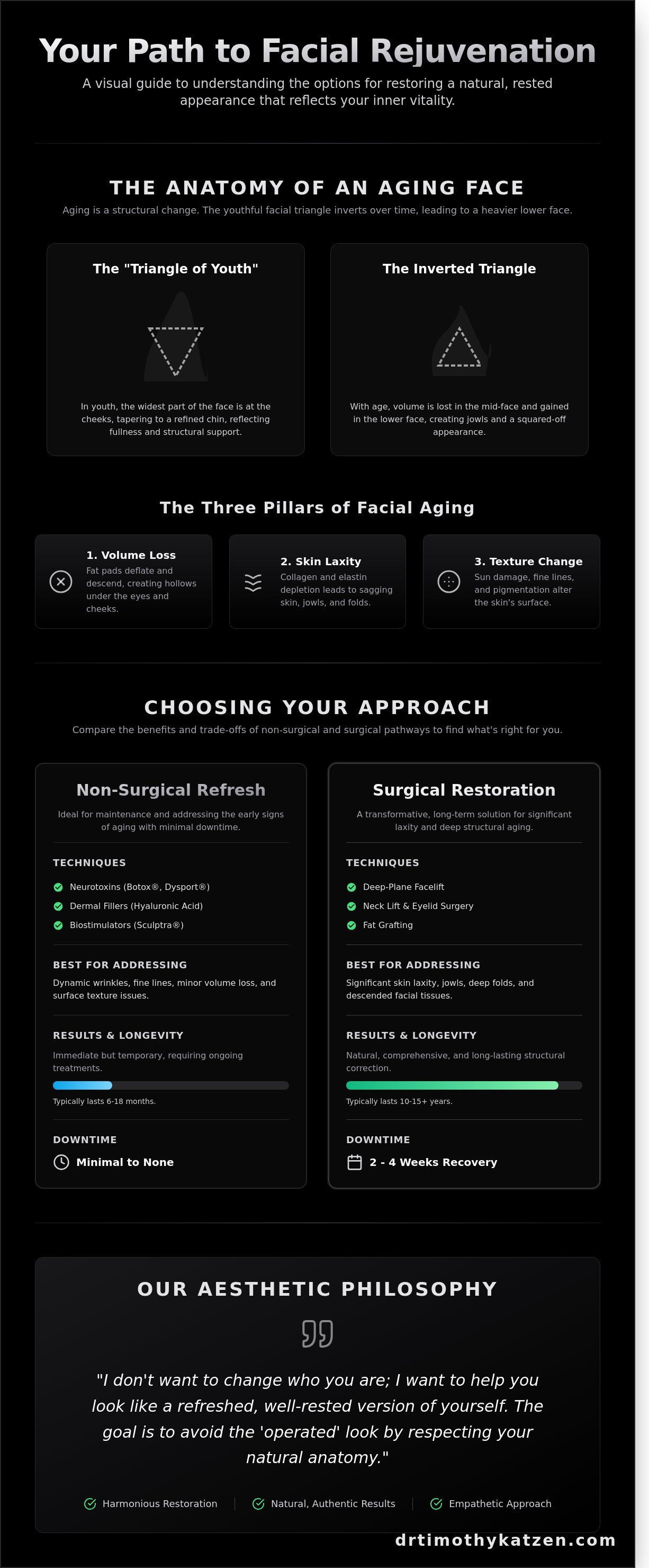
We define the aging process through three primary pillars. First is volume loss, where the face loses the youthful "plumpness" that reflects light. Second is skin laxity, caused by the gradual depletion of collagen and elastin. Third is textural change, which includes sun damage, fine lines, and pigmentation. Researching various facial rejuvenation techniques shows that successful outcomes depend on treating the face as a whole system rather than focusing on a single wrinkle.
Looking tired is often a structural issue related to the descent of tissue. As we age, the support structures of the midface weaken. This causes a downward shift that creates shadows and hollows. Because every patient ages differently, a personalized consultation is vital. We must map out your unique aging pattern to determine whether your concerns require surface-level refinement or deep-tissue support.
The Biological Signs of an Aging Face
The "triangle of youth" is a hallmark of a young face. In your 20s, the widest part of the triangle is at the cheeks, tapering down to a refined chin. Over time, this triangle inverts into a square shape. This happens because of fat pad migration and bone resorption. As the jawbone and eye sockets lose density, the skin loses its scaffolding, leading to jowls and a heavier lower face. You may also notice the difference between dynamic wrinkles, which appear when you smile or frown, and static folds, which remain visible even when your face is at rest. Addressing both is key to a natural result.
Restoration vs. Alteration: Our Aesthetic Philosophy
My aesthetic philosophy focuses on restoration rather than alteration. I don't want to change who you are; I want to help you look like a refreshed, well-rested version of yourself. The goal is to avoid the "operated" look by respecting your natural anatomy. This process has a significant psychological impact. When your external reflection matches your internal vitality, it often leads to a profound surge in self-confidence and empowerment. We aren't just fixing skin; we're helping you feel like yourself again.
Facial rejuvenation is the harmonious restoration of both skin health and facial structure.
Non-Surgical Facial Rejuvenation: The Art of the Aesthetic Refresh
For many of my patients, the path to facial rejuvenation begins long before they ever consider a surgical suite. It usually starts with a quiet observation in the mirror and the realization that the face looking back doesn't quite reflect the vitality they feel inside. MedSpa treatments serve as an essential maintenance tool during these early stages of aging. These minimally invasive options offer a low-stakes entry point, allowing you to address fine lines or volume loss without the downtime associated with a full surgical procedure.
To understand why these treatments are effective, we must look at the anatomy of facial aging, which involves a complex degradation of bone density, fat pads, and skin elasticity. While non-surgical paths are transformative for texture and minor volume issues, they do have a ceiling. When skin laxity becomes significant, particularly after a 100 pound weight loss or due to advanced chronological aging, a needle cannot replace the structural lift provided by a scalpel. Identifying this tipping point is a cornerstone of my consultation process.
Injectables: Neurotoxins and Dermal Fillers
I often utilize neurotoxins like Botox and Dysport to soften dynamic lines in the upper face. These are the wrinkles that appear during expression, such as crow's feet or forehead furrows. For static lines and hollows, hyaluronic acid fillers restore lost volume to the cheeks and under-eye area. I also recommend biostimulators like Sculptra. These products encourage your body to produce its own natural collagen. Clinical data suggests these treatments can increase collagen type I by 66% after three months, providing a foundation for long-term skin health.
Energy-Based Devices and Skin Resurfacing
Surface-level concerns require a different set of tools. CO2 laser resurfacing remains a gold standard for erasing deep sun damage and fine lines by removing thin layers of skin with precision. If you're looking for improved skin tone and clarity, chemical peels work at the cellular level to reveal fresher tissue. Microneedling is another favorite in my practice; it tightens pores and improves overall skin texture by triggering the body's wound-healing response. By combining these modalities, we can create a comprehensive non-surgical liquid facelift that addresses multiple layers of the skin simultaneously. If you're unsure which path is right for your goals, I invite you to schedule a personalized consultation to discuss your options.
Surgical Facial Rejuvenation: Restoring Structural Integrity
While non-invasive office treatments offer subtle enhancements, surgical facial rejuvenation remains the definitive gold standard for correcting significant tissue laxity. As your surgeon, I've seen how gravity and the natural loss of skin elasticity eventually reach a point where lasers and fillers simply cannot provide the necessary lift. Surgery isn't just about tightening skin; it's about restoring the underlying architecture that has shifted over time. It's a journey of restoration that addresses the root cause of aging rather than just masking the symptoms.
The field has evolved significantly from the tight, unnatural appearances of decades past. Modern techniques focus on repositioning the deeper structural layers rather than pulling the surface skin. This approach ensures you look like a refreshed version of yourself, not a different person. Patients often find that while temporary treatments require maintenance every 6 to 12 months, a surgical procedure provides a foundation that lasts between 10 and 15 years. This longevity makes surgery a more permanent investment in your confidence and quality of life.
The Modern Facelift and Neck Lift
I focus heavily on the SMAS (Superficial Musculoaponeurotic System) to achieve a lasting transformation. By repositioning these underlying muscles, I can eliminate jowls and restore a crisp, defined mandibular line. For many, the "turkey neck" is a source of deep self-consciousness. I address this through a platysmaplasty, where I tighten the neck muscles and excise redundant skin. This creates a smooth, youthful profile that non-surgical energy devices often fail to reach. According to 2023 industry data, surgical neck contouring remains the only way to effectively remove significant skin excess following massive weight loss or advanced aging.
Blepharoplasty: Opening the Windows to the Soul
The eyes are frequently the first area to show signs of aging. In my practice, I find that blepharoplasty is often the most impactful "isolated" facial rejuvenation procedure a patient can choose. It's a meticulous process that yields high patient satisfaction because the results are so immediate and visible.
-
Upper Eyelid Surgery: I remove heavy, drooping skin that can actually obscure your field of vision. This creates an alert and rested appearance that brightens the entire face.
-
Lower Eyelid Surgery: I eliminate under-eye bags and smooth the transition between the lid and the cheek. This removes the "tired" look that even the most expensive concealers can't hide.
This surgery offers a profound sense of empowerment. It restores the clarity and brightness of your expression in a single, precise intervention. By addressing the eyes, we often unlock a level of transformation that makes the patient feel they've regained their youthful spark.
Surgical vs. Non-Surgical: Which Path Leads to Your Goals?
Choosing between a syringe and a scalpel is rarely about vanity; it's about finding the most effective tool for your specific anatomy. I often see patients who have spent years chasing a youthful look with injectables, only to realize they've reached a point of diminishing returns. This is what I call the threshold of laxity. Once the skin has lost its elastic recoil, particularly after massive weight loss or natural aging, adding more volume with fillers can lead to an overfilled, unnatural appearance. At this stage, surgical facial rejuvenation becomes the only way to physically reposition the underlying tissues and remove redundant skin.
The financial reality is another critical factor. While a single session of dermal fillers or Botox has a lower entry price, these treatments require maintenance every 4 to 9 months. Over a decade, the cumulative cost of non-surgical upkeep often rivals or exceeds the cost of a definitive surgical procedure. Beyond the finances, safety remains the highest priority. Whether you choose a liquid lift or a deep-plane facelift, having a board-certified surgeon perform the procedure ensures a deep understanding of facial nerves and vascular structures. This expertise minimizes risks and ensures your results look like a more rested version of yourself, not a different person.
The Decision Framework: Longevity, Downtime, and Results
Your lifestyle often dictates your choice. Non-surgical treatments offer a "subtle refresh" with minimal downtime, usually ranging from 0 to 7 days. These results are temporary, lasting between 6 and 18 months. Conversely, surgical facial rejuvenation provides a "transformative restoration." While you should plan for 10 to 21 days of downtime to allow swelling and bruising to subside, the results typically endure for 10 to 15 years. This path is for those seeking a permanent correction of sagging jowls or a heavy neck.
When to Combine Both for Optimal Results
The most sophisticated outcomes often involve a hybrid approach. Surgery addresses the structural foundation by lifting muscle and removing excess skin, but it doesn't change the quality of the skin surface. I frequently use lasers post-operatively to fix texture issues like sunspots or fine crepey lines that a scalpel cannot reach. To protect your surgical investment, a commitment to medical-grade skincare is essential. According to 2023 industry data, patients who utilize retinoids and high-factor SPF daily maintain their surgical results 25% longer than those who don't. This comprehensive strategy ensures your skin remains as vibrant as your new facial contours.
If you're ready to move beyond temporary fixes and explore a permanent solution for your aesthetic goals, schedule a private consultation at my office to discuss your custom transformation plan.
The Katzen Approach: Empathetic Restoration for a New You
Choosing a specialist for facial rejuvenation is a decision that extends far beyond technical skill; it requires a partnership built on mutual trust and a shared vision for your future. I approach every patient with a philosophy centered on empathetic restoration. This perspective is vital for those who have achieved massive weight loss. When you lose 100 pounds or more, the skin on your face and neck often lacks the elasticity to retract, leaving behind a heavy reminder of your previous weight. My mission is to bridge the gap between your hard-earned physical health and your outward appearance.
I take a comprehensive 360-degree view of your aesthetic goals. This means I don't just look at a single wrinkle or a sagging jawline in isolation. I evaluate how every feature interacts with your overall profile to ensure balance. We prioritize your safety and comfort by utilizing accredited surgical suites and a team specifically trained in the needs of post-bariatric patients. Our commitment is to provide life-changing transformations that feel as good as they look.
A Partner in Your Transformation
Our process begins with a consultation where your personal story takes center stage. I listen to your concerns about skin laxity or volume loss that may make you look older than you feel. We don't use generic templates. Instead, I customize each surgical plan to match the precise contours of your unique facial anatomy. This ensures that your results appear natural and harmonized. J. Timothy Katzen, M.D. views each procedure as the final, celebratory step in a patient’s journey toward self-restoration.
Your Next Steps Toward Confidence
Taking the first step toward facial rejuvenation involves entering a comprehensive system of care. During your meeting at our world-class facilities, we'll review your medical history and analyze your skin's structural integrity. You'll receive a detailed roadmap of what to expect during the procedure and throughout your recovery. Our personalized follow-up care ensures you're never alone during your healing process. We've helped thousands of patients reclaim their sense of self through these meticulous interventions.
Schedule your facial rejuvenation consultation with J. Timothy Katzen, M.D. today.
Take the First Step Toward Your Restored Self
Deciding between surgical and non-surgical paths is a pivotal moment in your aesthetic journey. We've explored how understanding your facial anatomy allows for precise results, a principle emphasized by the American Society of Plastic Surgeons for safe, effective outcomes. Whether you choose the immediate refresh of dermal fillers or the lasting structural integrity of a surgical lift, your treatment should be as unique as your history. As a board-certified plastic surgeon with over 20 years of specialized experience in post-weight loss restoration, I've helped thousands of patients align their outward appearance with their inner vitality. It's about more than just skin; it's about reclaiming the confidence you've worked hard to build. Choosing facial rejuvenation is a personal commitment to your well-being. This process requires a partner who treats your goals with clinical expertise and profound empathy. My 360-degree approach ensures every procedure is tailored to your specific needs. You've already completed the difficult stages of your transformation. Now, let's work together to ensure your face reflects the vibrant life you've created.
Begin your transformative journey with a personalized consultation.
Frequently Asked Questions
How long does facial rejuvenation last?
The longevity of your facial rejuvenation depends entirely on the technique we choose together. A surgical facelift typically offers results that endure for 10 to 15 years, while non-surgical options like dermal fillers generally require maintenance every 6 to 18 months. I find that patients who maintain a stable weight and follow a strict medical-grade skincare regimen see their results last 25 percent longer than those who don't.
What is the best age to start facial rejuvenation?
There isn't a single "perfect" age for facial rejuvenation because every face ages at a different rate. Most of my patients begin preventative non-surgical treatments in their late 30s to address early volume loss. According to 2023 industry data, the average age for a first surgical facelift is 54, but I often perform these procedures earlier for patients who've experienced massive weight loss and have significant skin laxity.
Is facial rejuvenation surgery painful?
You'll be under general anesthesia or deep sedation during the procedure, so you won't feel any pain while I work. Most patients describe the post-operative sensation as a "tight" feeling rather than sharp pain, rating their discomfort at a 3 or 4 on a 10-point scale. I provide a comprehensive pain management protocol that includes local numbing agents and specific medications to ensure your recovery journey remains comfortable and safe.
Can I get a facelift without surgery?
You can't achieve the same structural lifting of a surgical procedure without an incision, but a "Liquid Facelift" can provide temporary restoration. This non-surgical approach uses a combination of Botox and fillers to address 70 percent of mild sagging and volume loss. While these treatments are excellent for subtle changes, they can't remove the excess skin that often follows a 50-pound or greater weight loss.
How much does facial rejuvenation cost?
The cost of facial rejuvenation varies significantly based on whether you choose a surgical or non-surgical path. The American Society of Plastic Surgeons 2022 report notes that the average surgeon's fee for a facelift is approximately 9,281 dollars, though this doesn't include anesthesia or operating room facilities. Non-surgical treatments like fillers typically range from 600 to 2,000 dollars per syringe depending on the specific product used for your transformation.
What is the difference between a mini-facelift and a full facelift?
A mini-facelift focuses primarily on the lower third of the face using shorter incisions around the ears, while a full facelift addresses the mid-face, jawline, and neck. I typically recommend a full facelift for patients with more than 2 centimeters of skin laxity in the neck area. The mini-facelift is a targeted 90-minute procedure designed for those with moderate jowling who don't yet require extensive neck muscle tightening.
How do I choose between fillers and surgery for my sagging skin?
We choose the best path by measuring the degree of skin elasticity and the depth of your facial folds. If your skin "bounces back" within 2 seconds of a pinch test, fillers might effectively camouflage early aging. However, if you have significant skin redundancy or "turkey neck" from massive weight loss, surgery is the only way to physically remove the extra tissue and restore a youthful contour.
What is the recovery time for a surgical facelift?
Most patients feel comfortable returning to social activities and work within 10 to 14 days after surgery. While initial swelling and bruising peak at the 48-hour mark, about 80 percent of the swelling subsides by the end of the second week. I advise my patients to wait 4 to 6 weeks before resuming high-impact exercise or heavy lifting to protect the delicate healing tissues of the face.